
🧠 In short: Artificial intelligence did not emerge from nowhere with chatbots. It is rooted in ancient myths, was formalized by Alan Turing and his groundbreaking work, experienced periods of freeze and unbridled enthusiasm, before being reborn with neural networks and deep learning. From Dartmouth 1956 to ChatGPT 2022, this seven-decade journey tells how humanity learned to educate machines. 📊 Key points: Mythological and mechanical origins; the Turing Test that redefines intelligence; the founding Dartmouth conference; the two AI winters that discouraged optimists; the resurrection by neural networks; the deep learning revolution powered by massive data and GPUs; the contemporary explosion of language models and generalist systems.
🏛️ When ancient dreams forged the idea of a thinking machine
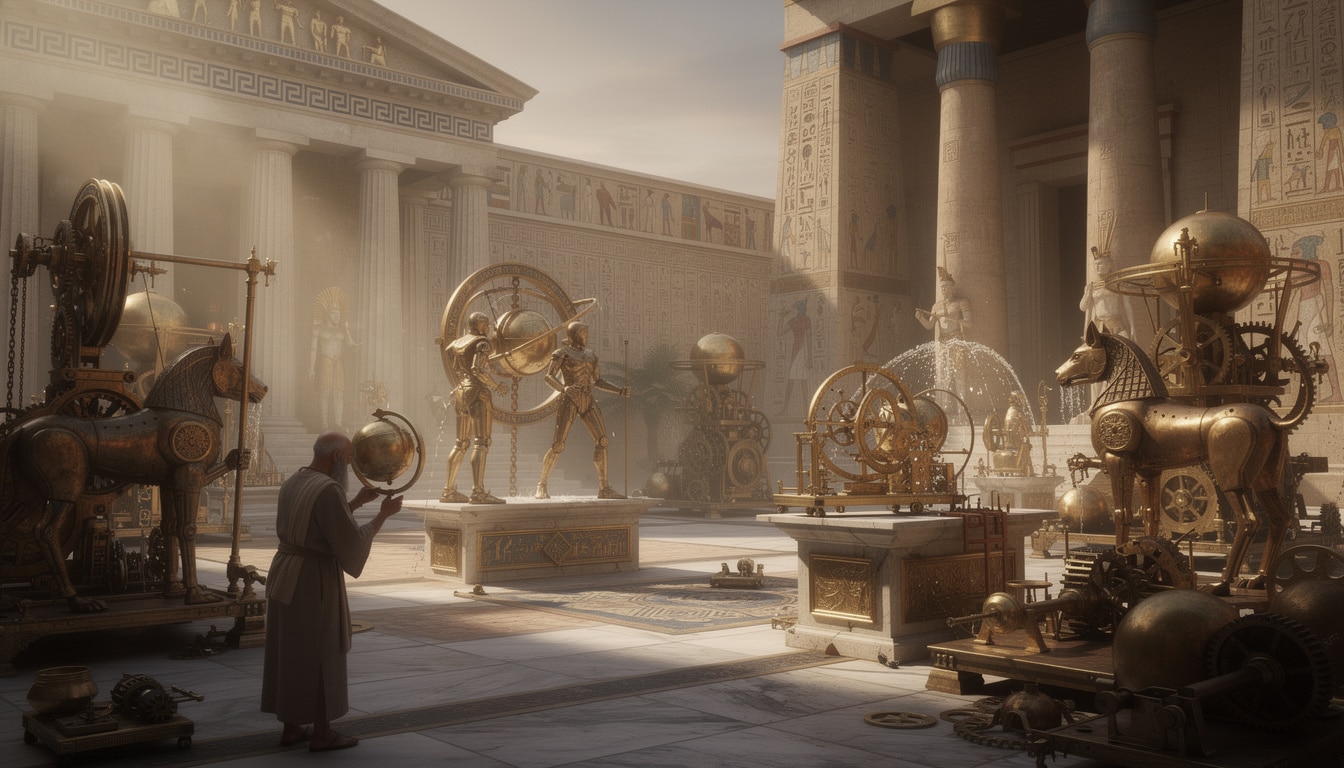
Long before computers, even before electricity, humanity dreamed of creating artificial beings endowed with intelligence. Greek mythology depicts Hephaestus forging mechanical creatures, while in ancient China and Egypt, artisans built automata reputed to be capable of wisdom and emotion.
These stories are not mere entertainment. They reflect a deep question: can what seems to belong to the soul be reproduced mechanically? This question crosses the centuries and quietly prepares the ground for modern science. Medieval engineers perfected the art of mechanisms, while alchemists speculated about secret means to breathe spirit into inert matter.
In the 19th century, this ancient fascination found a new language in fiction: Mary Shelley imagined Frankenstein, Karel Čapek coined the term “robot” and Samuel Butler sketched a philosophy of thinking machines. The imagination prepared the way before science knocked on the door.
💡 Alan Turing: the man who gave language to the question
In 1950, a British mathematician named Alan Turing posed a simple but vertiginous question: can a machine think? Rather than debating consciousness, Turing proposed the Turing Test, a pragmatic criterion. If a machine can hold a written conversation that no one can distinguish from a human's, then one can say it thinks.
This approach revolutionized the philosophical debate. It shifts the question from essence to observable performance. Turing did not assert that machines would have consciousness; he suggested that we do not need to resolve that enigma to recognize their intelligence. This humble simplicity opened the field to an entire scientific discipline.
Turing's foundational work on computability and the universal machine that bears his name also laid the mathematical foundations of modern computing. Without that theory, there would be no programming as we know it. The test remains surprisingly relevant: the most advanced chatbot systems, seventy years later, still try to pass it.
🎯 Dartmouth 1956: the moment AI was born as a discipline
In the summer of 1956, at a small university in New Hampshire, John McCarthy, Marvin Minsky, Claude Shannon and Herbert Simon gathered a handful of visionary researchers. They had a crazy project: to organize a two-month summer conference to explore the possibility of creating truly intelligent machines.
It was during this meeting that McCarthy coined the term “artificial intelligence”, thus crystallizing a field until then scattered across isolated research rhapsodies. The participants ambitiously defined their goals: to create machines capable of solving problems, learning, and simulating human intuition. Optimism was overflowing. Several sincerely believed a general artificial intelligence comparable to human intelligence would exist within a decade.
This initial confidence would prove overly bold. However, Dartmouth truly marks the birth of AI as a legitimate scientific discipline. The laboratories created afterward (MIT, Stanford, Carnegie Mellon, Edinburgh) became the homes of a new intellectual quest.
🎮 From early triumphant successes to the disappointments of the first winter
Between 1956 and 1974, achievements followed one another. AI programs solved geometric problems, proved theorems, and played checkers with increasing skill. In 1966, Joseph Weizenbaum's chatbot ELIZA simulated a psychotherapist so well that some users cried while confessing to this soulless machine.
Each victory reinforced the belief that the goal was not far off. Government agencies invested heavily. DARPA poured millions of dollars into funding research. Promises became even more demanding.
Then came the shock. Around 1973-1974, it became clear that AI systems were much more limited than had been believed. Problems thought to be “solvable” proved Herculean. Machine translation remained primitive. Computer vision stumbled over unexpected obstacles. Researchers discovered that the combinatorial explosion of computations made many previously essential approaches impractical.
The Lighthill report of 1973, commissioned by the British government, delivered a scathing assessment. Funding was abruptly dried up. The first “AI winter” began. This freeze would last a decade, raising a question few dared to ask: is artificial intelligence a myth?
🔄 A quiet resurrection: expert systems and rediscovered neural networks
The late 1970s and early 1980s saw a new strategy emerge. Rather than pursuing the dream of general intelligence, researchers focused on specific, manageable domains: expert systems. These programs captured human experts' knowledge as logical rules.
An expert system diagnoses infectious diseases, another optimizes computer configurations. In 1980, the Xcon system saved DEC (Digital Equipment Corporation) $40 million annually. It was the first time AI produced tangible commercial value. Investments returned. An entire industry structured itself around these systems.
At the same time, a long-dismissed approach resurfaced. John Joseph Hopfield and David Rumelhart resurrected artificial neural networks, a path abandoned after Marvin Minsky and Seymour Papert published a critical book on perceptrons in 1969. Hopfield showed that a certain type of neural network could learn and process information in a totally new way. Rumelhart popularized the backpropagation algorithm, enabling efficient training of multilayer networks.
These two currents—expert systems and neural networks—split AI into distinct trajectories. Symbolic approaches (logic, rules) and connectionism (networks, distributed learning) became the two pillars of a gradual renaissance.
⚡ Turn of the century: when raw power frees intelligence
On May 11, 1997, Deep Blue, IBM's computer, defeated Garry Kasparov, the reigning world chess champion. This event marked a symbolic turning point: a machine outperformed a human in a domain long held as the supreme expression of strategic intelligence. Kasparov himself suspected human intervention had assisted the computer, as some moves seemed impossible for a machine.
What sets Deep Blue apart is not a revolutionary algorithm, but the brute computational power meticulously applied. Deep Blue was 10 million times faster than the Ferranti Mark I which, in 1951, learned to play checkers. This dramatic increase follows Moore's Law: computing capacity doubles approximately every two years.
In the 2000s, new successes dotted the landscape: Roomba showed that a simple AI can solve everyday problems; Google quietly integrated machine learning algorithms into its search engines; IBM's Watson won Jeopardy! in 2011. AI diffused quietly into the infrastructure of modern technology.
🧬 The era of deep learning: when data becomes the fuel
In 2012, AlexNet, a convolutional neural network created by Alex Krizhevsky, won the ImageNet competition by a staggering margin. 15% error versus 26% for the best traditional approach. This was not a marginal improvement; it was a revolution.
What changed was the convergence of three elements: first, the massive data available on the internet (billions of labeled images); second, graphics processing units (GPUs) originally designed for video games, which accelerate the matrix computations of deep learning; and finally, improved algorithms born from decades of neural network research.
AlexNet triggered a rush toward deep learning. Big tech companies recruited heavily in computational neuroscience. Geoffrey Hinton joined Google. Yann LeCun became Facebook's vice president. AI investments exploded. The symbolic approach, long dominant, gradually ceded ground to connectionist approaches based on neural networks and deep learning.
Why this paradigm shift? Because deep learning automatically adapts its internal representations to the task. Engineers no longer need to program every rule manually. The machine learns from examples. It's an intellectual democratization of AI: anyone with data and a question can now let a machine dig for the answer.
🎨 2016-2017: when AI unfolds new forms of intelligence
In March 2016, AlphaGo, developed by DeepMind (a Google subsidiary), defeated Lee Sedol, the world Go champion. Go is a game far more complex than chess: 10^170 possible positions versus 10^50 in chess. Go masters sincerely believed no machine would master it for decades.
AlphaGo did not rely on brute force alone. It combined neural networks with reinforcement learning: the machine played against itself millions of times, gradually adjusting its strategy. Its moves even surprised human masters with their originality. AlphaGo developed a strange form of intuition.
A year later, in 2017, Google's research team published “Attention is All You Need”, introducing the Transformer architecture. This innovation revolutionized natural language processing. The Transformer architecture understands how words relate to one another in context. It allows a machine to “understand” not only isolated words, but the web of meaning that connects them.
Transformers became the basis of BERT, GPT, and the language systems that followed. Without this architecture, there would be no ChatGPT, no modern machine translation, no assistants that converse naturally with you.
📱 2018-2021: invisible AI serving everyday needs
As researchers progressed, AI quietly insinuated itself into digital infrastructure. Apple's Siri, Amazon's Alexa, Google Assistant, Microsoft's Cortana—these voice assistants converse naturally because they rely on machine learning systems trained on billions of hours of human speech.
In hospitals, AI algorithms diagnose breast cancer better than some radiologists. In banks, fraud detection systems learn to recognize suspicious transactions by analyzing patterns from billions of transactions. AI no longer asks permission to exist; it has already spread.
In 2021, OpenAI announced a strategic partnership with Microsoft. This alliance sealed the entry into a new phase: large-scale generative AI, financed by tech giants, would soon become accessible to the general public. The foundations were laid for the explosion that would follow.
🚀 2022-2026: generative AI levels up
On November 30, 2022, OpenAI launched ChatGPT to the public. No excessive fanfare, no overflowing marketing. Just a chatbot anyone could use. One million users in five days. 100 million in two months. It became the most rapidly adopted application in internet history.
ChatGPT is based on GPT-3.5, a large language model trained on hundreds of billions of textual tokens. It does not memorize those texts; it learns the statistical patterns that govern human language. When you ask it a question, it generates the answer word by word, computing at each step the probability of the next word given the context.
What surprises users is the fluency, coherence, and ability to maintain a complex dialogue on varied subjects. ChatGPT does not “understand” in the philosophical sense, but it simulates understanding well enough to be useful. It writes essays, codes programs, explains concepts, role-plays. It makes mistakes, asserts falsehoods confidently, and hallucinates invented citations. And yet, it remains impressive.
The race accelerates. Google launched Bard (then Gemini), Anthropic's Claude responded to ChatGPT with refined reasoning capabilities. Meta released Llama, providing access to a powerful open-source model. Generative AI is no longer a research lab curiosity; it's a field of geo-economic competition. Governments invest massively.
🧠 The convergence that changes everything: from symbolic to statistical
For seventy years, two rival approaches divided AI. The symbolic approach (from McCarthy and mathematical logic) aimed to represent knowledge as explicit rules. The connectionist approach (from McCulloch and Pitts) aimed to simulate biological neural networks.
The history of AI is largely the story of the battle between these two philosophies. In the 1960s-70s, symbolism dominated. In the 1980s, neural networks returned. In the 2000s, the raw power of deep learning gradually overwhelmed symbolic systems. But around 2020-2026, something new emerged: a pragmatic hybridization.
Large language models, although statistical at their core, develop reasoning abilities that seem almost symbolic. They can create plans, chain logical deductions, and explain their own reasoning. The clear distinction between statistics and logic blurs. Perhaps intelligence never had to choose between these two paths; perhaps it needed to borrow from both.
To explore this evolution further, consulting resources on the history of artificial intelligence according to IBM or this richly documented academic perspective can enrich your understanding of the stakes.
🔮 What machines have become, and what remains enigmatic
In 2026, a machine can converse with you, write a song, diagnose a disease, drive an autonomous car, create an image from words. It can translate instantly between a hundred languages, solve differential equations, play the piano.
But it understands nothing—or rather, the question of meaning remains deeply troubling. Does a machine processing text really “understand,” or does it simulate that understanding with such fidelity that the distinction no longer matters? This is the new formulation of the Turing Test.
Some phenomena remain opaque: why does a neural network give one response rather than another? (That's the explainability problem.) How can a system trained on Internet texts possess precise scientific knowledge? (That's the emergence problem.) How far can these machines go without risking getting out of our control? (That's the AI safety question.)
These enigmas strangely resemble those posed by philosophers to Plato and Aristotle about the nature of the soul and thought. Modern AI has inherited the old problems of philosophy, translating them into mathematics and code, but without solving them.
🌟 Cycles of hope and doubt: a historical lesson
One major lesson from AI history is the alternation between euphoria and depression. The optimists of the 1960s promised thinking machines within a decade. They had underestimated the complexity. The first AI winter (1974-1980) humbled that arrogance. The second winter (1987-1993) repeated the lesson.
Then came deep learning, which partially validated old hopes—but over a narrow spectrum: computer vision, speech recognition, language processing. These specific domains see remarkable successes, while others (common-sense reasoning, learning from few examples, adapting to radically new contexts) remain unbreached frontiers.
Wisdom may lie in recognizing that AI is neither the panacea prophesied by utopians nor the existential threat feared by pessimists, but a powerful technology with targeted applications, intrinsic limits, and social consequences that must be managed with discernment.
🎯 Current issues: ethics, governance, social impacts
As AI spreads, ethical questions become urgent. Data privacy: modern models are trained on billions of texts, images, and videos scraped from the web. Who consents to this use of their personal or creative data? Regulations like the GDPR in Europe try to respond, but the legal framework remains largely behind the technology.
Algorithmic bias is another issue: if training data reflect human prejudices, the machine amplifies them. A facial recognition system trained mostly on white faces will be less effective on Black faces. A language model trained on historical texts will inherit the sexism of those sources.
The question of employment arises. Some fear large-scale technological unemployment; others point out that past technological revolutions (mechanized textiles, railways, computers) destroyed jobs but created new opportunities. The real question may be that of transition: how to support those whose jobs become obsolete?
To deepen these contemporary issues, exploring how to secure data against AI or understand the creative applications of generative AI offers practical perspectives.
🔬 Beyond code: biocomputing and future frontiers
Around 2025, an Australian startup named Cortical Labs created something troubling: a mini artificial brain containing a few hundred thousand living human neurons connected to an electronic chip. This hybrid system, called intelligently activité biologique synthétique, can learn from very small datasets.
Why cultivate living neurons rather than simply model their behavior with mathematics? Because biological neurons do something our simulations struggle to reproduce: they learn efficiently from very few examples. A child recognizes a cat after seeing three. A language model needs billions of texts. Biocomputing could bridge that gap.
This hybrid approach—neither entirely biological nor entirely digital—opens dizzying horizons and raises new ethical questions. If we cultivate human neurons in a lab to connect them to machines, where does technology end and ethics begin?
📚 The quiet lessons of seventy years of research
Rereading the history of AI is also rereading the history of our illusions about ourselves. Alan Turing imagined that if a machine could imitate human language, we would have solved the question of thought. Seventy years later, we have machines that imitate language with breathtaking fidelity. The question of thought remains entirely open.
Researchers at MIT in the 1960s believed intelligence was mainly a matter of logic and symbol manipulation. Hubert Dreyfus criticized them: humans, he said, think more by intuition and embodiment than by formal deduction. Current deep learning has quietly proven him partly right: neural networks simulate a form of statistical intuition rather than clear logical deduction.
What we may lack, perhaps, is the humility to admit that intelligence—artificial or natural—remains mysterious. Each time we believe we have captured it, it slips through our fingers, revealing a new layer of complexity.
Profil de l'auteur
Derniers articles
 Electricity, Gas & Energy14 September 2026Gaz et électricité : ce que la hausse des tarifs va changer sur votre facture
- Agency, Webmarketing & SEO12 September 2026Fusion Omnicom-IPG : ce que la plus grande agence de publicité au monde change pour les marques
- Retirement & Senior Living10 September 2026Carte Avantage Senior SNCF : comment voyager moins cher en train après 60 ans
- Tech & Multimedia8 September 2026Objets connectés : la fin de la 2G et le nouveau Data Act vont rebattre les cartes




Table of Contents