
📱 In brief
Google is reshaping the search landscape with the arrival of the Search Generative Experience (SGE). This new approach, powered by generative artificial intelligence, radically changes how results are displayed, transforming the search engine into a true answer engine. Gone are the days of simple lists of ten blue links: instead there are concise summaries generated in real time, placed before traditional organic results. This shift sends shockwaves through the world of SEO, forcing sites and agencies to completely rethink their strategies to stay visible in this new ecosystem dominated by machine learning algorithms.
🎯 Key points to remember
• 🔄 SGE transforms the SERP by integrating AI responses directly at the top of the page
• 📉 About 60% of Google searches now result in no click-through to an external site
• 🌍 Deployment in Europe remains limited for now, due to regulatory constraints
• 💡 Content quality (E-E-A-T) becomes the decisive criterion for being selected by the AI
• 🚀 A multi-channel, user-focused strategy is required to offset traffic declines
• 🎬 Local and transactional queries hold up better against this revolution
When Google becomes an answer rather than a crossroads: upheavals in the SERP
For decades, Google structured its result pages according to an immutable principle: display ten blue links, ranked by algorithmic relevance. This mechanism gradually enriched itself with featured snippets, knowledge panels, and visual carousels. But the real break comes with the Search Generative Experience.
Test-launched in 2023-2024, SGE marks the shift from a traditional Google search to a fundamentally different experience. Google, now armed with sophisticated AI technology, no longer just indexes and ranks pages. It directly generates a synthetic answer, fed by multiple web sources, which it places at the top of the page – sometimes even before paid ads.
This transformation is like the binding of an old book: in the past, one consulted each page individually to assemble an answer. Today, Google weaves together the threads of several documents to offer the reader a coherent and immediate summary. The user gets their answer without clicking; their information need is satisfied on the SERP itself.
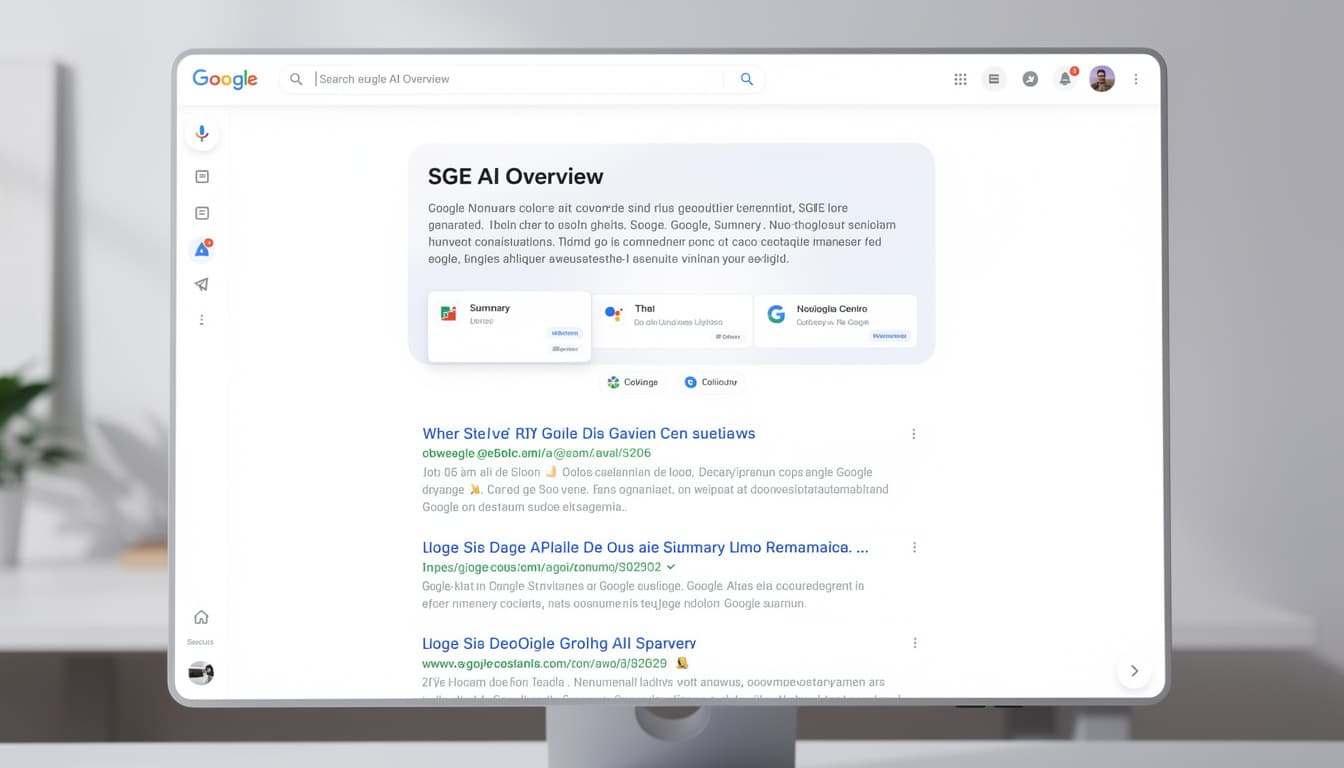
🤖 AI answers enriched with multimodal content
Google's generative AI is not limited to text. These new AI Overviews incorporate images, videos, and sometimes infographics to offer a rich, immediate experience. Imagine a search for “why is the sky blue”: Google displays in a second a clear explanation, accompanied by a scientific illustration and perhaps an explainer video.
This multimodal richness raises a question for content creators: how to position yourself when the AI can assemble the perfect answer from fragments scattered across the web? The answer lies in depth, originality, and the analytical angle that only a human can provide. A generic tutorial is no longer enough; you must offer a unique perspective grounded in expertise.
The “zero-click” phenomenon: when the SERP keeps the user
The numbers paint a striking picture. Before the arrival of AI Overviews, about 44% of Google searches already resulted in no click to a third-party site – the user found their answer in a snippet or a knowledge panel. Since SGE's deployment, that proportion has exploded: nearly 60% of searches now end in zero clicks.
Practically, this means that out of six Google queries, four generate no visits for the site ranked number one. Worse, traditional top organic results are pushed much further down the page – sometimes by more than 1,500 pixels, the equivalent of two to three full screens. The user must scroll a long time to see them, which drastically reduces their visibility.
This mutation is akin to an urban fabric upheaval: once, the shop windows on the main street attracted all passersby. Today, a large central display (the SGE block) captures attention, and the small surrounding shops disappear from view. For websites, this effect creates urgency: how to remain relevant when your preferred audience – those seeking a quick answer – no longer crosses your threshold?
📍 Informational queries vs. transactional queries: the uneven impact
SGE does not affect all queries equally. Informational searches – “how to”, “what is”, “why” – are the most exposed. Google can easily summarize the answer in a few sentences, devastating traffic for editorial sites, guides, and tutorials.
Conversely, queries with strong purchase intent – “buy [product] at [price] near [city]” – hold up better against the generative wave. Google prefers to offer local results and Shopping ads rather than an AI summary that would discourage purchases. Likewise, sensitive topics – health, finance, legal, categorized as “Your Money Your Life” – are still handled with caution by Google, which prefers to point to official sources.
For an e‑merchant who masters their local presence or an established law firm, there are therefore refuges where organic traffic remains preserved. The question becomes: which keywords are you really playing on? And in which categories is your content exposed?
Europe watches from afar: why SGE is slow to arrive in France
Here is a paradox: while more than 120 countries already benefit from the Search Generative Experience in dozens of languages, France – and much of Europe – is still waiting. The delay is all the more striking given that Google has all the technical means required.
The real reasons lie elsewhere. First, regulatory constraints: the European GDPR imposes strict rules on personal data and algorithmic transparency. Google must be able to explain how its models process user data and which sources it uses to generate answers. This is a technical and legal challenge that is far from trivial.
Then, natural language algorithms must be adapted to the linguistic and cultural nuances of French, Dutch, and German. Unlike tests in English on a homogeneous Anglo‑Saxon audience, adapting SGE to the French market requires rethinking models, testing them in real conditions, and correcting cultural biases. Google prefers to take its time rather than deploy a botched experience.
For French creators and agencies, this window of opportunity is valuable. While your foreign competitors are already adjusting their SEO strategies to SGE, you can prepare, observe, and experiment – without immediate urgency. It's the time to audit your content, improve its structure, and deepen its substance. When SGE arrives in France (and it will), you will be ready.
🌐 Signals from abroad: a roadmap
Watching what happens in the United States, Asia, and Latin America is a preview of our future. Aggregated data already shows trends: some categories of sites lose 18 to 64% of their organic traffic, depending on their sector. Generalist, encyclopedic sites suffer particularly. Conversely, well-structured e‑commerce sites, local platforms, and specialized communities adapt.
These observations feed an intelligent French strategy: anticipate rather than react. Consult detailed analyses on the impact of generative AI on SEO to prepare without delay. The expertise gained today will be your competitive advantage tomorrow.
When organic traffic collapses: the numbers and realities
The estimates speak for themselves. As artificial intelligence becomes widespread in Google, SEO agencies anticipate a 20 to 60% drop in organic traffic depending on the themes. For a site that lives mainly off natural referencing, that figure is terrifying. But reality is more nuanced than a simple average suggests.
Take the example of a site specialized in high‑tech product comparisons. Before, a query like “best smartphone 2026” brought massive traffic. Now, Google directly generates a summary listing the top three models, with prices and reviews. The user rarely clicks, and the site sees its traffic collapse by 70% on that keyword.
Conversely, a strategic marketing consulting firm that publishes deep analytical articles, fed by real cases and proprietary methodologies, maintains its traffic well. Why? Because these contents answer a more complex intention that the AI cannot satisfy alone: the decision-maker is not looking for an answer but for a perspective, validation, and expertise to internalize.
💰 When volume falls, quality improves: an involuntary exchange
An interesting observation emerges from the data: while traffic volume decreases, the quality of residual traffic tends to increase. Users who click despite the presence of an AI answer are often those who want to go deeper, who seek nuanced expertise or do not trust the generative summary.
These visitors arrive with strong intent, intellectual curiosity, and a desire to truly understand. Conversion rates observed for these micro‑audiences sometimes reach 10%, two to three times higher than the pre‑SGE average. You lose clicks, but you gain more qualified prospects – an involuntary but real trade‑off.
Additionally, a subtlety often forgotten: being cited in an SGE block grants free brand visibility. The user memorizes the site name shown in the answer and forms a mental association that increases trust. You didn't get the click, but you gained brand awareness. That's capital that must be converted elsewhere – via later direct searches, brand referrals, or a purchase.
The recipe for success: adapt your content for the AI algorithm era
Faced with this new reality, the question is no longer “how to be number one on Google.” It is: “how to be chosen by the AI as the best source.” This distinction reflects a major paradigm shift in the digital transformation of SEO.
The answer revolves around a few pillars: a sharp content structure, flawless quality, demonstrated expertise, and a fine understanding of user intent. Let's see how to make these concrete.
🏗️ Structure and readability: help the AI understand you
Generative AI, despite its sophistication, feeds on what it can “read” efficiently. Well‑structured content – clear hierarchy with relevant H2s and H3s, short paragraphs, bullet lists, and summary tables – is more easily understood and extracted by machine learning.
Think of it like a book binding: chapters, sections, and callouts help the reader navigate and find information quickly. For an AI, it's the same. A text where each idea is clearly delimited, where key terms stand out, and where examples are isolated will be more likely retained as a potential source for a synthetic answer.
Beyond mere technique, mind the tone. Gone are heavy jargon, convoluted sentences, and keyword stuffing. AI favors a conversational, natural tone, as if an expert were speaking directly to you. That also pleases humans: your readership will be more engaged and more likely to take action.
✨ E‑E‑A‑T: your trademark
Google has emphasized E‑E‑A‑T for years: Experience, Expertise, Authoritativeness, Trust. SGE heightens this requirement. To be selected as a source in an AI summary, your content must exude credibility.
Concretely, mention the author with their qualifications. Bring a unique point of view supported by original data, case studies, and examples from your real experience. Back your claims with links to reliable sources, up‑to‑date statistics, and recognized studies. Google values these signals highly: they are the brick walls of a house of trust.
Imagine an architect writing a guide on renovation: she doesn't write as a generalist but as a practitioner with 15 years' experience, supported by photos of her projects, client testimonials, and official building standards. Google and the AI will immediately spot her as legitimate. This is the kind of content that survives and thrives in the SGE era.
🎯 Anticipate secondary questions: comprehensive coverage
AI doesn't stop at a brief answer; it seeks to cover the search intent in its entirety. A great article should therefore “supercharge” its coverage by answering the follow‑up questions a user might ask.
Include FAQs and Q/A callouts that address variants and related sub‑questions. Use Google's suggestions (People Also Ask), related searches, and user forums. For example, an article on “how to choose your first camera” should also include answers about budget, the learning curve, recommended accessories, and common mistakes.
This “conversational” approach – a natural discussion where every need finds its answer – pleases the algorithm (content judged complete) and increases your chances of being cited for multiple facets of the topic. A user following a follow‑up question might thus land on your content, generating indirect traffic.
🔧 Structured data: speak Google's language
The structured data (Schema.org) tags are not optional; they are an investment in your AI visibility. These tags give Google structured context: they tell it “this is a product with price and reviews,” “this is an FAQ answer,” “this is an authoritative article published by X.”
Google's AI models partly rely on this metadata to assemble their answers. A site with Product schema well filled out, FAQ marked up in JSON‑LD, and a clarified organization will be “read” more efficiently by the AI. It's like filling out an online form: structured information speeds up and eases machine processing.
📸 Enrich with media: multimodality
Google's AI models are becoming multimodal. They can interpret not only text but also images and videos. Providing quality visual content on your pages offers two advantages: on one hand, the AI can include these media in its answer or draw on them; on the other hand, you gain visibility on other channels (Google Images, Google Videos).
An original infographic, a unique diagram, or a well‑optimized explainer video – these elements can appear as a thumbnail beneath the SGE block, encouraging the user to click to explore further. You didn't get the direct click, but you attract it via an alternative path. It's a fine but real trade‑off.
Preserved bastions: where organic traffic remains competitive
Not all is lost for traditional SEO. Some segments remain largely protected from the generative invasion. Identifying them allows you to focus efforts where they really pay off.
📍 Local SEO: an intact refuge
Geolocated searches – “restaurant near me,” “plumber in Lyon,” “museum open Sunday” – remain dominated by the classic local pack. Google shows location, reviews, opening hours, and photos of the establishment. SGE does not synthesize these queries: it points to Google Business Profile listings and local organic results.
For a local business, a proximity service, or a decentralized agency, this stability is a breath of fresh air. Continue to optimize your Google My Business listing, generate positive reviews, and localize your content – these efforts will pay off fully. Local traffic remains a reliable and quality source.
💳 Transactional queries: the commerce heartbeat
“Buy X,” “best price for Y,” “order Z online” – these high‑purchase‑intent searches receive few AI summaries. Google prefers to show Shopping ads, local results, and product listings. A synthetic AI answer could discourage a purchase by offering too many choices at once.
E‑commerce and online retail are therefore not dead. They remain hyper‑competitive, but the playing field is still open. Optimize your product listings, write descriptions with a converting tone, and use high‑resolution images. The ROI of transactional SEO remains solid – provided you play the technical and commercial game fully.
🏥 Sensitive topics: Google's caution
Health, finance, legal, psychology – “Your Money Your Life” domains are handled sparingly by SGE. Google prefers to refer to official sources (health institutions, financial authorities, recognized associations) rather than risk an incorrect or dangerous AI answer.
For a doctor, financial advisor, or legal expert, this restraint is an advantage. Your reliable, signed content remains valued. Keep investing in these areas: trust and authority remain your best allies against disintermediation.
Rethink strategy: beyond simple SEO
The true response to SGE does not lie in more aggressive technical optimization. It requires a mental shift: move from a vision centered on “being ranked number one on Google” to one centered on “becoming indispensable to my audience.”
🌍 Diversification: don't put all your eggs in Google's basket
Relying on Google for 70% of your organic traffic is walking a tightrope. SGE creates a new fragility. Building diversified traffic sources – social networks, newsletters, content on third‑party platforms, podcasts, YouTube, and online communities – reduces your vulnerability.
A site that retains its audience via an email subscription, builds an engaged community, and distributes content on TikTok or LinkedIn no longer depends solely on Google. Each channel is a bridge to your audience, and together they create commercial resilience. This multi‑channel approach is the true protection against algorithmic turbulence.
👥 User focus: beyond optimization
“Don't seek to be first on Google; seek to be chosen by the AI. To do this, invest in excellent content, thought of as a real answer for the user.” This maxim sums up the new philosophy. Content must first serve humans – useful, up‑to‑date, engaging – and then, as a side effect, please the algorithm.
This means deeply understanding your audience: their frustrations, aspirations, and recurring questions. Create content that truly answers them, that brings nuance and a human perspective the generic AI will never provide. A critical article on a product, an honest review of a trend, or a raw and candid experience report – that's what creates lasting value.
🏢 Brand building: your bulwark
In the long run, the strength of your brand is your best defense against AI. If your name is synonymous with excellence, reliability, and innovation in your field, users will search for you directly – by adding your name to their Google query or by visiting your site directly.
Google and AIs tend to favor recognized sources and established brands. Investing in brand awareness – through digital PR, authoritative publications, media presence, and thought leadership – is never a luxury. It is an investment in your survival capacity in the era of generative AI.
🚀 GEO: a new discipline
Some experts now speak of GEO – Generative Experience Optimization – as the new frontier of SEO. This means not only optimizing for traditional ranking algorithms but also aligning your strategy with how generative models work.
Concretely: provide impeccably structured data, content that is easily extractable by AI, and concise, verifiable answers. You want your information to become a building block of the knowledge the AI uses to compose its answers. It's a perspective shift: you no longer serve a simple index, you feed a generative brain.
Monitor, measure, adapt: the endless loop
Finally, adopt a decisive posture: agility. Google continually perfects its SGE – ongoing tests, fixes for hallucinations (AI model errors), and user feedback. The landscape will change regularly.
Measure real impact in Google Search Console: impressions by query, clicks, and CTR. Identify keywords where click‑through rates drop abnormally – a sign of growing SGE presence. Test your pages on tools that display the AI SERP. Analyze which types of content remain visible and which disappear. Iterate quickly by adjusting priorities, improving weak sections, and creating new content in less saturated segments.
This continuous learning loop – measure, analyze, adapt – will be your major competitive advantage against less reactive competitors. SEO has never been static; in the SGE era, that dynamic simply accelerates.
The digital transformation of search is a turning point, not an apocalypse. Sites and agencies that embrace this change – that produce excellent content, diversify their traffic sources, and build a strong brand – will continue to thrive. Those who wait passively, hoping “things will go back to the way they were,” will gradually fade from the landscape. The choice, as often in business, goes to those who move first.
Profil de l'auteur
Derniers articles
 Smartphones & Mobile Phones14 October 2026The loyalty penalty on your mobile bill: why staying put costs you more
- Family, Babies & Children5 October 2026Airline family seating fees: what the planned ban will change for parents
- Everyday Life & Society23 September 2026Consumer confidence index: what the monthly mood check on British households really measures
- Agency, Webmarketing & SEO31 August 2026SEO : a Google bug skews visibility statistics in AI results




Table of Contents