
In short : Identifying DYS disorders in a child requires patient observation and a careful listening to the signals the pupil sends. Dyslexia and dyspraxia do not manifest in the same way, but both leave traces before school becomes a battleground. Recognizing these warning signs makes it possible to trigger early detection, obtain an appropriate educational assessment and put in place tailored educational adaptations. It is a work of vigilance, not judgment.
The first signs of dyslexia in a child: understanding beyond reversed letters
Dyslexia is not a matter of letters dancing on the page. It is a deep difficulty in encoding and decoding written language, a kind of disconnection between what the eye sees and what the brain can process. Observing a dyslexic child is sometimes like seeing someone bright and intelligent who suddenly trips over simple words or reads with exhausting slowness.
The warning signs often appear as early as preschool or the beginning of primary school. A child may consistently confuse similar sounds (the “b” and the “d”), have trouble memorizing the alphabet or show marked resistance to learning to read. In class, some pupils skip words, rearrange syllables or reread the same line several times without really understanding it.
Like the pages of an old book that you unfold carefully, recognizing these learning difficulties requires patience. It is not about labeling the child as “slow” or “lazy”, but about seeing that their brain works differently. This is where personalized support begins: with recognition.
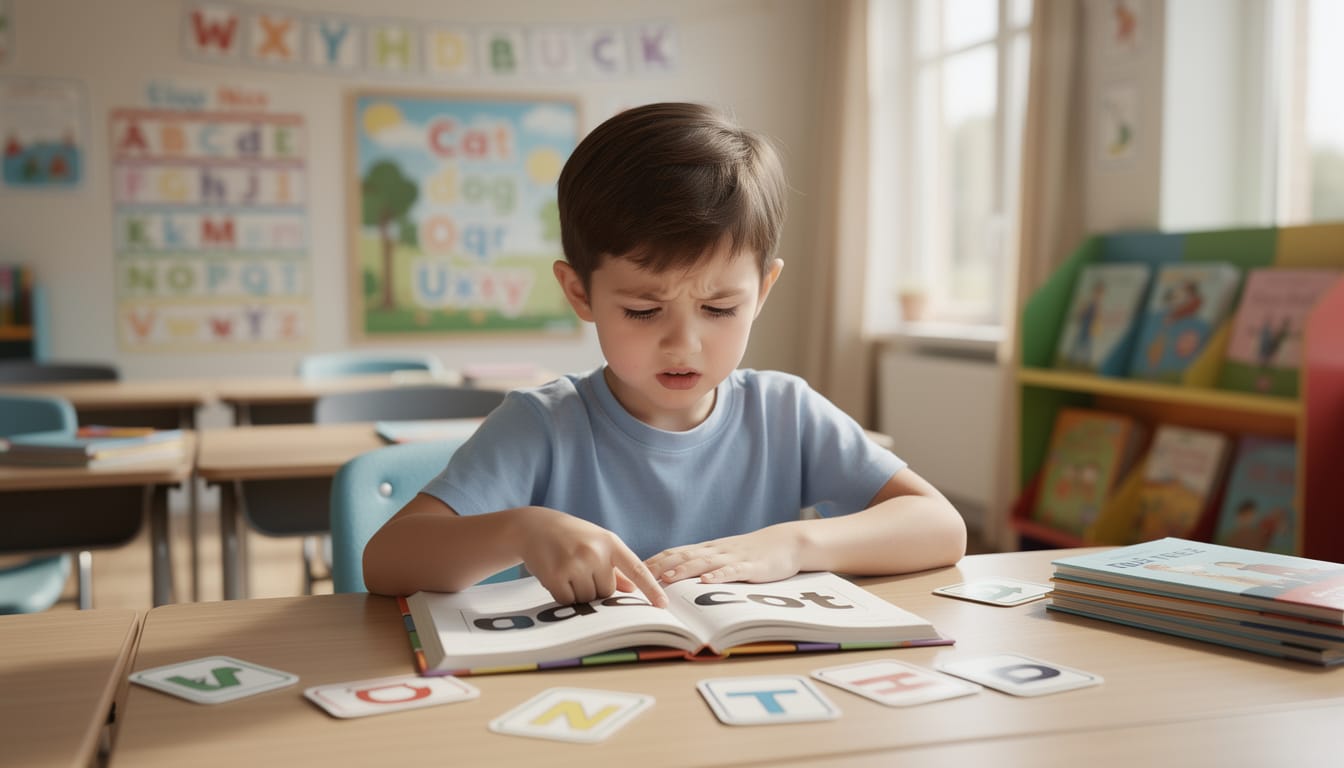
How dyslexia affects comprehension and reading fluency
A dyslexic child may decode isolated words with effort, but lose the overall meaning when reading becomes a continuous sequence. It's like trying to follow a story while perceiving only the letters, one by one, without seeing the narrative thread that links them.
Fluency is built on automatisms. In children with dyslexia, this automatization process remains blocked. Each word requires active concentration, which exhausts the cognitive resources available for comprehension. Over time, this creates an aversion to reading, chronic fatigue and sometimes even emotional difficulties related to school.
Dyspraxia: another form of coordination and motor execution disorder
Dyspraxia is more discreet, harder to name. It is a disruption in planning and executing voluntary movements, even in a child who has full physical strength. A dyspraxic child may fall regularly, have very clumsy handwriting or struggle to dress independently.
At school, the consequences are direct: handwriting becomes a mountain to climb every day. The child makes slow, small improvements, their strokes tremble, their letters float on the page. Pens break, notebooks tear. What seems simple to other children becomes an exhausting battle.
Unlike dyslexia, dyspraxia does not directly affect the ability to read or understand concepts. But it heavily impacts the way of communicating in writing, taking notes, and participating in everyday school gestures. That is why a thorough educational assessment is crucial to distinguish the disorders and propose the right tools.
Identifying dyspraxia: beyond “mere” clumsiness
Many confuse occasional clumsiness with real dyspraxia. True dyspraxia persists, worsens with fatigue or stress, and creates a glaring mismatch between what the child understands (their intelligence is intact) and what they can show through writing or movement.
A dyspraxic child may excellently understand a math problem but produce an illegible copy. They may have brilliant ideas in class, but putting them in writing becomes an obstacle course. This dissonance between intellectual potential and visible production is a major diagnostic clue.
How to observe and document signs of DYS disorders in class or at home
Detecting a DYS disorder is not a matter of a quick test, but of rigorous and compassionate observation. Parents and teachers are the first observers, the privileged witnesses of repeated gestures, moments of disengagement, and the strategies a child deploys to get around their difficulties.
Keeping an observation notebook — as one would note the delicate paper of an old volume — helps to pinpoint the pattern. At what time does fatigue appear? In front of what type of task does the child get stuck? Do they use effective workarounds? These small accumulated notes gradually compose an accurate picture.
Tools and resources for reliable early detection
Early detection requires access to specialized assessments: speech therapy for dyslexia, occupational therapy or psychomotor therapy for dyspraxia. These professionals have standardized tools that precisely measure deviations from the expected norm.
But before getting there, simple school screenings can guide the way: reading fluency tests, spontaneous writing, or motor execution assessments can reveal warning signs. Many schools put in place protocols for warning signs as early as cycle 2.
For families wishing to better understand linguistic issues or even explore alternative learning strategies, resources exist to enrich pedagogical approaches and enable the child to access other forms of learning.
Implementing pedagogical adaptations and personalized support
Once the disorder is identified, the urgency becomes creating a school environment where the child can learn despite their difficulties. Pedagogical adaptations are not a luxury or pity: they are tools that allow everyone to access knowledge in their own way.
For dyslexia: adapted fonts, access to a computer for writing, more time for reading, use of spellcheckers, reading aloud. The key idea is to work around the difficulty of accessing written language to let intelligence express itself through other channels.
For dyspraxia: adaptation of school furniture, ergonomic pens, reduction of writing volume (assisted note-taking, dictation instead of copying), encouragement of oral or digital presentations. Sometimes a slight adjustment is enough to free the child from the burden of clumsy gestures.
Beyond school: creating a continuum of support
Personalized support does not stop at the classroom door. At home, parents can become allies by applying similar strategies, valuing the child's strengths rather than their limitations, and accepting that their homework may take longer without meaning a lack of ability.
It is a long-term effort, requiring coherence between school, family and health professionals. As the binding of a beautiful book requires several coordinated hands, supporting a child with DYS disorders requires harmony among all the adults around them.
When to consult and which professionals to call on for a reliable evaluation
There is no ideal age to begin an investigation, but the longer one waits, the more failures and frustrations the child accumulates. A first serious alert is when difficulties persist despite visible effort and appropriate support in class.
The process often begins with the school doctor or general practitioner, who refers to specialists. For dyslexia, it is the speech-language therapist who conducts the complete educational assessment. For dyspraxia, the occupational therapist or psychomotor therapist. Some children will need both perspectives, as DYS disorders sometimes coexist.
A good assessment takes time—several sessions, even several weeks. It is not a simple test but a nuanced exploration of strengths and weaknesses, of each child's unique learning profile. It is an act of recognition, not judgment.
Profil de l'auteur
Derniers articles
 Smartphones & Mobile Phones14 October 2026The loyalty penalty on your mobile bill: why staying put costs you more
- Family, Babies & Children5 October 2026Airline family seating fees: what the planned ban will change for parents
- Everyday Life & Society23 September 2026Consumer confidence index: what the monthly mood check on British households really measures
- Agency, Webmarketing & SEO31 August 2026SEO : a Google bug skews visibility statistics in AI results




Table of Contents