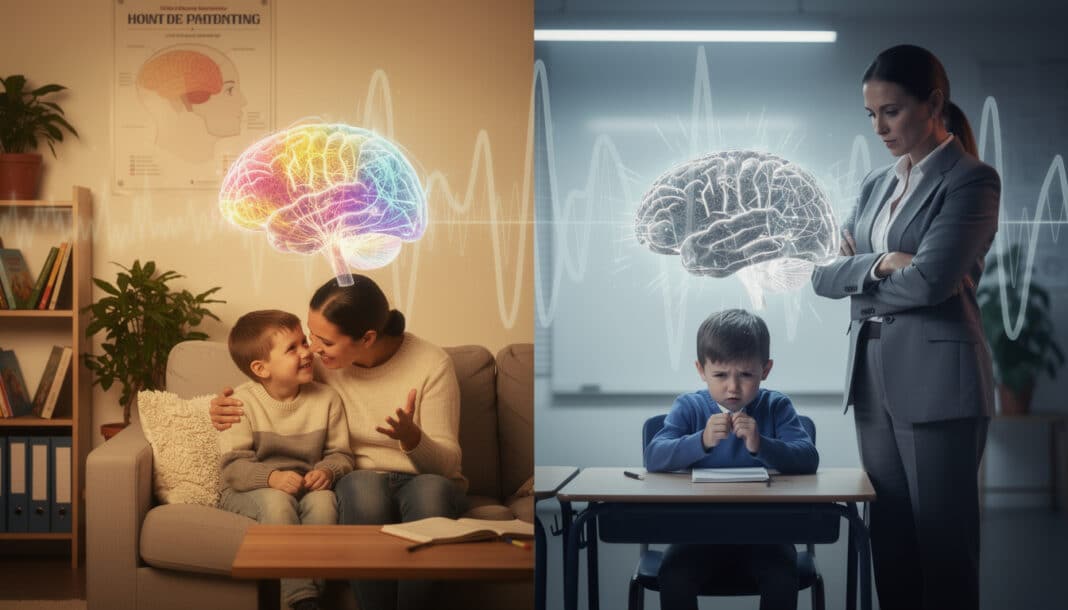
In short: Affective neurosciences are revolutionizing our understanding of raising children. Contrary to received ideas, kindness is not weakness: it is a biological necessity. The chronic stress generated by rigid authority physically damages the developing brain, while empathic relationships stimulate the maturation of key areas like the orbitofrontal cortex. In 2026, the science is clear: positive emotional interactions durably shape a child's ability to regulate emotions, form social bonds, and learn. Abandoning punishments does not weaken parental authority; it redefines it by grounding it in listening, clear boundaries, and respect for the child's neurobiological nature.
When science explains what the heart suspects: the neurological foundations of education
For a long time, education was built on intuitive certainties, passed down from generation to generation like the worn pages of an old book. People knew that authority closed doors, that gentleness opened windows, but they didn't really understand why. Today, affective neurosciences give us that understanding. They shed light on what really happens in a child's head when they cry, get angry, or shut down in the face of harsh words.
Since the end of the 20th century, research in cognitive and affective neuroscience has mapped the child's brain as one traces the contours of a new land. These studies show us that brain development is not an isolated process, folded in on itself. It is a constant dialogue between the body, emotions, and the social environment. Every interaction, every word, every gesture leaves a physical trace: a neural connection strengthened here, a brain area stimulated there.
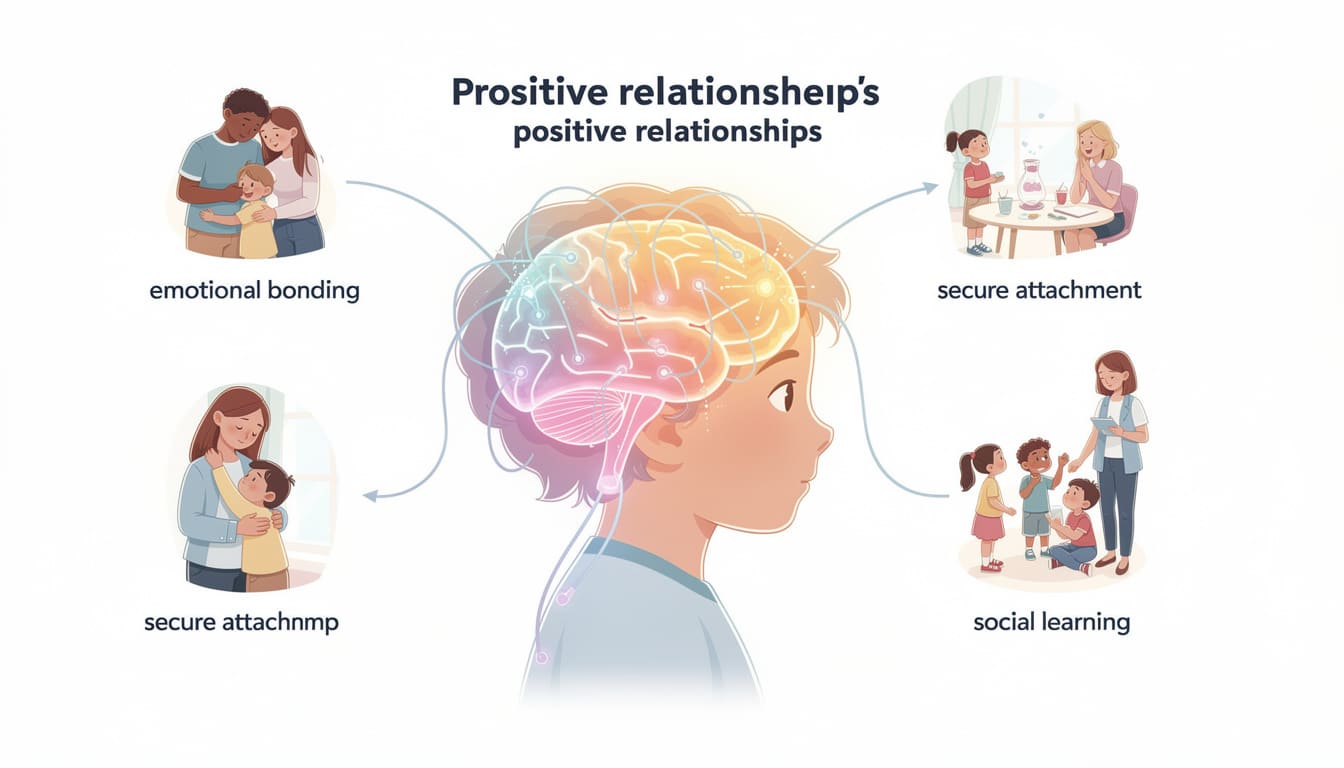
The major contribution of this research boils down to a simple revelation, almost obvious once stated: empathic relationships shape the very structure of the brain. A child wrapped in a warm emotional environment sees their brain develop differently from a child exposed to rigidity and indifference. This is not a matter of sentiment or morals. It is a matter of biology.
The orbitofrontal cortex, that silent architect of empathy and regulation
At the heart of this revolution lies a region of the brain barely the size of an almond: the orbitofrontal cortex. Located just above the eye sockets, it is the seat of our most human capacities. It is here that empathy, moral conscience, and the ability to make reflective rather than reactive decisions are born.
When a child grows up surrounded by empathy and patience, this orbitofrontal cortex becomes denser, developing more numerous and more robust connections. Concretely, this means the child gains better emotional control, greater sensitivity toward others, and an ability to navigate conflicts without aggression. Conversely, a child exposed to rigid interactions and repeated hurtful words sees that same cortex remain underdeveloped, like a muscle that is never used.
Imagine a bookbinding workshop: if you press the paper too harshly, you will break its fibers. But if you treat it with respect, letting it unfold naturally under your gentle and firm guidance, it yields, bends, and organizes into something strong and beautiful. The child's brain follows the same logic. It needs pressure, certainly, but a just, conscious, and compassionate pressure.
The invisible damage of chronic stress: when rigid authority injures the brain
Here is the question that plagues parents and educators: doesn't the absence of punishment make a child “soft,” undisciplined, unable to face the realities of the world? Neuroscience answers clearly: the opposite is true. Chronic stress caused by a strict, empathy-free authority physically damages the developing brain.
When a child lives in fear, is regularly humiliated, had their emotions ignored, or is harshly punished, their body releases massive amounts of cortisol, the stress hormone. This chemical flood is designed to activate the immediate survival system: flee, fight, or freeze. This mechanism is useful in the face of real danger, but when it is triggered daily in a rigid educational context, it becomes toxic.
Prolonged cortisol damages the hippocampus, the brain structure responsible for memory and learning. Studies have shown that in children subjected to chronic stress, hippocampal volume decreases in a measurable way. The result: the child struggles to memorize, to concentrate, to learn even when the teaching material is relevant. It is an extraordinary price to pay for supposed “discipline.”
Additionally, the prefrontal cortex, the region responsible for executive control, planning, and inhibiting impulsive behaviors, also suffers. Yet this is precisely the area that needs to be developed for the child to become autonomous and capable of self-regulation. Instead, an education based on fear creates an anxious, hypervigilant child, often unable to manage their emotions for lack of having been given the neurobiological tools to do so.
The myth of children's “emotional storms” and the scientific truth
How many times have we heard the phrase: “It's just a tantrum, let them be”? How many parents have believed their child was manipulating them by crying or screaming? This persistent belief overlooks a fundamental biological truth: until about 5 or 6 years old, the emotional brain massively dominates the rational cortex.
When a three-year-old bursts into tears because they were given a biscuit of the wrong color, it is not an attempt at manipulation. It is a child overwhelmed by an emotion that their immature brain does not yet know how to regulate. Their control structures are simply not developed enough. Asking a three-year-old to “control themselves” is like asking someone to stop their heart from beating: it is neurobiologically impossible.
This distinction changes everything. If we understand that the child cannot regulate their emotions alone, we also understand that our role is not to punish them for this inability, but to accompany them. To serve as an “external regulator” until their brain regions of control develop enough to take over.
Empathy as a tool: when kindness becomes a neuroscientific strategy
Adopting a compassionate parenting approach is therefore not a matter of overflowing sensitivity or laxity. It is a strategy backed by decades of research in affective neuroscience. When we welcome a child's emotions instead of repressing them, when we offer them a relationship of trust and clarity, we literally build their brain differently.
Take a seven-year-old who comes home from school furious: a classmate took their ball. Two opposite approaches present themselves to us.
The first: “Stop shouting, it's ridiculous. Millions of children have their things taken. There's no point crying.” This well-intentioned response sends a powerful message: your emotions are not legitimate, your pain does not matter. Neurobiologically, it reinforces cortisol and weakens the sense of security attached to the parent-child relationship.
The second: “I can see you're really angry. It's normal to feel that way when someone takes something you love. You find it unfair, and that's true. Together we can think about how you might get your ball back or handle the situation.” This approach acknowledges the emotion, validates it, then offers a framework to resolve it. Neurobiologically, it activates the orbitofrontal cortex, strengthens emotional security, and teaches the child that their feelings can be expressed and integrated.
The difference is subtle, but its effects on the brain are deep and lasting.
Setting limits without destroying the bond: compassionate clarity
A common misunderstanding claims that compassionate education means the absence of limits. That is false. Children need clear, reassuring, and fair frameworks. Without limits, they feel lost, abandoned, and unanchored. The developing child's brain seeks reference points.
The key lies in the way those limits are set. A limit stated with respect, explained with empathy, preserves the integrity of the parent-child relationship. The child learns the rule, but also learns they can trust the adult, that their self-esteem is not at stake, and that love is unconditional even when the behavior is not accepted.
Compare these two approaches: “You won't have dessert because you were unbearable” versus “I notice you're having trouble controlling your frustration right now. Dessert is after dinner. If that's hard for you, we can think together about what helps you stay calm.”
The second states a firm limit while preserving dignity and offering collaboration. It stimulates problem-solving brain areas instead of activating the stress alarm system.
Brain plasticity and hope: why it's never too late to change course
One of the most consoling discoveries of neuroscience is brain plasticity: the remarkable capacity of the brain to remodel itself, create new connections, and reinvent itself in light of new experiences. This plasticity is particularly intense during childhood, but it persists throughout life.
That means a child who grew up in a rigid environment is not doomed to remain so. An anxious child can learn to relax. A child who never learned to express emotions can develop that ability. A child who experienced rejection can rediscover trust. The brain is more mutable, more tender, more willing to heal than often imagined.
Imagine restoring an old damaged book. You cannot erase the traces of time, but you can restore it, strengthen its structure, and give it a second life. So it goes with the child's brain: even when wounded, it has an intrinsic capacity to rebuild if given the opportunity.
This plasticity creates a major responsibility for adults: every interaction we have with a child is an opportunity to trace neural pathways. And conversely, it also offers us hope. Because even on days when we give in to frustration, when our limits become too harsh, when our words become too sharp, we can repair. We can come back, apologize, and correct. And the child's brain, in its plastic generosity, will allow it.
Critical windows of development: when every moment counts
The child's brain experiences periods of explosive growth, windows of particular vulnerability and opportunity. Between 0 and 2 years, the brain creates more than a thousand synaptic connections per second. During this phase of juvenile exuberance, every sensory interaction, every caress, every soothing word builds the emotional foundations.
Between 3 and 5 years, the prefrontal cortex develops rapidly. This is the period when the child begins to learn social rules, the first steps of emotional self-regulation. Here they need a patient adult who recognizes their efforts, even when imperfect.
Between 6 and 12 years, the neural circuits linked to social cognition strengthen. This is the time when friendships, the ability to navigate conflicts, and awareness of others consolidate. A child who received compassion during the early years enters this period with a solid foundation.
Recognizing these critical windows helps adults adapt their approach. Just because a method failed with a 4-year-old doesn't mean it will fail at 7. The brain transforms and prepares for new learning. There is always a chance to start over.
From theory to practice: concrete tools of positive discipline
Understanding neuroscience is one thing, but how do we translate it into daily actions? How do we escape conditioned reflexes, that inner voice that screams “punish them!” when the child paints the walls fuchsia pink?
Nonviolent Communication, developed by Marshall Rosenberg, offers a practical framework rooted in neuroscience. It suggests naming the observation (what you noticed without judgment), the emotion it evokes, the underlying need, and the clear request. “I see paint marks on the wall. I feel frustrated because I need our home to stay clean. Can you help me clean and explain what made you want to paint here?”
This approach engages multiple brain areas: it activates mutual empathy, offers an explanation (satisfying cognitive curiosity), and places the child in the role of an actor rather than a victim. Neurobiologically, it is the opposite of reprimand or punishment.
Mindfulness and meditation, increasingly integrated into schools, are another powerful tool. Ten minutes of conscious breathing and present-moment awareness soothe the nervous system and reduce cortisol production. A child who knows how to pause, breathe, and recognize bodily sensations has a lever to regulate emotions rather than suffer them.
Finally, innovative pedagogical approaches that respect the child's rhythm and natural curiosities provide an optimal environment for neurodevelopment. When a child is allowed to explore at their own pace, choose activities, make mistakes, and learn from experience, we stimulate the development of the prefrontal cortex and strengthen their sense of autonomy.
Creating a safe environment: the fundamental role of routines and predictability
The developing brain instinctively seeks predictability. A reassuring routine, clear temporal markers, and a stable environment provide the child with what the walls of a workshop provide the craftsman: a space to create and experiment with confidence.
Children exposed to routines, announced transitions, and clear, fair expectations develop better emotional self-regulation. Their nervous system knows it is safe, so it can relax enough to learn and explore. This does not mean absolute rigidity, but rather a flexible, understandable, and compassionate structure.
Also take the time to create moments of intentional emotional connection: a bedtime ritual, a game together, a conversation without digital distractions. These moments reinforce secure attachment bonds and nourish the brain areas responsible for empathy and trust.
The adult's role: cultivating one’s own emotional regulation to guide the child
Here lies an sometimes uncomfortable truth: you cannot teach a child what you do not possess yourself. A hyperreactive, chronically anxious parent, unable to manage their own frustration, can know neuroscience by heart but will primarily transmit their emotional dysregulation.
That is why self-work is central. Not out of guilt or perfectionism, but out of biological realism. The child learns first by imitation. They observe how the adult breathes when angry, how they speak when disappointed, how they recover after a mistake. The child's brain records these models and reproduces them naturally.
Cultivating one's own mindfulness, recognizing emotional patterns, seeking to understand oneself with kindness rather than harshness: this is a gift passed directly to the child's developing brain. It does not require perfection. It requires intention and honesty.
A parent who tells their child “I lost my temper earlier, I shouldn't have spoken to you that way, I'll do better” offers a far more powerful lesson in emotional regulation than a thousand theories. They show that emotions are normal, that mistakes do not erase love, and that repair is possible.
Beyond the home: a society reinventing its relationship to childhood
This revolution in affective neurosciences concerns more than families. It calls into question schools, institutions, and public policies. If we accept that the child's brain is extremely sensitive to social and emotional interactions, it challenges many established practices.
Why do schools continue to use numeric grades that provoke stress and comparison? Why are children who learn differently stigmatized rather than supported? Why do teachers, themselves exhausted and stressed, receive so little training in affective neuroscience?
Today's children will grow up in a demanding, complex, and often difficult world. But if we want them to face it with resilience, creativity, and empathy, we must first offer them the neurological conditions to develop these capacities. It begins by recognizing that compassionate education is not a luxury or a choice for “too soft” parents. It is a biological necessity.
The temptation remains, of course, to revert to old methods. They are quick, they produce immediate obedience, and they match what we experienced as children. But we now know the price the child's brain pays for that apparent speed. And we also know the richness, depth, and humanity of an approach that honors both the structure and the sensitivity of the learner.
Every child who grows up in a relationship of empathy and clarity becomes an adult capable of regulating their emotions, building authentic bonds, and contributing thoughtfully to their environment. This is not a naive promise. It is a reality written into the synapses, hormones, and the very chemistry of the developing human brain.
Profil de l'auteur
Derniers articles
 Smartphones & Mobile Phones14 October 2026The loyalty penalty on your mobile bill: why staying put costs you more
- Family, Babies & Children5 October 2026Airline family seating fees: what the planned ban will change for parents
- Everyday Life & Society23 September 2026Consumer confidence index: what the monthly mood check on British households really measures
- Agency, Webmarketing & SEO31 August 2026SEO : a Google bug skews visibility statistics in AI results




Table of Contents