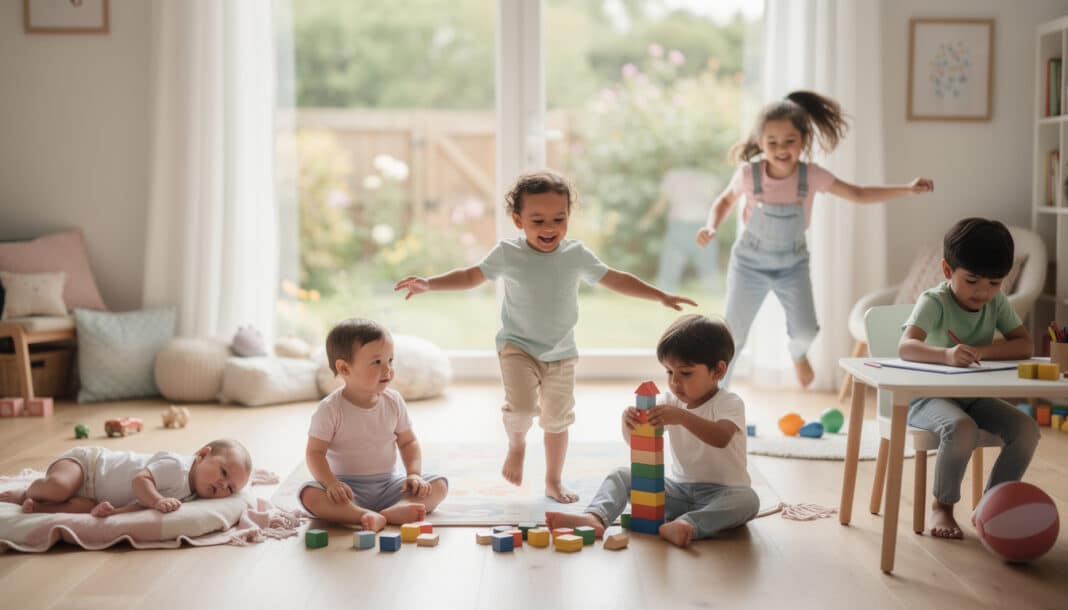
In brief — From birth to six years old, the child undergoes profound transformations that shape their future. Psychomotor development follows a predictable yet singular path: from innate reflexes to self-awareness, from rudimentary coordination to mastery of movements. Understanding these stages allows parents and educators to offer appropriate support, without haste or comparison. The first three years remain decisive, with the brain forming millions of neural connections every day. Each acquisition — from the first smile to the first step, from voluntary grasping to symbolic thought — bears witness to an invisible harmony between body and mind.
The invisible foundations: understanding motor skills in the first two years
When observing a newborn, one sees only fragility and dependence. Yet beneath this apparent immobility unfolds intense neurological activity, comparable to an ancient manuscript where each page is written slowly, with precision. Between birth and two years, the child goes through what specialists call the sensorimotor stage, during which they discover the world through their senses and movements.
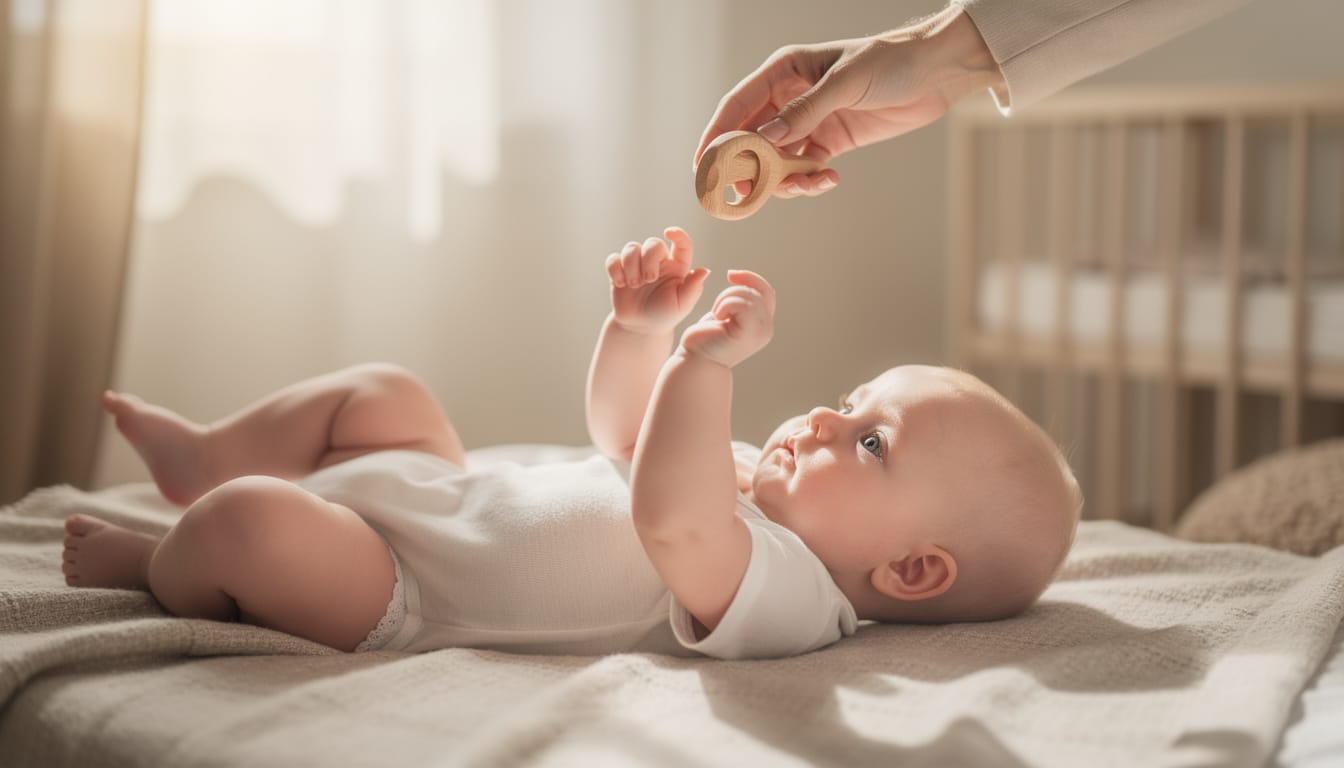
This period begins with archaic reflexes — innate gestures like sucking or grasping — which gradually progress toward intentional actions. The newborn first follows objects with their gaze, then learns to grasp them, to turn them, to explore them with their mouth. This sensory exploration is not random: it is the body's first language, its way of weaving a connection with its environment.
By three months, the child begins to grasp that objects exist even when they disappear from their visual field — what psychologists call object permanence. This quiet cognitive discovery transforms their understanding of the world. Around six months, coordination sharpens: the child moves from clumsy use of both hands to true grasping, capable of seizing an object with intent.
Acquiring walking: far beyond the first step
The first step, often celebrated around twelve months, symbolizes autonomy. But this acquisition of walking is part of a long learning process of balance and confidence. Before walking, the child must master rolling over (three to four months), then sitting (around six months), crawling or scooting (eight to ten months).
Each stage consolidates their gross motor skills — that is, the control of large body movements. Noticing that a child moves by scooting rather than belly-crawling is not a delay, but an individual variation. Parents who observe without judging offer a precious gift: the freedom to develop at their own pace, like a binding that takes shape according to the unique nature of each book.
The emergence of symbolic thought: when the child becomes a storyteller
Between two and four years a remarkable transformation occurs. The child no longer lives only in the present and the sensory; they gain the ability to mentally represent what is not there. This symbolic thought opens a new universe where a stick becomes a magic wand, where a chair becomes a castle.
Language then takes off at high speed. Where the toddler babbled, the two-year-old produces their first meaningful words. By three, simple sentences emerge. By four, they tell stories and ask a thousand questions. This burst of language reflects a mental architecture in reorganization: the child organizes experiences into concepts, symbols, and narratives.
It is also the time of symbolic play. The child imitates adult gestures — making coffee, driving a car, caring for a doll. Through these games, they exercise their understanding of the social world and consolidate their fine motor skills, the precision of small hand and finger movements.
Egocentrism: a natural stage, not a flaw
At this age, the child sees the world from their single point of view. They think that if they did not see something, no one else saw it. This characteristic, which Piaget called egocentrism, is not a lack of future empathy but a normal cognitive stage. It will naturally progress toward understanding that others also have their perspectives.
Routines and repetition play a crucial role at this stage. The child loves stories they know by heart, songs they hum endlessly. This repetition consolidates their learning, just as binding consolidates a book's signatures by the patient stitching of the same repeated gestures, page after page.
Intuitive thought and early logic: questions that arise everywhere
From four to six years, the child crosses a new threshold. Their thinking refines; they become capable of classifying objects according to criteria — color, shape, function. Yet their reasoning remains focused on appearances. They will believe that a row of spaced objects contains more pieces than a tight row, even if the quantities are identical.
It is during this period that sensory awakening sharpens. The child refines their perceptions: they distinguish sounds better, recognize smells, develop preferences. Their need to understand becomes voracious. The “why?” questions fire off incessantly. These questions are not obstacles but signals that the brain is asking to build meaning.
Social interaction intensifies. Children begin to truly cooperate, to negotiate, to share the rules of a game. They develop an embryonic moral awareness: that of right and wrong, of fair and unfair. These stages outline the contours of future sociality.
Sensitive periods: windows of learning not to be left closed
Montessori pedagogy, founded at the beginning of the 20th century, highlighted the existence of distinct stages of development, but also what are called sensitive periods. These are moments when the child is particularly receptive to certain learnings, like a fabric that absorbs dye at a precise moment in its preparation.
The sensitive period for language runs from birth to six years. That for order extends from one to three years — which is why children of that age love to tidy, sort, and structure. The sensitive period for small objects falls between two and a half and four years. Recognizing these temporal windows helps adults offer activities at the right time, not too early, not too late.
The brain in motion: the first thousand days that change everything
If a single period summarizes the importance of early development, it is the first thousand days of life — that is to say roughly the first two years. During this window, the brain develops at an astonishing speed. Millions of neural connections form every second, creating the networks that will support all future learning.
A rich environment of stimulation, affectionate interaction with stable figures, a balanced diet: this triptych largely determines the quality of these connections. It is not a question of parental perfection, but of patient attention, of embodied presence. A child who sees their parent respond to their cries, who feels a caregiver's skin, who hears voices speaking directly to them — that child builds solid neurological foundations.
At the same time, the archaic reflexes that dominate at birth gradually integrate into the voluntary motor repertoire. This process of neurological integration underlies all subsequent motor acquisitions. That is why children who have been allowed free natural movement generally develop better motor skills than those who have been severely restricted.
Supporting without rushing: the art of accompanying psychomotor development
The temptation is great, for adults in 2026, to want to accelerate every stage. Programs claiming to stimulate precocity emerge, apps promising more advanced children. Yet a child's psychomotor development does not obey the logic of productivity. It follows a biological rhythm, like the opening of a flower that cannot be forced without damaging it.
Observe patiently, adapt the environment, offer opportunities without imposing: this is the stance children ask for. A child who fully masters their gross motor skills and their fine motor skills at their own time will be more confident in future learning than a child pushed before their time.
The environment as a silent teacher
The space we create around the child speaks before we do. An environment designed for their autonomy — objects within reach, surfaces at their scale, safe materials to explore — naturally invites development. There is no need to buy a hundred toys: a few simple, authentic objects stimulate the imagination more than a mountain of colorful plastic.
Likewise, daily interactions weave the fundamental affective bond. Narrating what we do during care routines (diaper changes, bath), singing, dancing, simply being present — these ordinary gestures are in fact extraordinarily powerful. They form the mortar of the emotional and social development the child will carry throughout life.
Recognizing each child's uniqueness
Age benchmarks provided by professionals are useful, but they are only statistical averages. Each child goes through the stages of development at their own pace. A child who walks at fifteen months instead of twelve is not delayed; it's simply their rhythm. One who speaks little but watches attentively may be building language differently, but just as richly.
Comparison, a silent poison, can turn what only required confidence into anxiety. Children sense this adult worry and internalize the implicit message: “You are not going fast enough.” What gift to offer instead: to be received as one is, in the pace that is one's own, with the certainty that one is trusted.
Accompanying the psychomotor development of the child from zero to six years is ultimately learning to see beyond the surface, to listen to what their body and movements express, to create spaces where each small step has its value, neither magnified nor minimized. It is the forgotten art of embodied slowness, the patient binding that weaves, thread by thread, experiences into maturity.
Profil de l'auteur
Derniers articles
 Smartphones & Mobile Phones14 October 2026The loyalty penalty on your mobile bill: why staying put costs you more
- Family, Babies & Children5 October 2026Airline family seating fees: what the planned ban will change for parents
- Everyday Life & Society23 September 2026Consumer confidence index: what the monthly mood check on British households really measures
- Agency, Webmarketing & SEO31 August 2026SEO : a Google bug skews visibility statistics in AI results




Table of Contents