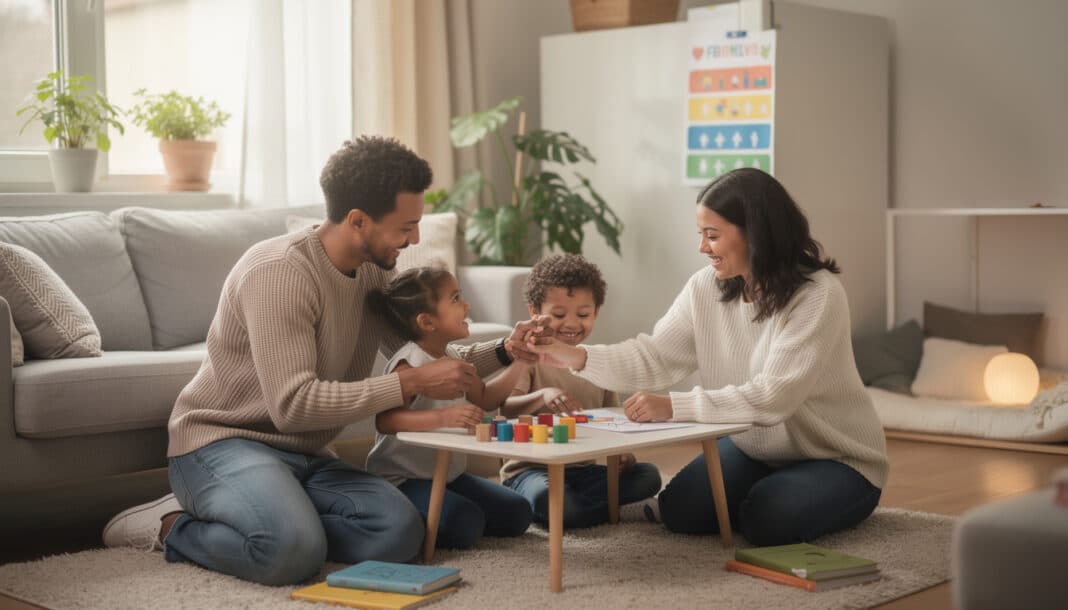
Positive parenting is gradually establishing itself as an educational philosophy based on mutual respect, empathic listening and the caring support of the child. Born in the United States in the late 1990s under the influence of positive psychology, this approach invites parents to abandon coercive methods in favor of a nonviolent communication and constructive management of family conflicts. Far from being a mere trend, it rests on scientific foundations, particularly advances in affective neuroscience, which shed light on how the child's brain is built in a secure and loving environment.
In short: Positive parenting favors empathy over punishment, sets clear boundaries without humiliation, recognizes the child as a full person, promotes their gradual autonomy and excludes any educational violence. Specialists like Catherine Gueguen see it as a path to a happy childhood, while other critics denounce a lack of scientific rigor and lax tendencies. Between an attractive theory and realistic application, this approach arouses as much support as debate among professionals and parents.
Understanding the foundations of positive parenting and compassionate education
Imagine a binding that assembles the pages of a book with patience and delicacy, respecting the fragility of the paper. That is how positive parenting works: it links parent and child not by constraint, but by gestures of listening and understanding. This approach was born from the positive psychology movement launched in 1998, a movement that sought to overturn the traditional perspective by exploring not psychological disorders but the conditions of human flourishing.
The theoretical roots of this philosophy dive into the work of Martin Seligman on resilience and that of Mihály Csíkszentmihályi on optimal experience, also called “flow.” These researchers have shown that individuals thrive more in an environment where their emotional needs are acknowledged and valued.
In France, positive parenting experienced remarkable growth thanks to popularizers like Isabelle Filliozat, Catherine Gueguen and Héloise Junier, whose books have sold by the hundreds of thousands. Filliozat particularly emphasized the concept of integrative empathy: the parent's ability to place themselves in their child's emotional universe, recognizing that the juvenile brain does not yet have the neurobiological tools to regulate its impulses and anxieties on its own.
The five fundamental pillars of a caring parent-child relationship
At the heart of positive parenting lies a solid architecture built on five interdependent elements. The first is affective and emotional education: recognizing and validating the child's emotions, whether they be joy, frustration or sadness. This does not mean giving in to all their whims, but offering them a space where their feelings find welcome and naming.
The second pillar establishes a framework and clear rules of life, non-negotiable, which ensure physical and emotional safety. These limits are not hindrances; they are reassuring guardrails. A mother who says no to her child to protect them from danger does not act out of authoritarianism, but out of structuring love.
The third pillar requires recognizing the child as a person in their own right, endowed with rights and dignity. This implies truly empathic listening, without hasty judgment, and respect for their emotional and physical integrity.
The fourth pillar encourages gradual empowerment: gradually granting freedoms and responsibilities that reinforce the child's sense of competence and personal agency. Letting a six-year-old choose their clothes, within the limits set, nurtures their self-confidence.
Finally, the fifth pillar is nonviolent education, which radically excludes any corporal punishment—spanking, slapping, punitive isolation—and any recourse to psychological humiliation. This position crystallized in France with the law of July 10, 2019, which explicitly prohibits corporal punishment, recognizing that hitting a child violates their physical and human integrity.

Nonviolent communication as the language of mutual respect
At the center of any successful application of positive parenting is a skill rarely taught: nonviolent communication. Inspired by the work of Marshall Rosenberg, this approach rests on four steps: factual observation, identification of emotions, recognition of needs, and the formulation of an explicit request.
Rather than shouting “You're always dirty, you never listen!”, a parent trained in this communication would say: “When I see dirt on your clothes and I ask you to wash, I feel frustrated because I need order and respectful care for the home. Would you be willing to go wash up before dinner?”
This reformulation adds a layer of humanity: it shows the child as a partner capable of cooperation, not as an adversary to be subdued. Parents who integrate this practice often report a reduction in shouting and repetitive conflicts.
Catherine Gueguen, a pediatrician specializing in social neuroscience, emphasizes that this compassionate communication promotes in the child the formation of lasting brain connections in areas involved in empathy, emotional regulation and responsible decision-making.
Concrete examples: positive parenting in everyday life
To give flesh to this philosophy, imagine scenes from ordinary life. A three-year-old refusing to leave the park to go home. Instead of dragging them by force while shouting, the parent trained in positive parenting could crouch down and name it: “I see that you love sliding on this slide. It's hard to leave, isn't it?” This emotional validation recognizes their experience, making the transition less violent.
Then the adult sets a framework: “We must go home now, the sun will soon disappear. Do you want to run to the door, or would you prefer to hop there?” Offering limited choices—not the absolute freedom to stay, but the power to choose how to comply—preserves autonomy while maintaining benevolent authority.
Another example: a thirteen-year-old comes home with a bad grade. Traditionally, the reaction might have been punitive. In positive parenting, the parent first asks: “Tell me what happened. How do you feel about this result?” This compassionate curiosity opens a dialogue rather than creating a fortress of anger. Together, they can explore the causes—lack of sleep, test anxiety, misunderstood material—and co-construct an action plan.
Scientific contributions and critical debates
Since its popularization in France, positive parenting has benefited from an increasingly robust scientific framework, notably the support of researchers in affective neuroscience who demonstrate how parental empathy activates key brain areas linked to emotional regulation. Programs like Triple P, created in Australia in 2001 by Professor Matthew Sanders, have been deployed in thirty-five countries and validated by the WHO in twenty nations, drawing on more than four hundred and fifty studies and more than one hundred and forty-five randomized controlled trials.
However, the explosive commercial success of this movement—with its best-selling books, private coaching and paid conferences—has attracted sharp criticism. In 2022, a collective of three hundred and fifty childhood specialists denounced what they consider the excesses of an “exclusively positive” version that would be naive, watered-down and potentially dangerous.
Renowned psychologists like Didier Pleux and Caroline Goldman have pointed to abuses: the overuse of empathy that would reinforce the pursuit of immediate pleasure, the absence of constructive frustration necessary for resilience, and above all a biased interpretation of neuroscience. According to them, some parents find themselves “victimized” by their children, due to an insufficiently firm framework.
The criticism also targets the instrumentalization of neuroscientific concepts. Didier Pleux emphasizes that studies conducted on stressed rats or cases of chronic maltreatment are unduly extrapolated to ordinary parental situations. The use of oxytocin as neurobiological proof of benevolence is also contested by neuroscientist Marie-José Freund Mercier, who urges caution regarding its applications in behavioral psychology.
The limits and gray areas of gentle parenting
Positive parenting does not exist without its shadows. One concerns the vague definition of what constitutes genuine empathy or disguised permissiveness. A child who refuses to do their homework—can we really let them explore their emotions, or must we impose a structure?
Another tension: the mental and emotional load that this approach imposes on parents, particularly mothers. Being constantly attentive, validating every emotion, setting boundaries without humiliating requires considerable energy, even untenable for some families in precarious situations or subjected to intense systemic stress.
In 2019, journalist Béatrice Kammerer pointed out in her book that positive parenting, “morally good”, should also accept that parents from working-class backgrounds take their own paths. She criticized the dogmatic imposition of this method, as if it were the only valid route to a flourishing childhood.
Furthermore, some children—those suffering from behavioral disorders, ADHD or other neurodevelopmental conditions—may require hybrid approaches integrating stricter limits and concrete reinforcers beyond pure emotional verbalization.
Managing emotions: equipping the child rather than repressing them
Where positive parenting excels is in its view of emotion management as a skill to teach, not as a scourge to crush. A child who screams or cries is not “mean” or “badly behaved”; they are in distress, and their nervous system lacks regulatory tools.
Rather than “Stop crying!”, a parent trained in this approach recognizes: “You are angry. Breathe deeply with me.” Giving names to emotions allows the child's brain to process them rather than undergo them in cascade.
This stance transforms the adult into an emotional coach. They offer tools: mindful breathing, the deflating balloon technique, or identifying physical sensations (“Where do you feel your anger in your body?”).
Over time and with repeated practice, the child progressively integrates emotional regulation as an intrinsic skill, rather than perceiving it as a constraint imposed from the outside.
Positive reinforcement versus punishment: two visions of behavioral change
At the heart of the debate on positive parenting lies a fundamental educational question: how to motivate a child to adopt a desired behavior?
The traditional view relies on punishment: “If you misbehave, you will be punished.” Positive reinforcement, on the other hand, reverses the logic: “When you adopt this behavior, here is what you gain.” This can be a sincere compliment, an extra activity, or simply explicit recognition of progress.
Rather than repeating “You didn't tidy your room”, a parent using positive reinforcement would say: “I noticed you folded your sweaters this morning. That's a responsible action. How do you feel about your more organized space?”
Studies on Triple P and the Kazdin Method (developed at the Yale Parenting Center with a documented effectiveness rate of eighty percent) show that positive reinforcement produces lasting changes, while punishment often generates superficial obedience or an increase in hidden rebellious behaviors.
Benevolent authority: the right posture between firmness and tenderness
A misunderstanding persists: benevolent authority would be the absence of authority. That is false. It is rather a reformulation, moving from “authority of power”—based on fear—to “authority of relationship”—based on mutual respect and legitimacy.
A child deeply needs to feel that an adult is at the helm. That reassures them. But this authority can be exercised without shouting, without humiliation, without threats. It is stated calmly: “This is non-negotiable. Not because I am stronger, but because your safety is at stake.”
The distinction proposed by critics like Didier Pleux between “upstream authority”—clearly established from the start—and the absence of structure remains relevant. A pre-established framework, accepted and clearly communicated, generates fewer conflicts than an emerging, incoherent or reactive authority.
It's like the threads of a binding: they must be at the right tension—not too loose, not too tight—for the book to hold and close gently.
Respecting the child and recognizing their interiority
Beyond techniques, positive parenting invites a profound change in the way childhood is viewed. The child is not a tabula rasa to be filled, nor a tyrant-in-waiting to be subdued. They are a person in development, endowed with their own inner life, preferences, sensitivities and even intuitive wisdom.
This respect for the child as a whole subject—and not as an object to be molded—transforms daily interactions. Asking “What do you think?” or “How would you like us to solve this problem together?” amounts to saying: “I see you. I consider you.”
This recognition creates in the child a sense of valued existence. Over time, they internalize that their opinion counts, that their emotional well-being deserves attention, and that human relationships rest on respectful dialogue rather than on a hierarchy of domination.
That is what deeply differentiates positive parenting from a mere behavioral technique. It is a relational philosophy that places the child as a partner in their own development.
Resilience and emotional construction: long-term outcomes
Professional observations and early results from longitudinal studies suggest that children raised within a framework of positive parenting develop more affirmed self-confidence. Rather than fearing authority, they learn to collaborate with it.
This early emotional development also appears to strengthen resilience in the face of adversity. A child who has internalized that their emotions are valid and that problems are solved through dialogue—rather than through submission or rebellion—has mental tools to navigate future difficulties.
Catherine Gueguen insists that children who have benefited from parental kindness show better stress regulation, a more developed capacity for empathy, and a reduced risk of anxiety or depressive disorders in adolescence.
Nevertheless, it is wise to remain cautious: these benefits are not automatic, and they depend largely on consistency, balance and the absence of confusion between kindness and lack of limits.
Integrating positive parenting into the family: beyond theory
Moving from theory to practice requires time, patience with oneself, and often training. Many parents discover positive parenting with enthusiasm, then find themselves disarmed by the real complexity of daily situations.
Starting modestly helps: choose a single recurring situation—for example, a difficult bedtime—and apply the principles of nonviolent communication and emotional validation. Little by little, the tools become natural, integrated into the parental relational repertoire.
For interested families, various resources exist. Des programmes structurés comme Triple P offrent des modules de formation aux parents. Des livres, des ateliers et des professionnels de l'accompagnement parental peuvent aussi soutenir cette transition.
The essential thing is to remember that no parent is perfect. Positive parenting is not a quest for emotional perfection, but a direction, a repeated intention day after day to listen, respect and guide with kindness.
What place for frustration in constructive education?
One last issue deserves attention: the role of frustration in psychic development. The critique of Didier Pleux and Franck Ramus raises a pertinent question: will a child without frustration learn to persevere, to accept refusals, to transform desire into creative effort?
According to these specialists, there is a difference between pathogenic frustration—caused by lack of love or security—and structuring frustration, which allows the child to learn that the world is not magical, that dreams require tenacity.
Anglo-Saxon positive parenting, in particular Triple P, integrates this point: it does not eliminate limits, it states them with respect. It does not promise a world without “no”, but a “no” that accompanies rather than crushes.
This subtle balance between empathy and demand, between validation and constructive frustration, remains the central challenge for 21st-century parents seeking to raise resilient, responsible children ethically anchored in a complex world.
Profil de l'auteur
Derniers articles
 Smartphones & Mobile Phones14 October 2026The loyalty penalty on your mobile bill: why staying put costs you more
- Family, Babies & Children5 October 2026Airline family seating fees: what the planned ban will change for parents
- Everyday Life & Society23 September 2026Consumer confidence index: what the monthly mood check on British households really measures
- Agency, Webmarketing & SEO31 August 2026SEO : a Google bug skews visibility statistics in AI results




Table of Contents