
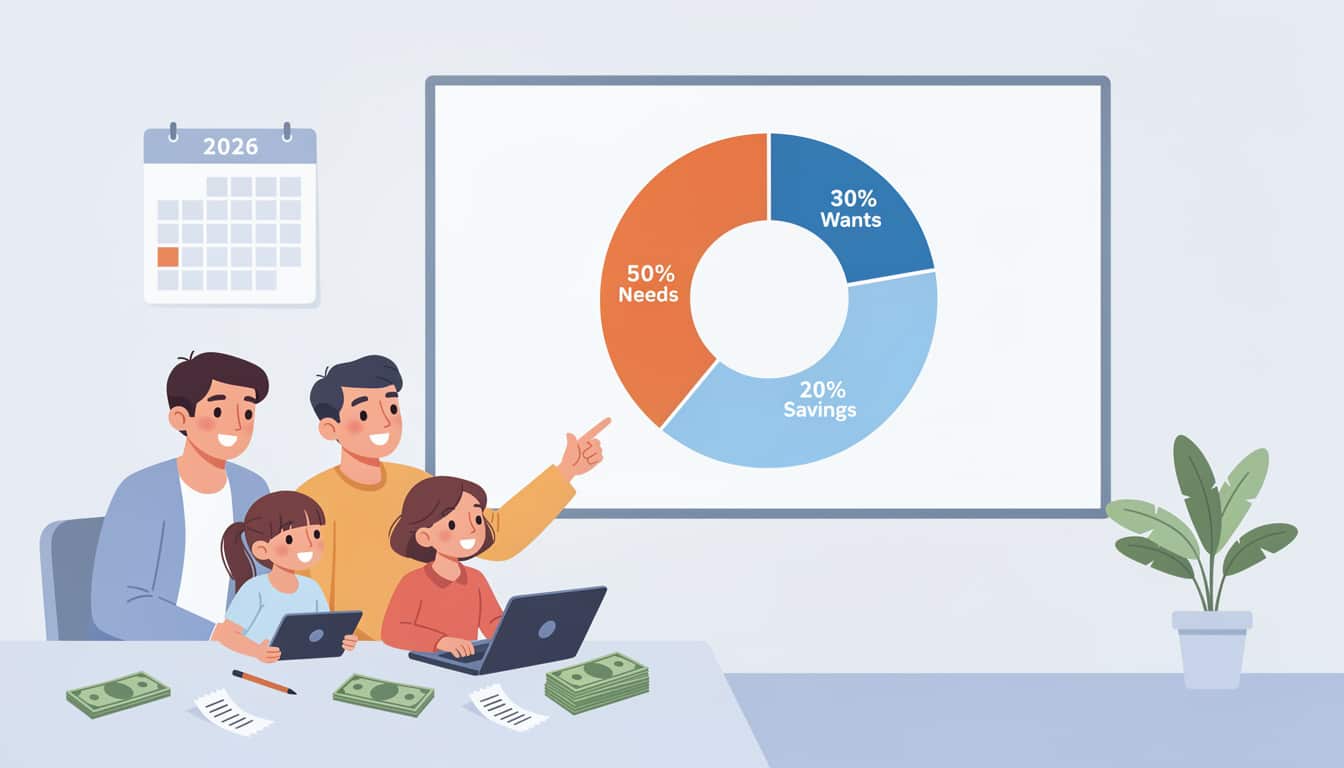
The 50/30/20 method provides a simple and effective framework for organizing family finances in 2026. This system is based on a clear allocation of income: 50 % for essential needs, 30 % for wants and leisure, 20 % for savings. Far from being a rigid formula, this approach allows households to regain control of their budget management while retaining room for everyday pleasures. The main advantage lies in its simplicity: no financial expertise is required to apply it and adapt it to one’s personal situation.
Key points to remember: A balanced allocation among three major categories makes financial planning easier and reduces money-related anxiety. This method adjusts to regional realities and income variations. Savings become an integrated priority rather than an optional surplus. Households that apply it experience better visibility of their cash flows and progress toward their long-term goals.
Understanding the foundations of the 50/30/20 budget allocation
Popularized by Elizabeth Warren, a law professor turned U.S. senator, the 50/30/20 rule rests on a basic principle: divide monthly net income into three distinct categories. This approach changes the way families view their personal finances by replacing confusion with a clear, manageable logic.
The first slice of 50 % covers essential needs: rent or mortgage, electricity, food, transport, insurance and other non-negotiable expenses. These items form the foundations of daily life and generally cannot be removed without consequences. The second slice of 30 % is reserved for wants: dining out, subscriptions to streaming platforms, shopping, leisure and entertainment. This portion acknowledges that a life focused solely on survival is not desirable. Finally, the remaining 20 % funds savings or contributes to debt repayment, forming a gradual accumulation of financial security.
Why this method works despite its apparent simplicity
The 50/30/20 method thrives precisely because it avoids complexity. Unlike elaborate systems that require exhaustive daily tracking, this approach only requires a simple monthly categorization. Its visual nature makes it easy to remember, while its inherent flexibility adapts to almost any financial situation.
It also works because it legitimizes financial pleasure. Many people feel guilty with every non-essential purchase, creating a counterproductive tension with their money. By explicitly allocating 30 % to wants, this method grants moral permission for discretionary spending. Paradoxically, this permission is what encourages people to stick to the budget: they do not feel deprived and can therefore meet their savings goals over the long term.
Applying the method to your family budget in practice
Turning this theory into practice requires a few methodical steps but is not difficult. Let’s start with a concrete example: a family receiving €2,500 net per month can allocate its resources as follows.
Calculate net income and identify essential needs
The first action is to determine precisely the amount of monthly net income after taxes and social contributions. For a family earning €2,500, the essential expenses would amount to €1,250, distributed between rent (€800), groceries (€300), transport (€80), insurance (€70) and other mandatory charges (€50).
This step often reveals a first reality: in large urban areas or for single-parent families, reaching 50 % for needs is a challenge. A Parisian or Lyon rent quickly absorbs this proportion, forcing the formula to be adapted to local reality. This is where the system's flexibility comes into play.
Structure discretionary spending and plan savings
Once needs are identified, the 30 % allocated to wants and leisure becomes easier to determine. For the same family, this represents €750 to be distributed between outings (€150), subscriptions and entertainment (€250), shopping and other pleasures (€350). Note that these amounts remain below the 30 % cap, leaving some wiggle room.
The decisive step concerns savings: the remaining 20 %, or €500, should be paid automatically as soon as the salary is received. This automatic transfer mechanism eliminates the temptation to postpone saving. Over twelve months, this family thus builds a reserve of €6,000, enough to cover emergencies or finance medium-term projects.
Adapting the method to contemporary economic realities
Although the 50/30/20 model is universal, economic constraints require territorial and contextual adjustments. In France, disparities between Paris and the provinces, between homeowners and renters, between single-parent families and dual-income couples, make a certain creativity necessary when applying the principle.
Regional variants and by family structure
For households living in dense urban areas, a 60/20/20 split becomes realistic: 60 % for needs, 20 % for wants, 20 % for savings. This adjustment acknowledges prohibitive rental costs without abandoning financial goals. Similarly, a single-parent family or one with modest incomes might consider a 70/10/20 breakdown, focusing more on necessities while preserving an accumulation of savings.
The important thing remains to maintain a clear and conscious logic. Rather than blindly following percentages disconnected from reality, it is necessary to understand the underlying principle: prioritize needs, keep a margin for pleasure, and ensure progress toward financial security. How could this structure adapt to your specific situation? The question deserves personal reflection.
To explore how to optimize discretionary spending items, notably in the entertainment budget management strategies, several external resources offer enriching perspectives on smart savings.
Managing exceptions and one-off projects
Each year brings its share of non-recurring expenses: family vacations, unexpected repairs, vehicle replacement. The 50/30/20 method incorporates these events in two ways. First, monthly savings gradually create a cushion for these unforeseen events. Second, some months the allocation can be adjusted temporarily without undermining the overall system.
A household deciding to go on vacation in the summer could increase its discretionary spending to 40 % that month, in return for a reduction to 20 % the previous month, maintaining the annual balance. This controlled flexibility preserves motivation: goals do not seem unattainable, and rare deviations do not demoralize.
Practical tools and support to meet your financial goals
Applying a budgeting method is easier when digital tools support the effort. Many free or paid solutions offer 50/30/20 calculators, while mobile apps automate monthly expense tracking. These technologies turn abstraction into concrete visualization.
For families seeking a more sophisticated approach, integrated financial management software offers an overview of finances, facilitating simultaneous tracking of multiple accounts and cross-referencing of data. Technology remains, however, a catalyst; real change comes from discipline and regularity.
Set up monitoring and adjustment mechanisms
A budgeting system without regular review gradually erodes. A 15-minute monthly review is enough: check that categories respect the proportions, identify unexpected gaps, and correct course for the following weeks. This habit, repeated each month, consolidates financial awareness and strengthens adherence to the plan.
Annual adjustment also takes on crucial importance. Life changes—salary increase, a new arrival in the household, moving—require recalibration. The 50/30/20 method then becomes a reference point rather than a prison: it provides the structure, and the household’s experience refines the proportions.
Beyond the numbers, this approach cultivates a healthier relationship with money. By accepting the three facets—necessity, pleasure, accumulation—it eliminates sterile guilt. Families who persist see a tangible transformation within a few months: reduced financial stress, a gradual increase in savings, and growing freedom in the face of unforeseen events.
Profil de l'auteur
Derniers articles
 Retirement & Senior Living14 September 2026Retraites : ce que le gouvernement prépare pour économiser sur votre pension
- Weddings & Special Occasions13 September 2026Mariage : pourquoi la date choisie peut faire varier la facture de plusieurs milliers d'euros
- Development, Digital Marketing & SEO11 September 2026ChatGPT Ads en libre-service : ce qui change pour les annonceurs français
- Farming & Nature10 September 2026Seuils ICPE en élevage : ce qui change pour les agriculteurs




Table of Contents