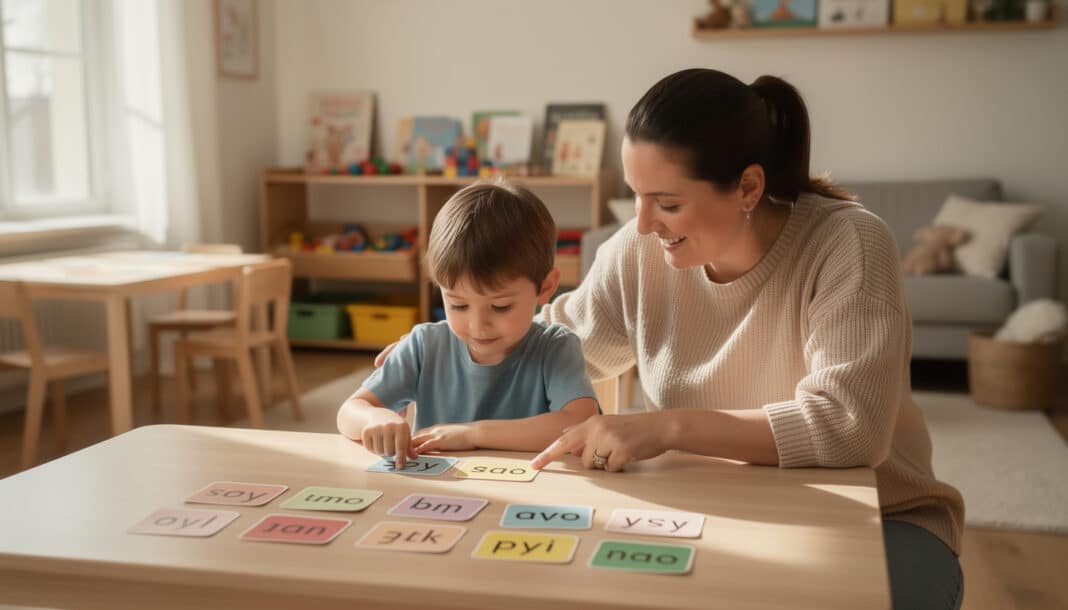
In short — The syllabic method remains one of the most structured approaches to introduce a child to phonetic reading. Based on the progressive decoding of sounds and syllables, it offers parents a clear and reproducible reading tutorial to use at home. Unlike whole-word methods, it favors understanding the reading mechanism rather than visual memorization. This approach requires patience and regularity, but it builds a solid foundation for durable syllable learning. Children who progress with this method develop reader autonomy and gain confidence when facing unfamiliar texts.
Why the syllabic method remains relevant for learning to read
There is something deeply reassuring in the syllabic method — a certain logic that children grasp quickly. Unlike approaches that require recognizing whole words at first glance, this method breaks the text down into elementary building blocks: sounds, then syllables. It's a bit like assembling the pages of an old book before binding it; each step makes sense, each gesture prepares the next.
Research in cognitive psychology shows that this gradual progression strengthens the child's brain ability to make connections between graphemes (letters) and phonemes (sounds). A child who masters this system will never be helpless in front of an unknown word — they will have the tools to decode it themselves. It's a form of valuable autonomy, often forgotten in our era of automatic recognition.
The foundations of the syllabic method: a progressive and structured learning
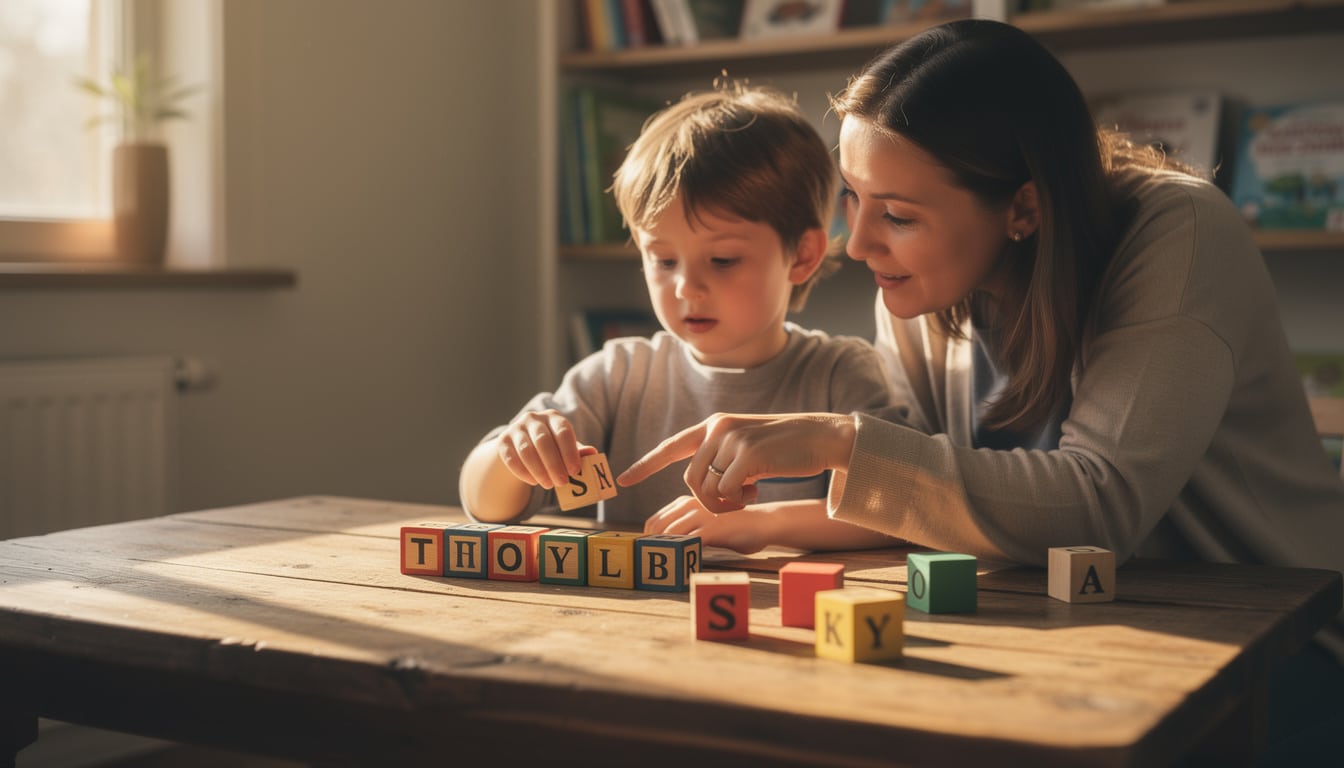
Understanding how the syllabic method works begins by accepting a simple truth: you cannot learn to read without first learning the sounds. It's the foundation, the equivalent of quality paper before binding. Children begin by identifying the individual sounds of consonants and vowels, then learn to combine them.
This progression generally follows a logical order. One starts with simple vowels (a, e, i, o, u), then consonants easy to pronounce (m, l, n, p, t). Next, children learn to assemble these sounds into basic syllables: ma, me, mi, mu ; la, le, li, lu. Gradually, complexity increases — doubled consonants, complex sounds like « ch », « on », « an ».
The progression of sounds and the first syllables
The first weeks of reading support aim to solidify this phonetic base. A parent who accompanies their child can use flashcards with a single letter, then move on to two letters forming a syllable. The important thing is regularity: ten to fifteen minutes per day, in a calm atmosphere, without pressure.
Some children progress quickly and can move to more complex syllables in a few weeks. Others need more repetition and practice. This variability is natural — it does not reflect a lack of ability, but simply each child's individual pace. Respecting that pace honors the child in their uniqueness.
The transition to the first words and the first readings
Once syllables become fluent, the child can assemble their first words. These first steps — reading « mom », « dad », « cat » — generate remarkable pride. It's the moment when something shifts in the child's mind: they understand that this play of sounds and letters can really mean things they know.
The first texts should remain simple, with words without orthographic traps, illustrations to support comprehension. Gradually, length and complexity increase, but always with kindness.
How to implement the syllabic method at home
Parental guidance requires a simple but thoughtful preparation. Creating a space dedicated to the child's reading, without digital distractions, with soft light, makes all the difference. It's not about recreating a school, but rather a moment of shared intimacy around language.
Prepare materials and the learning environment
Materials can be very simple: cards with letters, images, small adapted books. Some parents find it useful to print pages of syllables to combine, others prefer to use existing resources. The essential thing is that the material is visually engaging without being overwhelming.
The physical environment matters too. A table at the child's height, a comfortable chair, a clock that does not display a stressful deadline — these small details create a setting where learning can happen naturally, like the steady stitching of a bookbinder who weaves the pages without haste.
Progressive and encouraging teaching techniques
Begin each session by reviewing known sounds. This step reinforces confidence and creates a stable base for new items. Then present one or two new sounds maximum. Too much new information at once creates a cognitive overload that children recover from with difficulty.
Encouragement should be sincere and specific. Instead of saying « bravo, c'est bien », it's better to say « you combined the sound ‘ch' with ‘at' well to make ‘cat' ». This encouragement values effort and the process, not just the result. It's a nuance that profoundly changes the child's relationship to learning.
Create regular and playful practice moments
Regularity takes precedence over intensity. Fifteen minutes each day produces better results than an hour at the end of the week. These moments can be integrated naturally into daily life — by looking for sounds on street signs, by playing at forming words with letters from a board game, by reading stories together.
Play is a powerful ally. Turning learning into riddles, syllable races, word hunts keeps enthusiasm alive. Children learn better when they have fun, when they don't feel forced.
Common challenges and how to overcome them
Every parent who undertakes to support their child in home education will encounter moments of frustration. A child who refuses to progress, who confuses sounds, who loses patience — these situations are normal, almost inevitable. They do not signal failure, but rather the existence of points that require adjustment.
When progress seems to stall
Some children get stuck on certain sounds or combinations. A child may master the « m » but stumble over the « r ». This is often because the sound is harder to pronounce or to distinguish auditorily. The solution is not to intensify pressure, but to step back, perhaps wait one or two weeks, then resume with listening exercises.
There is also a question of age and neurological maturation. A three-and-a-half-year-old child who begins to recognize letters will not have the same pace as a six-year-old. This variation is not a problem to solve, but a reality to accept with serenity.
Managing impatience and maintaining motivation
Impatience often comes from the parent more than the child. We live in an era where everything must go fast, where immediate results are expected. Yet learning to read is a process that stretches over several months, sometimes longer. Accepting this natural pace requires a certain mental deceleration.
When motivation drops, it's a signal that something must change — perhaps the materials, the time of day, the pedagogical approach. Listening to that signal rather than forcing shows the child that their emotions matter.
Beyond the first readings : consolidate learning and develop the pleasure of reading
Once the fundamentals are in place, the stakes change. It's no longer just about decoding, but about creating a positive relationship with reading, making it a source of pleasure and discovery. This is the moment when technical learning turns into a love of books.
Progress towards more complex texts
Books for beginner readers are a valuable bridge. They respect the constraints of the syllabic method (controlled vocabulary, short sentences) while telling engaging stories. Reading then becomes an act of meaning, not just a decoding exercise.
At this stage, the child may also begin to encounter irregular words, exceptions to the rules they have learned. It's a delicate step: you should show them that even rules have exceptions, that this is part of the richness of language. Gradually, the brain creates automatisms to recognize common words without going through syllabic decoding.
Integrate reading into the child's life
True success is measured when a child asks to read, when they look for a book to understand something that interests them. At that moment, the syllabic method has done its job — it has created the tools necessary for the child to become an autonomous and fulfilled reader. The rest depends on what we offer them to read, the role models we propose, the value we give to reading in our own lives.
Profil de l'auteur
Derniers articles
 Smartphones & Mobile Phones14 October 2026The loyalty penalty on your mobile bill: why staying put costs you more
- Family, Babies & Children5 October 2026Airline family seating fees: what the planned ban will change for parents
- Everyday Life & Society23 September 2026Consumer confidence index: what the monthly mood check on British households really measures
- Agency, Webmarketing & SEO31 August 2026SEO : a Google bug skews visibility statistics in AI results




Table of Contents