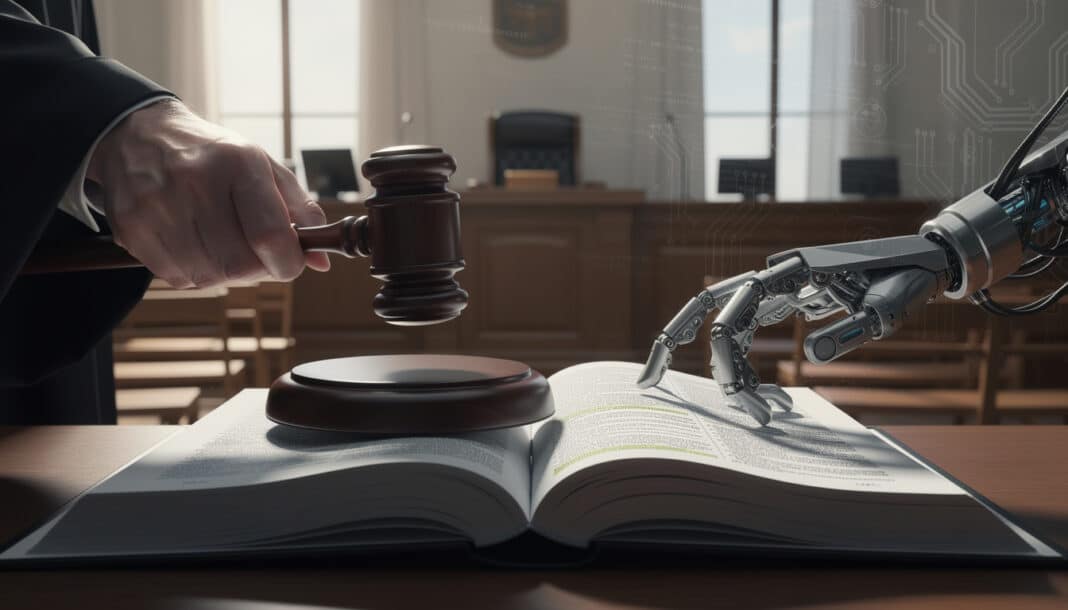
In short: Far from signing the death warrant of copyright, generative artificial intelligence is provoking its greatest mutation since Beaumarchais. Algorithm-generated content raises an existential question: does value lie in the copy or in the origin? As infinite abundance erases the economics of scarcity, copyright is reinventing itself as a guarantor of human authenticity, a protector of singularity against digital simulacra. From lawsuits to emerging legislation, a new legal architecture is taking shape — that of a “cognitive rent” where creators and platforms negotiate the price of knowledge. The question is no longer whether copyright will survive, but what it must now protect.
🎨 When the machine copies better than the original: the end of the economy of scarcity
For centuries, copyright has functioned like a vigilant gatekeeper. Its role? To prevent the unauthorized reproduction of works precisely because copying was costly, required time and resources. A book had to be recomposed by hand. A record had to be re-recorded. Each copy was a commercial rarity, a tangible economic stake.
Artificial intelligence has shattered this paradigm in a few years. Generating an image, a poem or music now costs only a few cents, or even less. Marginality has given way to dizzying abundance. In a market flooded with generated content that is technically perfect but spiritually empty, the mere act of production tends toward zero in value.
This mutation forces us to revisit the primary question: what does copyright actually protect? The answer can no longer be “the production of the object.” It becomes “the certification of origin.” It's a silent but fundamental shift, comparable to the one handmade bookbinding experienced in the face of the printing press — one no longer pays for the copy, but for the encounter with a human singularity.
📊 From protecting the object to valuing the source
Understanding this evolution requires looking beyond catastrophist rhetoric. Pessimists proclaimed that the machine would kill the author. The reality is more nuanced: it only kills artificial scarcity, which necessarily frees copyright to protect what it should have always protected — the creative act itself.
Where yesterday the law said “don't copy this book,” tomorrow it will have to say “don't dilute my singularity into your models without paying me.” This is the shift from a logic of protecting the object to a logic of valuing the source. An imperceptible move for the distracted jurist, but seismic for the creative ecosystem. This renaissance of copyright in the face of AI deserves to be explored with finesse.
💼 The “cognitive rent”: when AI becomes a client of human creation
Here is a savory paradox: those who assert that regulating access to training data is “suicidal” concede a crucial point. Artificial intelligence needs raw material. It devours oceans of it. And in no market economy is raw material obtained for free.
Oil is traded. Why should human genius, an infinitely rarer and more complex resource, be poured into silicon reservoirs for free?
This is precisely what legislators and judges are beginning to understand. The New York Times' proceedings against OpenAI, the collective licenses signed by press groups, are not nostalgic rear-guard battles. They are the foundations of a new pact: one where intellectual property becomes the central monetary stake of the digital economy.
🔐 Towards a SACEM for creative data
Imagine a mechanism where every time an AI generates content, an infinitesimal fraction of its value automatically flows back to the thousands of creators whose works fed the model — those who taught the machine that syntax, that touch of light, that particular tone.
This is not science fiction. It's the logical trajectory that current legal debates on the protection of AI creations are slowly but surely outlining. A sophisticated collective management where copyright ceases to be a mere prohibitor and becomes a true instrument for value distribution.
Far from being an obstacle to technological progress, it is, on the contrary, what allows human creators to remain shareholders of the machine rather than mere mineral resources.
✨ The lost aura, the aura regained: when originality becomes a luxury
Walter Benjamin, that 20th-century thinker, intuited something prophetic. When a work of art can be reproduced infinitely by mechanical means (photography, cinema), it loses its “aura” — that unique presence, that mark of time and human gesture. Generative artificial intelligence is this ultimate machine, capable of generating the infinite at zero cost.
But here is the delightful paradox: by crushing the value of the copy until it disappears, AI miraculously restores absolute value to what cannot be copied — intention, flesh, lived experience, the assumed human choice.
Tomorrow, when flows of slick, average-pleasing content flood the networks, a work protected by copyright will be a luxury good. Not because it will be rare (it will be rare), but because it will attest to something infinitely more precious: an authentic connection with a verified human subjectivity.
🏷️ The “created by a human” label: a new certificate of authenticity
Moral rights — that branch of copyright law that protects the integrity of the work and the author's authorship — will no longer be a legal curiosity. It will become a seal of certification, an “Appellation d'Origine Contrôlée” label applied to thought itself.
This is also what is taking shape with the labeling obligations the European Union is considering. Indicating that content comes from a generative AI is not a limitation; it is an act of transparency that repositions human content in an arena where everyone knows what they are looking at.
In this context, writing an article without algorithmic assistance, painting a canvas without generative tools, composing music by raw intention — this becomes an act of poetic resistance and, oddly, a form of economic luxury.
⚖️ The ongoing legal adaptation: watermarking, transparency and new responsibilities
The current legal framework is faltering in the face of challenges posed by generative algorithms. Legal exceptions for “text and data mining” remain vague. Compensation mechanisms are rudimentary.
Several instruments are emerging, however, to rebalance the scales. Watermarking — that invisible digital tattoo that marks a work — is becoming mandatory in European regulations. Algorithmic transparency is gradually being imposed: AI developers must declare which data fed their models.
It is a mutation of copyright that climbs the value chain. It no longer protects only the final result (the finished work), but the original creative act — the input that gave birth to the model.
🌍 The AI Act and its limits: incomplete but significant legislation
The European Union adopted in 2024 a regulation on artificial intelligence that marks a historic step. This AI Act classifies systems according to their risk level and imposes transparency obligations. Generative AIs must now inform users when content has been created by a machine.
Yet — and this is symptomatic — this monumental text remains silent on the central question of copyright applied to generated content. The legal void persists regarding ownership of rights, the remuneration of creators whose works fed the training, and the very notion of originality in the face of algorithms.
The legal challenges for creators and businesses require increased vigilance in the face of these regulatory gaps.
📜 The legal responsibility of creators: what you need to know today
If the law reinvents itself, creators and companies must anticipate. Using an AI to produce content for commercial purposes does not automatically confer any copyright simply because a prompt was entered. Case law confirms it: only a substantial human creative intervention can justify protection.
This means that if you generate an image via Midjourney and resell it without further modification, you expose yourself to claims. The risk of algorithmic plagiarism exists: your generated content could look exactly like someone else's, creating endless litigation.
Worse still, if the AI was trained on protected works without consent — which is the standard practice — you potentially become complicit in an intellectual property infringement.
🛡️ Best practices to secure your creative use of AI
Meticulously document your creative process. Keep your prompts, iterations, and substantial edits. This will constitute proof of your human contribution in case of dispute. It's like keeping an artist's notebook, but in digital format.
Check the terms of use of each AI service. Some grant commercial rights only to paid accounts. Others reserve the right to use your creations to refine their models — which could violate your license if you work for clients.
Finally, explicitly state that your creations must not be used to train future AIs. European Directive 2019/790 allows you to do this: it's the opt-out. Amend your general terms, add restrictive metadata to your files, configure your robots.txt.
🔍 When your own creations feed models: the right to refuse
The reverse problem deserves attention: your works, your articles, your illustrations have probably already been sucked up by AI crawlers to feed training models. You gave no authorization. You received no compensation.
Legally, your remedies are limited. Courts and legislators still hesitate to rule. Bringing an action is costly and the outcome is unpredictable. The legal prospects for generated works are evolving, but slowly.
Hence the importance of defending yourself proactively. You have the right to say no today, even if you could do nothing about what happened yesterday.
🚫 Implement a genuine, effective opt-out
Add an explicit clause to your terms and conditions stating that your content cannot be used for AI training. Insert tags in the metadata of your files (images, videos, texts) to signal this prohibition in a machine-readable way.
Configure your robots.txt file to selectively block access to AI crawlers on certain sections of your site. Some responsible systems respect these indications. Others ignore them, but you will at least have established a legal record of your intent.
Understand this well: this refusal applies only to future training. Yesterday's remain out of reach, which underscores the importance of reacting now rather than tomorrow.
🎯 Between rebirth and transformation: the real debate we must have
Saying that copyright is being reborn under the impact of artificial intelligence may seem optimistic, almost naive. But it's an interpretation that deserves to be taken seriously, not out of naivety, but out of lucidity.
The real question is not whether copyright will survive — it will survive, it is an institution too deeply rooted to disappear. The question is: in transforming, will it truly protect human creation, or will it become a mere legal instrument accompanying the progressive marginalization of authors?
Two futures are possible. One where copyright becomes a true bargaining power for creators, guaranteeing legal protection and fair remuneration. The other where it becomes a form of legal fiction, a nominal protection devoid of real economic substance.
🧵 Preserving the human essence in a world of algorithms
What is at stake is the place we want to reserve for human subjectivity in an economy dominated by statistical objectivity. AI does not dream. It does not suffer. It has no embodied memory, no embodied point of view.
And that is precisely what copyright can protect tomorrow: not “creation” as a technical act, but human creation as an act of resistance, of intention, of taking a position in the world. The analysis of copyright in the face of generative AI continues to reveal these underlying stakes.
In this sense, AI forces the law to become smarter, subtler, more capable of discerning between utilitarian production (what can well be handed over to machines) and true creation (what engages a worldview).
It's long, meticulous work, not very sexy. Like hand bookbinding when rotary presses were already running. But that work, that art of protecting the fragile against automation, may be the most noble thing copyright can accomplish in the century of algorithms.
Profil de l'auteur
Derniers articles
 Smartphones & Mobile Phones14 October 2026The loyalty penalty on your mobile bill: why staying put costs you more
- Family, Babies & Children5 October 2026Airline family seating fees: what the planned ban will change for parents
- Everyday Life & Society23 September 2026Consumer confidence index: what the monthly mood check on British households really measures
- Agency, Webmarketing & SEO31 August 2026SEO : a Google bug skews visibility statistics in AI results




Table of Contents