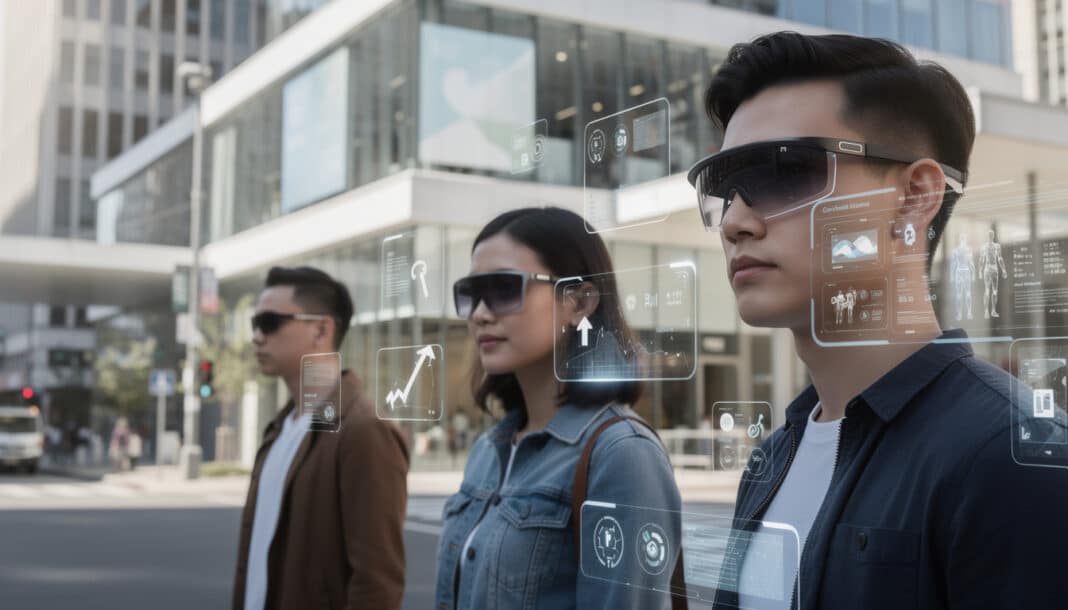
📱 In short : Ten years after the failure of Google Glass, Google is returning to the augmented reality market with an ambitious project. The new connected glasses, powered by Android XR and the Gemini AI, promise an unprecedented immersive experience: real-time translation, contextual memory, intelligent display. Unlike its previous attempts, Google is this time betting on a strategic partnership with Samsung and other manufacturers to conquer this promising sector. The first commercial models are expected in 2025.
🥽 Augmented reality: from a forgotten dream to a digital resurrection
Ten years ago, Google Glass embodied the promise of a future where technology would mirror our everyday gestures. Those thin frames with a holographic display aroused fascination and anxiety in equal measure. Then, silence. Oblivion. Like a poorly glued binding that gradually comes loose from the pages, the project collapsed, a victim of its own optimism and the visceral fears it raised.
Today, this story could see an unexpected epilogue. Google, accompanied by Samsung, is reopening the doors to a universe long considered dead. But this return is not a mere resurrection: it is a metamorphosis. The new connected glasses integrate an intelligence capable of understanding the world, translating it, remembering it. The path traveled in a decade reminds us that some ideas, even when they fail, carry the seeds of future innovations.
🔄 From Google Glass to immersive interfaces: the evolution of a vision
The first connected glasses of 2013 resembled technological curiosities: a small screen, a camera, a few basic features. Their major flaw? They posed a question no one had asked: did we really want that? The unease was visceral, expressed by the term circulating at the time: “Glassholes,” users perceived as intrusive, threatening others' privacy.
The fear was legitimate. Filming discreetly without consent, recording conversations: those glasses revealed an uncomfortable truth about our technological aspirations. They forced the question of whether each innovation was progress or simply a new form of surveillance. It's a bit like bookbinding: you can bind the pages firmly, but if the result stifles the reader rather than serves them, the gesture is meaningless.
Today, Google has listened. Google Glass return with a radically different approach, where wearable technology is quieter and smarter. The Gemini AI records only a few minutes of video feed, not a complete trace. It's an effort to find a balance, a harmony between capabilities and ethics.
💡 What the new connected glasses truly promise
Imagine sitting in a restaurant in Beijing, facing a menu in Chinese characters. You look up, and without gesture, without effort: the text appears in English in your field of view. Later, someone speaks to you in Mandarin. Their words instantly become subtitles. It's alluring, almost magical.
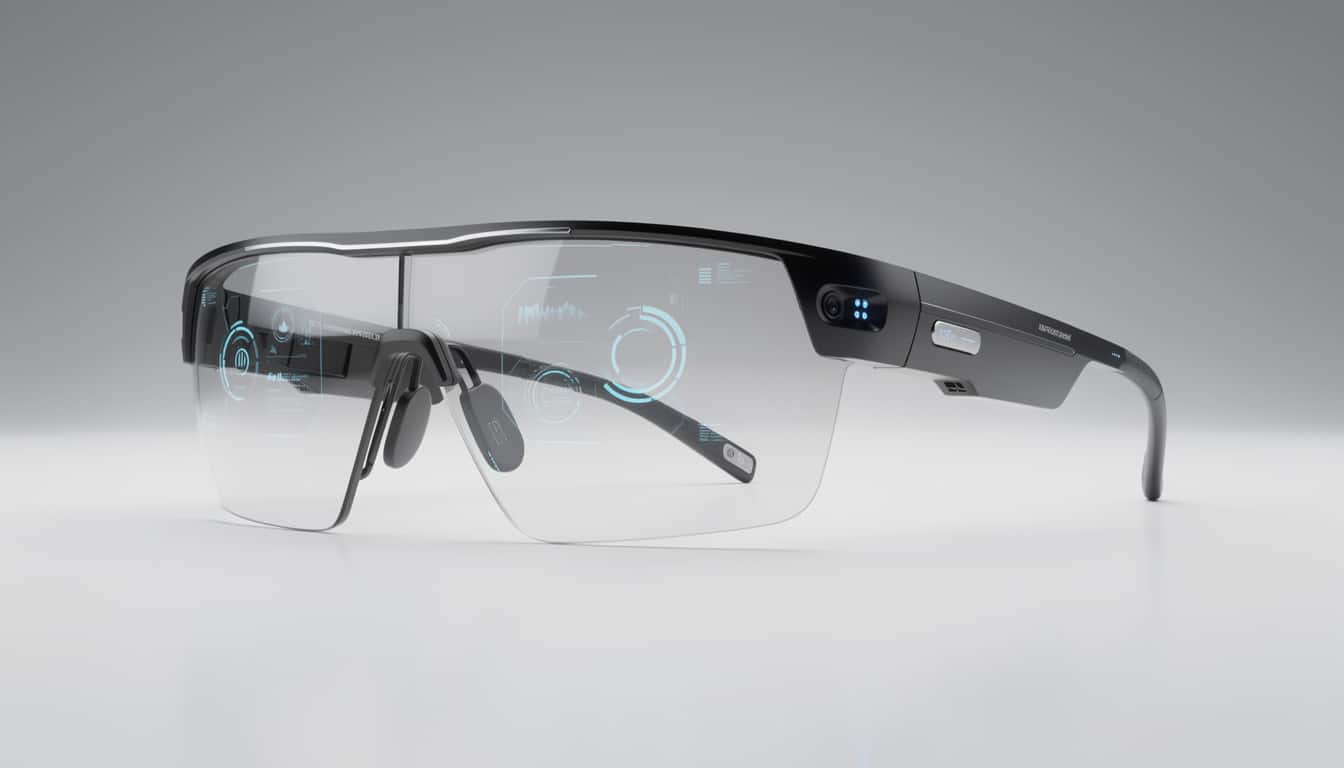
This smart vision relies on several converging technologies. The glasses are equipped with two discreet cameras housed at the corners of the lenses, a microphone and speakers integrated into the temples. But the key element Google added, absent from Meta's glasses, is an internal mini projector allowing information to be displayed directly on the lenses, without turning the user into a walking screen.
🎯 Use cases that change the game
One of the major innovations concerns contextual memory. After leaving that restaurant, you can ask your glasses: “What was the price of the roast duck?” or “What color was the tablecloth?” They will answer, drawing from their digital memories of the last few minutes. It's an assistant that accompanies your fragile memory, filling the gaps of everyday forgetfulness.
This capability fundamentally transforms how we interact with the world. Imagine an archaeologist excavating ruins with these glasses, capturing and analyzing architectural details in real time. A simultaneous translator would converse naturally with speakers from around the world, language barriers reduced to background noise. Google's Project Aura aims to offer the best of augmented and virtual reality, abolishing the boundaries between physical and digital worlds.
🔐 The shadow of privacy: always present
Yet a shadow hangs over it. Google assures that only ten minutes of video will be stored. But what happens to those ten minutes? Are they anonymized, encrypted, deleted after a period? The answers remain vague, leaving a discomfort that never entirely disappears. It's the price of convenience: every technological gain implies a form of trust, and trust is a rare commodity in these times of widespread surveillance.
The question becomes less technical than philosophical. Do we accept that a machine observes the world through our eyes, even briefly? Where is the line between helpful assistance and silent intrusion? These questions, raised with the original Google Glass, remain relevant, perhaps even more pressing.
🤝 The partnership strategy: why Google changes its game
The mistake of 2013 was not so much the technology as the strategy. Google wanted to sell its own glasses, impose its vision on a market that was not ready. This time, the Mountain View firm has chosen a different route: not to sell directly, but rather to license its Android XR platform and its technologies to other manufacturers.
Samsung is at the forefront of this partnership, with a dozen other brands awaiting integration. Each manufacturer will be able to design its own look, adapt the device to its identity. Google provides the brain, the others shape the form. It is an implicit recognition that a product is born not just from technology, but also from context, design, and the meaning given to it.
⚙️ Android XR: the invisible foundation
At the heart of this ecosystem lies Android XR, an operating system specifically designed for “extended reality.” Unlike a simple adaptation of mobile Android, this OS has been conceived for immersive interfaces, where the screen is no longer a flat surface but a three-dimensional space that surrounds you.
The native integration of Gemini, Google's conversational AI, allows the glasses to understand context without having to type text. You point at an object, ask a question, and the artificial intelligence responds. It's a radically different paradigm: gesture becomes interface, speech becomes code.
💼 The advantage of manufacturing diversity
By opening its ecosystem, Google avoids the trap of monopoly and aesthetic uniformity. If Samsung creates sleek, premium glasses, another partner could develop more affordable, more accessible models. Wearable technology gains in diversity, richness, and humanity.
It's a lesson bookbinders know well: the same text can be dressed in thousands of different covers, and each changes how the reader approaches it. Google finally understands that innovation does not reside in exclusive ownership, but in the ability to create a common language, a shared grammar.
🚀 The innovation timeline: toward 2025 and beyond
Google did not give a precise date for the commercial launch of partner glasses. However, the firm plans to offer its own models in 2025, in the manner of Pixel phones or Pixel Watch. A gesture of leadership, a proof of concept for its manufacturing partners.
This timing reveals a measured but firm ambition. Ten years after the collapse of Google Glass, Google does not accelerate; it advances cautiously, testing each step. The history of Google Project Glass shows the lessons from that initial failure, transformed into tacit wisdom.
🎓 Luring developers before consumers
The public announcement is above all a call to developers. Google knows that a platform without applications is an empty shell, a beautiful technology without a soul. Creative studios, startups, designers must begin imagining how to exploit these immersive interfaces long before the general public has access to the glasses.
It's a smart strategic turn. By involving creators upstream, Google ensures that the market will be rich in applications at launch, that the user experience will be smooth and engaging. Digital innovation no longer emerges alone; it arises from the entire ecosystem.
📈 The stakes of a market being redrawn
The augmented reality and smart glasses sector will soon become a major front of tech competition. Meta, with its Ray-Ban, is preparing its response. Apple, historically silent, is watching. Microsoft continues its investments in mixed reality. Google reappeared, not as the isolated pioneer of 2013, but as a major player in an ecosystem where multiple visions of the future coexist.
This fragmentation may be healthy. Rather than a single imposed future, we will see multiple paths emerge, several ways of imagining how smart vision integrates into our lives. Some will prefer the lightness of connected Ray-Bans. Others will adopt Samsung's sleek glasses. Others will wait for the technology to mature further.
🌍 Applications that will seem obvious tomorrow
To truly understand the stake, you must project yourself forward. Imagine a tourist in a Paris museum: the glasses deliver the history of each work, translated instantly into their native language. A surgeon in an operating room benefits from augmented assistance, seeing medical images superimposed to guide each gesture. Augmented reality is already reshaping marketing and will soon affect all sectors.
These scenarios are not science fiction. They are the logical applications of a technology that improves perception and access to information. The question is no longer “if,” but “when” and “how.”
🏥 Medicine and professional assistance
Sectors that require precision and expertise will be the first to adopt connected glasses. A dentist operating on a complex patient would benefit from detailed 3D models superimposed on reality. An electrician accessing installation diagrams instantly, without taking their eyes off the circuit in front of them. An architect visualizing a future building on an empty lot.
The user experience is enriched by a permanent, contextual, and non-intrusive information layer. Work becomes more efficient, more precise, less mentally tiring.
🌐 Education and knowledge transmission
In classrooms or artisan workshops, glasses could transform the transmission of knowledge. Imagine a master craftsman mentally guiding an apprentice through the complex gestures of a traditional trade. The glasses would display the steps, the angles, the necessary details. Know-how, often implicit and hard to transfer, would become visible and reproducible.
It's paradoxical: the most futuristic technology could revive traditions, make accessible the knowledge that slept in the hands of the elders. A bridge between yesterday and tomorrow, woven by augmented light.
🛍️ Commerce and immersive discovery
Online commerce would be reborn in a new form. Virtually trying on an eyeglass frame before buying, visualizing how a piece of furniture fits in your living room, discovering the ingredients of a product by scanning its packaging: interactions would become fluid and natural. The space between digital and physical would collapse, or rather unite.
🧵 Reflections on the essence: technology and humanity
What strikes in this trajectory is the constant tension between promise and ethics. Connected glasses embody a sincere technological utopia: improve perception, democratize access to knowledge, abolish barriers. But they also carry risks: surveillance, informational addiction, the erosion of moments of authenticity.
Google, through its measured silence and partnership strategy, seems to have integrated this tension. It does not come as a messiah promising to save the world. It offers a tool, imperfect, laden with responsibilities, to be adapted according to the contexts and values of those who wield it.
When gluing together the pages of the future, one always wonders: will what we stick together really hold? Will it serve the reader or smother them? For the connected glasses of tomorrow, the answer will depend less on technology than on the wisdom with which we integrate it into our lives. It is up to us, then, to learn the right gestures.
Profil de l'auteur
Derniers articles
 Everyday Life & Society23 September 2026Consumer confidence index: what the monthly mood check on British households really measures
- Agency, Webmarketing & SEO31 August 2026SEO : a Google bug skews visibility statistics in AI results
- Tech & Multimedia29 August 2026Earbuds that transcribe your meetings without a smartphone : how Plaud One changes things
- Home Appliances & Equipment28 August 2026Home appliances: the durability index extends to four new appliances




Table of Contents