
📱 In short — Generative artificial intelligence is profoundly reshaping the professional landscape of marketing and creative occupations. Between the accelerated automation of repetitive tasks and the emergence of new skill requirements, professionals face a transformation that is neither a simple threat nor a panacea, but rather a pivotal moment where collective choices will determine whether this technology becomes liberating or alienating. Data show that 31 % of TPE-PME had adopted generative AI by the end of 2024, while a majority of companies remain in a cautious experimentation phase. What is even more striking: employees often take the tools into their own hands well before formal directives from their employer, a phenomenon referred to as “shadow GPT” that reveals a gap between managerial fears and on-the-ground practices.
📌 Key points to remember — Technology replaces tasks, rarely entire jobs: in 19 out of 20 jobs, there remain activities that AI does not master. Administrative and commercial roles are experiencing the most visible transformations, while women and recent graduates are more exposed to the risks of deskilling. Social dialogue is still largely absent from companies: fewer than one agreement in a thousand mentioned AI in 2017. Finally, AI projects have a failure rate exceeding 50%, often due to the lack of real involvement of frontline professionals from the design phase.
🎯 When generative AI redraws the contours of creative work
There is something strangely paradoxical about watching technology seize the gestures we thought were the most human. In a bookbinding workshop, some finishing tasks require tactile sensitivity, an almost poetic reading of the material that escapes any automatism. It is this same intuition that creatives fear or hope to see amplified by generative AI tools.
Since November 2022 and the public arrival of ChatGPT, estimates have swung wildly: Goldman Sachs spoke of 300 million jobs potentially at risk worldwide in March 2023, while McKinsey estimated that more than 30% of working hours in Europe and the United States could be automated by 2030. These raw figures terrify until they are contextualized. Because what emerges from real surveys conducted in French companies paints a more nuanced picture: AI replaces tasks, not jobs. The Commission on Artificial Intelligence reminded in March 2024 that only 5% of jobs in France would be directly replaceable.
But this statistical stability hides real turbulence. Creative and marketing professions are becoming zones of friction: generation of textual content (68% of TPE-PME users), visual creation, social data analysis. These areas, once reserved for human expertise, turn into grounds where the tool proposes and the professional adjudicates or refines.
💡 Does automating repetitive tasks really free creative time?
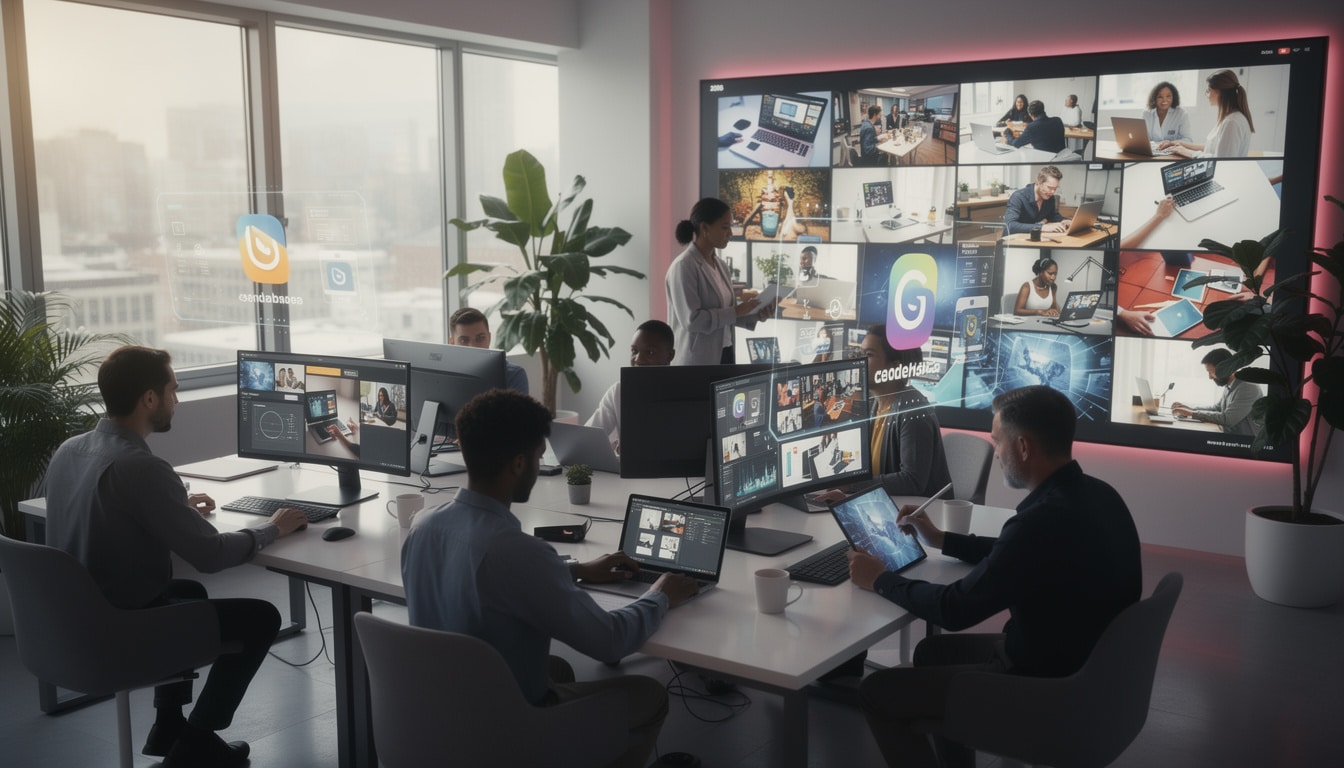
Imagine a marketing copywriter who previously spent 4 hours a week writing standardized product descriptions. With generative AI, that work shrinks to 30 minutes of supervision and adjustment. In theory, 3 hours and 30 minutes of creative freedom regained. In practice, organizations that adopt these tools for administrative management and marketing often observe a reduction in positions in intermediate professions, suggesting that productivity gains do not systematically translate into amplified creativity.
What is at stake is a tension between two logics: that of the manager (optimize processes, reduce errors, increase productivity) and that of the creative in real situations (preserve autonomy, give meaning to their action, maintain responsibility for the work produced). When this tension is not explicitly addressed through social dialogue, a risk of alienation emerges: the professional becomes a controller of a tool rather than a creator in power.
Research-action laboratory LaborIA‘s data reveals precisely this pitfall: one in two AI projects fails in companies due to the lack of real involvement of affected teams from the design phase. It is not AI that fails technically; it is the absence of compromise between rationalities that generates disengagement and then abandonment.
📊 Marketing professions facing a silent revolution
In hair salons as in creative agencies, a discreet phenomenon is occurring: employees secretly test generative AI tools, tinker with prompts, optimize processes without waiting for official approval. This is the “shadow GPT” researchers talk about — an invisible appropriation showing that employees sense the opportunity even before their employer formulates a strategy.
A global 2023 survey of over 14,000 employees showed that 28% used generative AI at work, more than half of them without formal approval. For digital marketing roles in particular, this statistic likely approaches 40–50%, as the tools lend themselves naturally to content creation, social media data analysis and message personalization.
Yet business leaders remain hesitant. An Adecco Group study (2024) revealed that 57% of company leaders doubted their management team's ability to grasp the risks and opportunities of AI. Only 34% planned to train their employees on these tools; 66% preferred to recruit external experts rather than build internal skills.
🚀 Personalized content creation and targeted advertising: the new standard
Generative AI excels in three areas particularly prized in marketing: production of optimized written content (emails, landing pages, ads), quick extraction and synthesis of customer data, generation of images and videos in varied styles. What used to take two days of creative iteration now takes a few hours, including revisions and contextual adjustments.
But beware: these gains are best interrogated collectively. According to the Terra Nova report on generative AI, the conditions under which this technology becomes a lever for improvement rather than precarity depend closely on the social dialogue put in place. Lack of training, unclear usage policies, concerns about intellectual property of generated content: all factors that can turn a liberating tool into a source of stress and uncertainty.
For agencies and marketing teams in particular, the challenge is to redefine the value delivered. If AI automates basic production, what about strategy? Deep customer knowledge? Creative risk-taking? These questions should shape a new definition of key skills: less routine writing, more strategic direction, data storytelling, and ethical decision-making about what to automate and what to keep human.
🎨 Visual creation, image and video: where does AI stop and the artist begin
How many times have you seen an image generated in seconds by DALL·E or Midjourney, technically perfect, composition balanced, and yet… lacking that spark, that intention, that rupture that inhabits a truly thought-through creation? Generative AI has crossed an impressive technological threshold. But it also reveals, by contrast, what we truly admire in creation: the mark of sensitivity, the trace of an assumed choice.
For visual creation professions — graphic design, illustration, commercial photography — the impact occurs in two movements. First, a commodification of part of the work: generating 20 variants of banners to test with an audience accelerates exponentially. Then, a redefinition of valued skills: those who master not only the software but also the prompt and the machine's creative direction will emerge as indispensable.
The impact of AI on creative professions is therefore not reduced to a binary substitution. It is a transformation of the relationship to the tool, to intention, to responsibility. The creative becomes a director, a creative director assisted by a powerful cognitive machine devoid of intentionality.
⚖️ Ethical and reliability challenges of algorithmic creation
Every powerful tool carries proportional risks. For generative AI applied to creation, three major shadows emerge: the reliability of produced content, the unconscious reflection of biases present in training data, and the potential usurpation of creators' copyrights whose works fed the models.
An AI-generated email can contain subtle inaccuracies imperceptible on a quick read. An image created to illustrate an inclusive product can reproduce, amplified by the algorithm, gender or appearance stereotypes present in the training corpus. An award-winning design can inadvertently incorporate motifs too close to a preexisting creation. These risks do not disqualify the tool; they demand methodical vigilance and shared responsibility.
Hence the urgency of a co-constructed ethical framework. CESE pointed out in 2024 nine essential axes of social dialogue: clarity on introduction procedures, consequences for job content, impact on work organization, physical and mental health, bias prevention, sharing productivity gains, data protection, environmental impact and access for TPE-PME to the technology.
🔄 Reskilling and skill evolution: anticipate rather than endure
Let's connect this moment to a broader question: how can professionals not only survive this transformation but derive real uplift from it? Data suggests two trajectories: the unfortunate one, where AI automates and employment declines; and the more promising one, where it frees up time for higher value-added activities.
Companies that adopt AI generally see net job creation, according to the INSEE survey cited by the Commission on Artificial Intelligence. But these jobs are not for everyone. Some sectors experience net employment declines that must be supported by public authorities. Others see the emergence of new roles: AI manager, data labeler, prompt engineer, head of ethical quality for generated content.
This shift crucially depends on companies' ability to invest in training. Yet, the transformations of professions and new skill needs are advancing faster than classic development programs. How to bridge this gap? By involving employees in the very design of changes, from the outset.
🎓 Train or recruit: the leaders' dilemma
Faced with the disruptive arrival of generative AI, companies mostly choose the quick solution: recruit an external expert. 66% of French leaders plan to recruit externally in response to this revolution, compared with only 51% who favor internal retraining of affected employees. It's an understandable but risky choice.
Why? Because real appropriation of the technology requires deep knowledge of professions, data, and the risks specific to each context. An external expert can provide direction, but it is frontline employees who must translate, adapt and improvise in contact with reality. Without simultaneous internal training, AI remains an external object to be suffered rather than mastered.
The most mature organizations on this subject adopt a hybrid approach: recruit yes, but also train continuously. And above all, establish regular spaces for dialogue where the implications of AI on real work are debated, anticipated and adjusted. This is precisely what tools like Dial-IA, developed by IRES and ANACT, offer: sheets, methods, levers to “talk about AI collectively in the company”.
🌐 Generative artificial intelligence and the transformation of digital marketing
The landscape of digital marketing has transformed before our eyes. In 2025, social platforms are flooded with content, fragmented audiences reject standardized advertising, and competition sharpens daily. In this creative chaos, generative AI has appeared as a promising crutch: produce faster, test more variants, personalize at the scale of millions of profiles.
Except the tool does not think: it recombines. The art of digital marketing remains elsewhere — in understanding hidden motivations, in the ability to anticipate trends, in the courage to break established codes. AI excels at reproducing patterns; it struggles to invent ruptures. Truly new things in marketing remain matters of intuition, listening and creative risk-taking.
The most effective marketing teams in 2026 are those that have grasped this nuance: use AI to accelerate hypothesis execution, free cognitive time for strategy, test quickly, learn and iterate. Not waiting for AI to “do” marketing, but deploying it as an amplifier of human intuitions.
📈 Data analysis and customer insights amplified by AI
One of the most tangible and high-performing uses of generative AI in marketing is the extraction and synthesis of insights from vast corpora of behavioral data. Where a human would have spent days digging through reports, AI condenses significant patterns in minutes: which customer segment responds to emotional versus rational appeals, which time of day a message converts more, which content generates maximal organic engagement.
57% of TPE-PME that adopted generative AI use it precisely for research, collection and analysis of data or information. This allows small teams to rivet the performance of much larger structures equipped with dedicated data scientists. The technological equalization effect is real and desirable.
But beware: generative AI also presents a risk of misplaced confidence. It can be confidently wrong, weaving plausible but erroneous narratives from insufficient or noisy data. Outsourcing strategic analysis entirely to the tool is to equip oneself with a compass whose manufacturing biases are unknown. A healthy approach remains hybrid: let AI accelerate, synthesize, propose; keep human judgment critical, skeptical and responsible for decisions.
🛡️ Governance and social dialogue: build AI together rather than endure it
Here is a finding that should concern every company leader: between 2018 and 2023, the proportion of company agreements mentioning AI increased by 2.5 times. That said, this also means that in 2023 fewer than one agreement in a thousand addressed AI. Social dialogue on this technology remains almost nonexistent in the vast majority of organizations.
This is serious for a simple reason: decisions made today — on the introduction of a tool, its configuration, redistributed roles, and valued skills — will largely determine whether AI becomes a lever to improve working conditions or a driver of intensification and deskilling. These are not technical questions that only engineers can decide. They are collective, political and ethical choices.
CESE is precisely calling to “co-construct a new social dialogue” upstream of any deployment. Not an information note to the works council at the time of launch, but a true negotiation on expected impacts, anticipated risks, shared benefits and necessary protections.
🔑 Nine pillars for a meaningful technological social dialogue
Clarity on the approach. Every introduction of AI in a profession or service must be transparent: why this change? What results are expected? What impacts on jobs? The risks of biases amplified by AI — gender, disability, appearance, skills — must be explicitly documented and debated.
Transformation of job content and training. Which tasks will be entrusted to AI? Which tasks become more complex or shift? Which new skills prove indispensable? These questions require structured and continuous training, not a simple memo.
Organization of work and time. AI changes not only what we do but also how we do it and for how long. A collective reflection on organization, schedules and rhythms is necessary. AI can become a source of cognitive overload and stress if not accompanied by a reorganization of work.
Physical and mental health. Risk of work intensification, stress linked to algorithmic surveillance, loss of meaning if humans become passive controllers of machines. These issues must be monitored and addressed collectively.
Sharing the value created. If AI generates significant productivity gains, how are they distributed? More pay, fewer hours, more training time, new benefits? This question is rarely asked; it should be systematic in negotiations.
Data protection and outsourcing. Personal megadata, intellectual property, confidentiality: who has access to what? Deploy AI externally or internally? Major risks to make explicit and govern.
Environmental impact. Training AI models consumes enormous amounts of energy. This impact must be part of the debate.
Access for TPE-PME. Only 31% of small businesses were using generative AI at the end of 2024, due to costs and complexity. How to democratize access to these technologies without widening inequalities?
Joint observatories of effects. Determine together, regularly, which jobs are transforming, which are declining or under strain, and how to adjust career paths and training to support employees.
📍 Where do we really stand in 2026?
A striking contrast emerges between technological rhetoric and on-the-ground reality. The media announce a revolution; companies experiment cautiously. Employees adopt tools in secret; leaders remain hesitant about net benefits. According to PwC's analysis on AI and employment, the real transformation will only accelerate in the months to come.
For marketing and creative professions, the present moment is reminiscent of what the publishing industry experienced in the 15th century with the printing press. The tool revolutionizes the relationship to production, not the meaning of work. Scribes had to retrain; publishers emerged as new professions. Manuscript illuminators lost part of their market; modern illustrators created others. No prediction was exactly verified. What prevailed was the capacity to learn, adapt and redefine one’s value in a transformed context.
That is where we are in 2026. Not at the end of a transition, but at its beginning. Everything will depend on the quality of the social dialogue we can establish, the training we invest in, the generosity with which we share the benefits, and the ethical vigilance with which we scrutinize where the human remains irreplaceable — and where it must not be.
Profil de l'auteur
Derniers articles
 Smartphones & Mobile Phones14 October 2026The loyalty penalty on your mobile bill: why staying put costs you more
- Family, Babies & Children5 October 2026Airline family seating fees: what the planned ban will change for parents
- Everyday Life & Society23 September 2026Consumer confidence index: what the monthly mood check on British households really measures
- Agency, Webmarketing & SEO31 August 2026SEO : a Google bug skews visibility statistics in AI results




Table of Contents