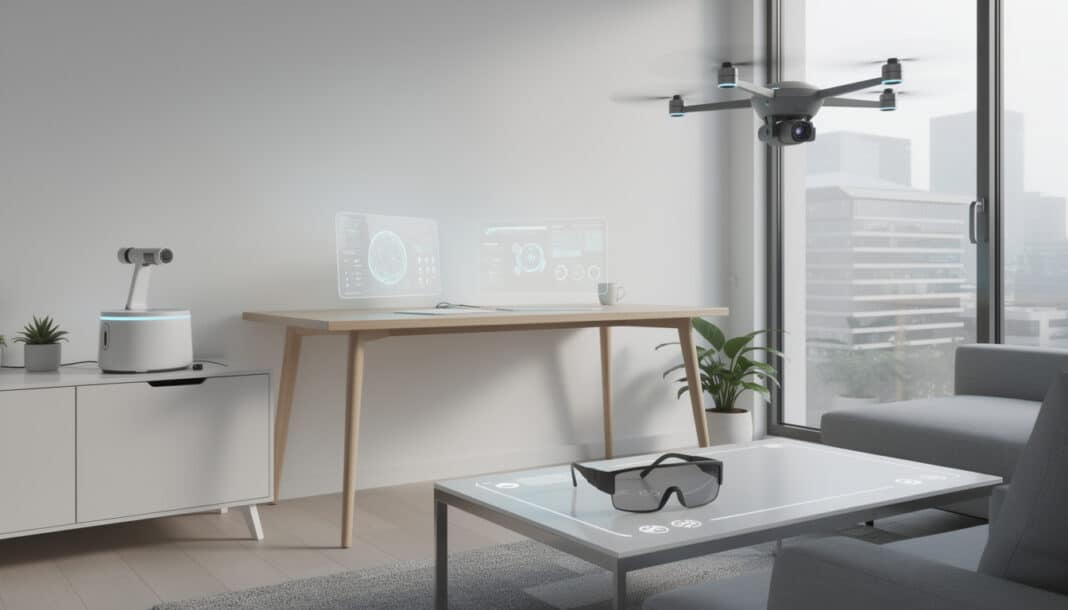
Summary — As screens shine with technological promises, remarkable innovations sleep in our drawers, little known or deliberately ignored. Artificial intelligence, augmented reality, connected objects and many other emerging technologies are already within our reach, yet we continue to live as before. This gap between the possible and the used deserves attention, by linking these advances to everyday gestures, habits that change slowly, and the deeper reasons for this collective inertia.
In short — Artificial intelligence has been simplifying our domestic and medical tasks for years; augmented reality transforms learning and commerce into immersive experiences; connected objects manage our homes without being actively commanded; autonomous cars are reshaping urban mobility; home automation enriches our houses with welcome autonomy; connected health anticipates our health issues; finally, blockchain and advanced robotics provide security and automation. Yet many of us ignore them, judge them too complex, or simply forget they exist.
🔮 Artificial intelligence, that silent companion we don't really listen to
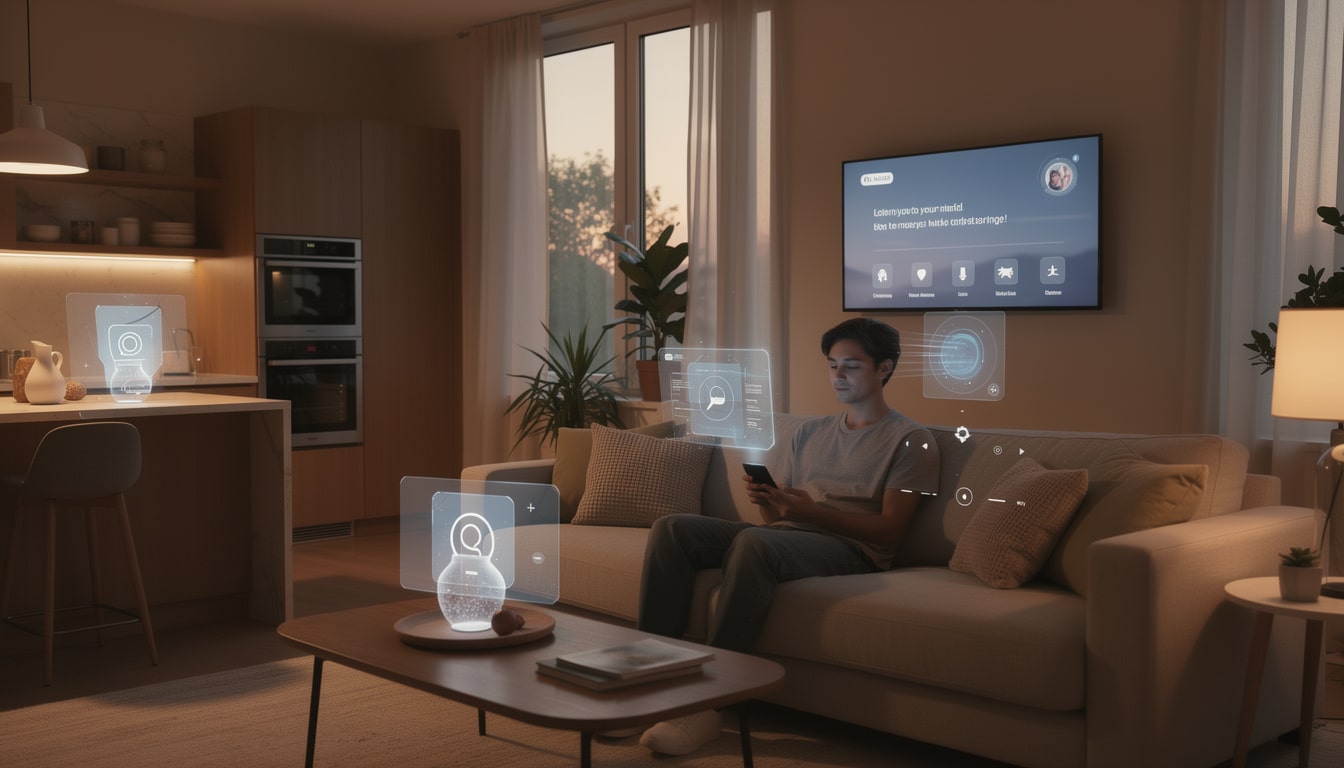
Have you ever noticed how many times your phone anticipates your needs without you having asked it? It's artificial intelligence whispering in the background, orchestrating thousands of microscopic decisions. It powers our voice assistants, analyzes our preferences, predicts our moves. And yet, we treat it like a servant whose capabilities we ignore.
In modern homes, AI manages calendars, offers optimized routes, suggests films tailored to our tastes. It analyzes patterns of our sleep, detects cardiac anomalies on a connected watch, predicts crises before they occur. But how many users really explore these advanced features? Most settle for the bare minimum.
In healthcare, innovation breathes through the pores of algorithms that scrutinize our medical data. Thanks to the emerging technology of machine learning, doctors now have digital assistants that recognize pathologies the human eye might miss. Yet many ignore that this resource exists, free or almost free, a few clicks away. It's like having an entire library in your pocket and preferring to always read the same book.
💡 Why does AI remain unused despite its power?
The answer lies in the gap between what is technically possible and what is humanly adoptable. We remain prisoners of our habits, like the pages of an old book we no longer turn for fear of damaging them. For many, AI looks like a complicated tool that requires long learning curves.
There is also that visceral mistrust: what if AI knows too much about us? This fear, legitimate, slows the massive adoption of technologies designed to simplify our lives. Between control and trust, we oscillate, paralyzed.
🎨 Augmented reality: when the future overlays the present, with no one noticing
Imagine walking through a museum where each painting whispers its story, where sculptures start to dance to tell you their meaning. Augmented reality has allowed that for several years. It enriches the real world with a subtle informational layer, almost invisible to anyone not looking for it. And that's precisely the problem: no one looks for it.
In commerce, customers could try on clothes without putting them on, visualize how a piece of furniture would fit in their living room. Apps exist, performant, even graceful. But ask around how many have really used this feature. You will be surprised by the silence.
Education too lies dormant. Students could manipulate molecules in three dimensions, explore the inside of a volcano, understand human anatomy by observing it from within. Instead, we still project flat videos on flat screens, as if we hadn't progressed for decades.
📱 Unused technologies in education
See the perspectives on pedagogical evolution to grasp how many future technologies are waiting in the wings of schools, ready to transform the relationship to learning.
It's like holding a golden brush in one hand, and continuing to paint with gray water with the other. Augmented reality offers immersive access to knowledge, but we cling to our digital blackboards, out of habit or fear of change.
🏠 Connected objects: a home that thinks, alone in its corner
Your home could be a living organism, able to adjust the temperature before you feel cold, prepare the lighting for your wake-up, secure access before you even ask. The Internet of Things makes this possible, almost commonplace. Discreet sensors monitor, learn, and adapt to your rhythms.
Yet the majority of households remain equipped with dumb thermostats, mechanical locks, lights controlled like in the last century. Connected objects exist, affordable, simple to install. But installation requires courage, curiosity, and the will to relearn your own environment.
There is something almost melancholic in this passive resistance. It's like owning a beautifully architected house but choosing to live only in the living room, leaving the other rooms abandoned. Emerging technologies wait, patient, for us to cross the threshold.
🔐 Invisible security and savings
A well-configured home automation system reduces energy bills by 20 to 30%. It secures your home better than any lock. It optimizes your comfort without intervention. These benefits are real, measurable, documented. Discover how experts envision the sustainable integration of these systems.
But change requires mental time. We prefer known efficiency over promised efficiency. It's the daily tragedy of progress: it waits for us, silent, while we continue our old gestures.
🚗 Autonomous cars: the road revolution nobody asked for
You could let go of the wheel tomorrow. The technology exists. Cars were already driving without drivers in test cities before 2020. It is now 2026, and most daily trips are still made while clutching a wheel like people once clutched the reins of a horse two centuries ago.
Autonomous cars promise increased safety — fewer accidents, because machines do not fall asleep at the wheel, do not look at their phones, do not lose patience. They also promise time: those hours spent driving returned to read, work, or simply breathe. It's an innovation that profoundly changes our relationship to mobility.
And yet we remain tense. Fear of software failure. Fear of losing control, the last bulwark of autonomy against the system. Fear of trusting a machine with our lives. These fears are not irrational, but they freeze us in place, paradoxically immobile in the heart of a technology capable of liberating us.
🌍 Urban mobility and carbon footprint
An autonomous car optimizes its route based on collective traffic, reducing congestion by 40%. It lowers polluting emissions, shares rides, saves fuel. This is not marketing: these are data, studies conducted by the pioneers who observed this transformation.
Yet cities remain congested. City dwellers continue to hunt for parking spaces, lose time in transit, breathe toxic gases. The solution was already rolling beside them, but they did not see it.
💊 Connected health: your body speaks, no one listens
Your watch records your heart rate 1,440 times a day. It detects arrhythmias, anticipates heart attacks, measures blood oxygen with hospital-grade precision. It monitors your sleep and translates its irregularities into alert signals. It's a biological sentinel, invisible on the wrist, that keeps watch.
But how many users actually consult this data? How many have configured alerts? How many even know that these features exist in the device they wear every day? Connected health is here, revolutionary, and we treat it like a step-counting app.
Teleconsultations have become democratized. They allow isolated patients, people with disabilities, residents of remote areas to access quality care without leaving home. It's a major advance for health equity. Yet many still prefer to wait three months to see a doctor rather than try a video consultation.
❤️ Personalized prediction and prevention
The algorithm of a connected watch can detect a heart attack risk before symptoms appear. It allows you to act, to prevent, to live longer and better. It's the age-old dream of medicine: to cure before the disease. And yet, we leave it sleeping in our pockets.
Data generated by these devices also feed medical research, helping scientists understand diseases at a population scale. You could participate in this revolution of medical knowledge simply by wearing your watch and allowing anonymous data sharing. What a silent power.
🔗 Blockchain: encrypted trust we don't understand
Imagine a universal, inviolable ledger where every transaction, every document, every agreement is etched forever, transparent and untouchable. That's blockchain. It revolutionizes financial transactions, secures digital identities, authenticates official documents.
Yet, for 99% of people, blockchain is reduced to cryptocurrencies — a speculative bubble, a playground for traders, a symbol of predatory finance. We forget that beneath these volatile tokens lies a deep technology capable of turning human trust into inviolable code.
It secures connected objects, ensuring your data is not tampered with. It authenticates diplomas, allowing an employer to instantly verify your education without fear of fraud. It enables farmers in developing countries to prove land ownership, receive microcredits, and free themselves from bureaucratic oppression. But these stories remain invisible, subsumed by the noise of crypto speculators.
🛡️ Data security and radical transparency
Every transaction recorded on a blockchain is verifiable, traceable, impossible to deny. It's a safeguard against fraud, corruption, and manipulation. In a world where disinformation thrives, where deepfakes become convincing, where identities are stolen, blockchain offers a foundation of encrypted truth.
But it requires a technical understanding that few possess. It also requires trust in the system, which traditional institutions have never managed to inspire.
🤖 Advanced robotics: the digital hands waiting for their moment
A Dyson robot vacuums your home while you sleep. A robotic arm assists surgeons in delicate operations, with gestures so precise no human hand can rival them. Drones deliver packages, robots clean skyscraper facades, others explore the ruins of collapsed buildings, saving lives.
Advanced robotics is here, active, transforming professions. And yet, we talk about it as a threat. Robots will take our jobs. It's true, in part. But they also create other jobs, free humans from repetitive, dangerous, degrading tasks.
A surgeon equipped with a robotic arm can operate remotely, crossing continents to provide care. Imagine the lives saved, remote regions finally accessible to medical excellence. It's a digital future already tangible, and we let it slip through our fingers out of fear or indifference.
🏥 Precision surgery and medical accessibility
See the groundbreaking advances in laser and robotic surgery to understand how robotics is transforming medicine. Success rates increase, recovery times decrease, access democratizes.
Yet many hospitals still lack these tools, due to budget, training, or simply awareness of their existence. It's a gap between privileged institutions and others, a digital divide at the heart of the healthcare system.
📡 5G and the invisible digital future that surrounds us
5G is not just an improvement over 4G. It's a paradigm shift: near-zero latency, massive bandwidth, the capacity to connect millions of devices simultaneously. It enables what once seemed science fiction: remote surgeries, real-time autonomous cars, networked immersive experiences.
It is being deployed in large cities. You can access it. And yet, how many really use it? How many know what it deeply changes about their lives? Most continue to browse the web at the same speed as before, unaware of this revolution spinning above their heads.
Discover how emerging technologies intertwine to redraw the digital future. 5G is the framework, silent, invisible, omnipresent.
🌐 Connectivity and digital freedoms
With 5G, a child in rural Africa can follow classes from a teacher in Singapore, in real time, without latency, with crystal-clear video quality. It's equality of opportunity redefined by the digital cable. It's also a form of freedom: accessing knowledge without borders.
But this same 5G can monitor, trace, control. It is a double-edged weapon, and we move forward with our eyes closed, accustomed to the compromise between convenience and surveillance that our era quietly imposes on us.
⏰ The paradox of inaction in the face of innovation
Why do we remain thus, frozen, in the face of these technologies that could transform our lives? The question deserves attention, because it says a lot about our values, our relationship to trust, our gradual disinvestment from the future.
First there is the friction of change. Our daily gestures are rituals, well-worn neural paths. Introducing a new technology means relearning everything, losing the efficiency of habit. And then it takes time to adopt, to fumble, to train. We are always in a hurry, always exhausted. The human cost of change seems disproportionate to the promised gains.
There is also the mistrust of progress, justified by our past experiences. Social networks promised connection; they gave us polarization. Mobile apps promised freedom; they gave us incessant notifications. Every technological promise carries the scar of the previous one.
Finally, there is the simple lack of visibility. How many people really know that these technologies exist, that they are accessible, that they work? Marketing is loud for phones, televisions, gadgets. But for true revolutions? A polite silence, as if we were ashamed to sell the future to those still camped in the present.
🎯 Take the time to really understand what is changing
Perhaps we need a reverse movement: not to accelerate adoption, but to slow down enough to really look at what is already there. Like a bookbinder who takes the time to examine each page before sewing it, take the time to feel, test, and understand before integrating.
There are communities, blogs, spaces that patiently detail how to use these unused technologies to improve your life. Not with the screaming tone of marketing, but with the serenity of someone who has explored, tried, verified. Consult resources like this overview of current tools and advances to gently familiarize yourself with what surrounds you.
Each technology, correctly integrated, can become a friend rather than an intrusion. The AI that understands your calendar. The connected object that protects you. Augmented reality that enriches learning. These are not invasions, but invitations to a smoother, more conscious, better-lived life.
🔍 Towards conscious and personalized adoption
The real question is not: why don't we use these technologies? but rather: how do we integrate them in a way that makes sense for us, individually?
Everyone has different needs. An isolated parent will find teleconsultation revolutionary. A person with disabilities will find new autonomy in home automation. A farmer will find in the IoT a fine understanding of their land. A chronic patient will find in connected health a longer, happier life.
The everyday technological innovations are not uniforms imposed from above. They are tools, possibilities, that can be shaped in one's own image.
So perhaps the first gesture is simply to take the time to notice what exists, to read a few articles, watch a demo, put a curious hand on a technology. Not to adopt it immediately, but to know that it exists. For ignorance is also a form of choice, but a poorly informed one.
The future is not built by waiting for it to arrive. It is built by a thousand small decisions, a thousand little acts of curiosity. Perhaps by reading these lines you will recognize a technology that was sleeping in your pocket, waiting only to be finally looked at with attention. And on that day, something will change, silently, like the sting of a well-made binding that leaves an invisible but deep mark.
Profil de l'auteur
Derniers articles
 Development, Digital Marketing & SEO11 August 2026Influencer marketing: French brands are increasing their budgets
- Psychology11 August 2026This personality trait may be linked to a longer life
- Agency, Webmarketing & SEO10 August 2026Advertising market in France: CTV and retail media drive growth, despite advertisers' caution
- Farming & Nature8 August 2026Wheat and corn harvests : why the heatwave is causing French production to drop sharply




Table of Contents