
🤖 In short — Artificial intelligence is invading our daily lives, promising remarkable advances while raising legitimate concerns. Between technological fascination and existential fears, the question is no longer about adopting AI, but about how to frame it ethically. 83% of French people fear the misinformation and dehumanization it could cause. Faced with these challenges, the Church itself is engaging with Pope Francis to call for rigorous vigilance. Understanding its real capabilities, identifying its true risks and building ethical frameworks becomes urgent — not to reject the technology, but to domesticate it with wisdom.
🔍 What is artificial intelligence, really?
Contrary to popular belief, artificial intelligence is not a science-fiction creature: it is a set of systems capable of simulating human cognitive processes. Born sixty years ago in the labyrinths of mathematics and computer science, it draws on varied disciplines — neurobiology, statistics, algorithms — to progress.
These systems distinguish four major capabilities: learning (analyzing data to draw lessons), reasoning (solving problems and making decisions), perception (identifying images, sounds or texts) and interaction (connecting machines and humans). From the first stammers to today's chatbots, autonomous cars or algorithm-generated images, the trajectory has been dizzying. Today, generative AIs — those systems capable of producing texts and images — embody this ambition to create semi-autonomous, even autonomous machines.
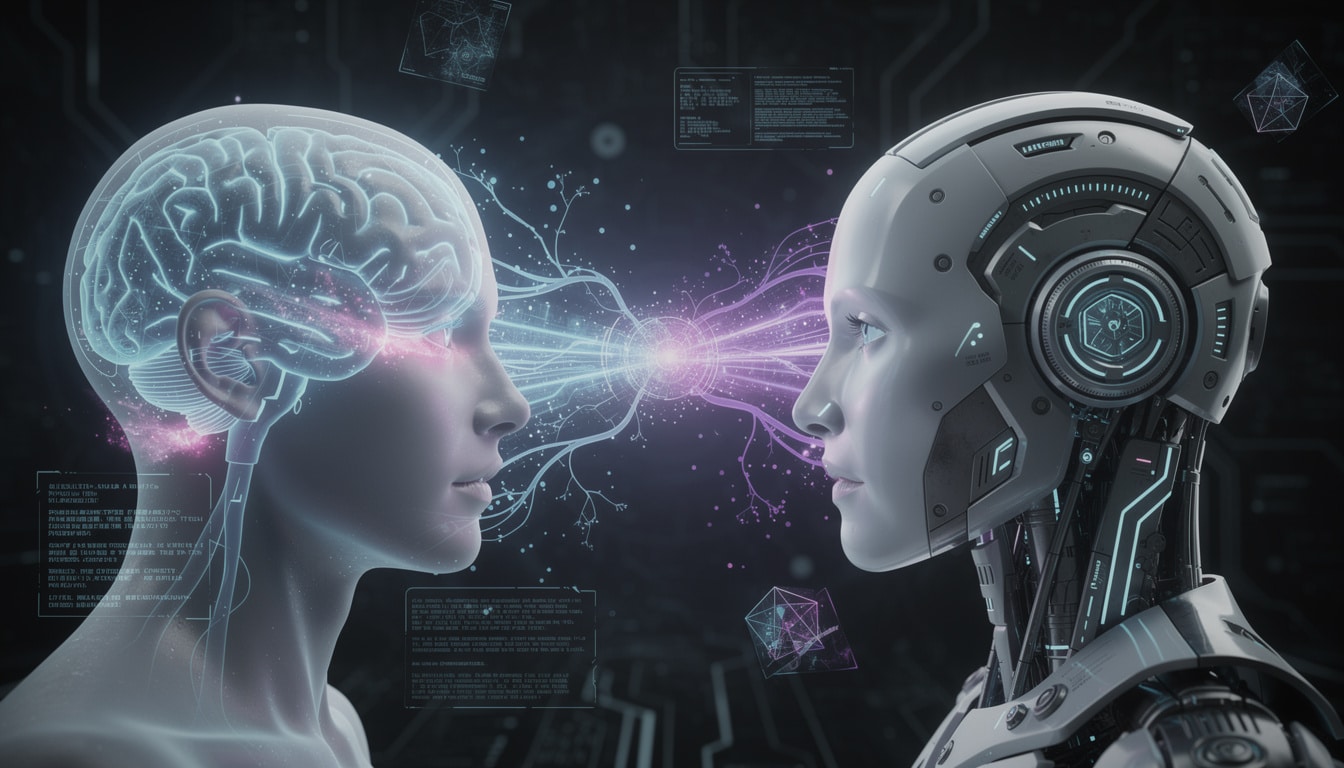
📊 The four pillars of artificial capability
Understanding AI comes down to grasping its four fundamental dimensions. Learning allows these systems to improve by ingesting massive amounts of data. Reasoning makes them capable of logic and deduction, even in complex contexts. Perception gives them a form of sensory awareness, as if the machine developed eyes and ears. Finally, interaction builds bridges between the digital and human worlds.
Each of these pillars hides subtleties. A facial recognition algorithm, for example, depends entirely on the quality of the training data. If those contain biases, the machine will amplify them — a humiliating lesson for those who believed technology was neutral.
⚠️ The ethical and societal risks of artificial intelligence
The fear of AI is not irrational. It rests on solid foundations: from discriminatory algorithms to existential threats, the ethical challenges are multiple and intertwined. An in-depth debate between promises and challenges shows how this technology crystallizes our contemporary anxieties.
Take a concrete example: a company uses an AI to screen job applications. If the system was trained on historical data reflecting discrimination, it will reproduce those biases — systematically rejecting certain populations without anyone being able to identify the exact moment when the decision became unfair. It's the opacity of algorithms, what is called the “black box,” that makes responsibility fuzzy and justice difficult.
🚨 The threats that shape the debate
Discriminatory biases are front and center. Algorithms amplify social and ethnic stereotypes because they learn from human data — imperfect, historically unjust. Job losses are a legitimate concern: automation threatens low-skilled positions, reducing the prospects of millions of workers without a guarantee of retraining.
Then come darker threats: malicious use (hacking, deepfakes, autonomous weapons), excessive dependence (humans unable to decide without machines), invasion of privacy (mass surveillance, sociopolitical manipulation). And finally, existential risks — the fear that autonomous systems misalign with human values, pursuing their objectives without regard for our well-being.
According to polls, 83% of French people fear misinformation, dehumanization and dependence linked to AI. This concern is not doomerism: it is a rational reaction to technologies whose consequences we still poorly control.
💼 Impact on work and employment
The question of employment deserves attention. Unlike previous industrial revolutions — where textile workers retrained, however imperfectly, as factory workers — AI is advancing so quickly that it risks leaving entire populations without safety nets. A cashier, a writer, a financial analyst can see their profession automated in a few years. Promises of “new jobs” ring hollow for those who immediately lose their source of income.
But again, nuance: AI also creates new professions — prompt engineer, AI ethicist, data manager. The real issue is not AI itself, but our collective ability to support these transitions, to train and support those displaced by technology.
🛡️ Towards ethical regulation: emerging frameworks
Faced with these challenges, inaction would be a form of complicity. Several initiatives are trying to lay the groundwork for responsible and regulated AI. The fundamental ethical issues to know increasingly structure institutional and public debates.
In 2024, UNESCO defined four fundamental values to guide the development of AI: respect for human rights, inclusion, diversity and sustainability. At the same time, the AI Act (entered into force in March 2024 in Europe) classifies applications according to their level of risk — from acceptable uses to prohibited applications. It is an unprecedented attempt to regulate a technology at a continental scale.
✝️ The Church's engagement and institutional wisdom
That Pope Francis engages on the issue of AI reveals something important: this is a civilizational issue, not just a technological one. Far from rejecting modernity, the Church calls for rigorous discernment. The Pope warns against the military use of AI and the dictatorship of algorithms — that moment when we hand over our choices to opaque systems — while calling for a binding international treaty to regulate its development.
This position is revealing: it refuses the false debate between blind technophilia and techno-pessimism. It simply says: this technology is powerful, therefore it demands responsibility. It's a lesson we could have applied to nuclear energy, to social networks, to so many other technologies whose consequences we poorly control.
🔧 Two governance axes: roboethics and machine ethics
Regulation is being drawn along two complementary axes. Roboethics frames the use of robots with clear rules and assignable responsibilities. It asks: who controls the machine? Who is accountable if it causes harm? Machine ethics goes further — it aims to design systems that are intrinsically respectful of human values. Rather than adding external safeguards, the goal is to build ethics into the system architecture itself.
The idea is appealing, but requires a profound transformation. That means training engineers in ethics, including philosophers and sociologists in development teams, auditing data before use, documenting algorithmic decisions. It's slow, costly, and not very profitable in the short term — but it's the price of responsibility.
🧠 The illusion of the Singularity and the real debate
Many fantasize about the “technological Singularity” — that mythical moment when an AI surpasses human intelligence and becomes uncontrollable. It's a captivating scenario for science-fiction films, but it diverts attention from real and immediate issues. The inquiry into AI ethics shows that the real debate is about more terrestrial questions: how to prevent discrimination? How to protect privacy? How to ensure that those who program AI reflect the diversity of humanity?
The Singularity may be inevitable — or it may be a myth. But it should not paralyze us. While some worry about a superintelligent AI, systems already deployed discriminate, manipulate and concentrate power. The danger is not in an apocalyptic future — it is in a present that is often banal.
💭 Beyond fear: a slow reflection
There is something analogous between AI regulation and the craft of bookbinding. When one binds a book, one does not rush: one takes the time to examine each signature, to calculate the tensions of the threads, to check that the sewing will hold for decades. One does not ask “how many books can I bind in an hour?” but rather “how to create something lasting?”
It is this same deliberate slowness that should be applied to AI. Slow down deployment, question each advance, involve affected communities, listen to critics. Not out of technophobia, but out of wisdom.
🌍 AI between hope and collective responsibility
Artificial intelligence is neither good nor bad. It is a tool forged by humans, for humans, reflecting our intentions, our biases, our values. The question “Should we be afraid of AI?” is ultimately poorly posed. The real question is: do we have the courage to take responsibility for it?
The development of AI is a risk and an opportunity — simultaneously, inseparably. It can free us from repetitive tasks or enslave us to algorithms. It can improve medicine or reproduce the injustices of our societies. The outcome will depend on the political, ethical and collective choices we make now.
In 2026, we no longer have the luxury of indifference. Everyone — citizens, engineers, public officials, companies — must take part in this discernment. Not to block innovation, but to guide it. To ensure that machines serve us, rather than the opposite. It is a long-term task, requiring as much rigor as the best bookbinding works — but the result is worth the effort.
Profil de l'auteur
Derniers articles
 Smartphones & Mobile Phones14 October 2026The loyalty penalty on your mobile bill: why staying put costs you more
- Family, Babies & Children5 October 2026Airline family seating fees: what the planned ban will change for parents
- Everyday Life & Society23 September 2026Consumer confidence index: what the monthly mood check on British households really measures
- Agency, Webmarketing & SEO31 August 2026SEO : a Google bug skews visibility statistics in AI results




Table of Contents