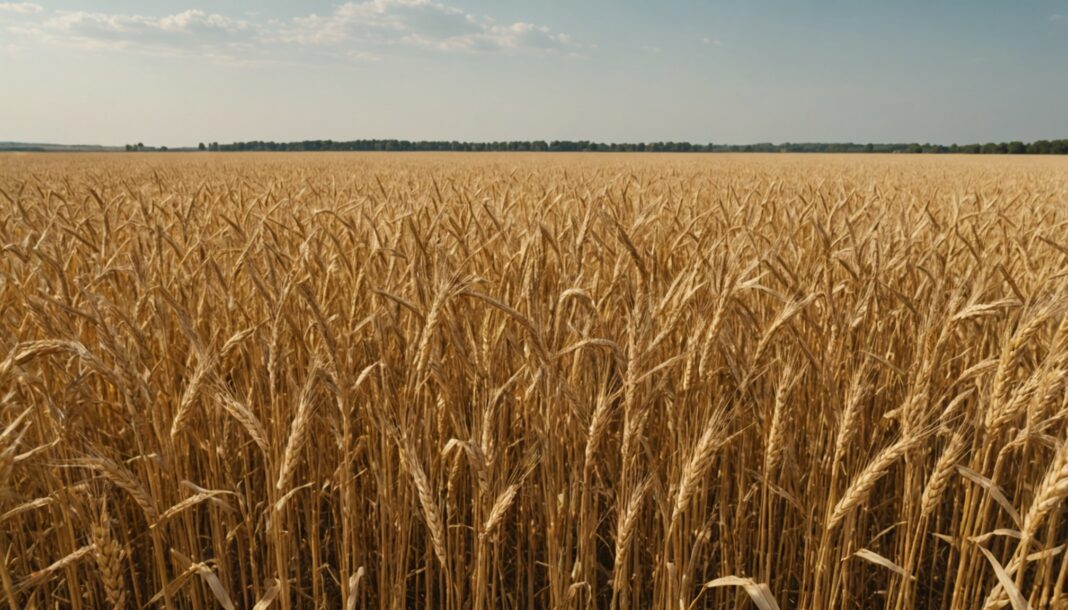
After a summer marked by repeated heatwaves, the French 2026 wheat and corn harvests are expected to fall well short of expectations. The Ministry of Agriculture estimates soft wheat production at around 32 million tonnes, a decline of 4% compared with 2025, while the corn harvest could drop by 35%, to a low not seen since 1980.
Wheat penalized by a succession of heat episodes
According to ministry data, the drop in the wheat harvest is explained by the drought and heatwave episodes that have followed one another since May, despite a slight increase in cultivated areas. The independent firm Argus Media, based on a field survey conducted in mid-July, is even more pessimistic and estimates the harvest at only 30.8 million tonnes, a decline of 7.6%. The national average yield would reach 6.67 tonnes per hectare, a level 6.5% below the ten-year average.
Corn at its lowest since 1980
The situation is even more pronounced for corn. The crop entered flowering during the second heatwave of mid-July: the pollen was literally burned and the ears struggled to fill. As a result, national production is expected to fall by 35%, to around 9 million tonnes, a low not seen since 1980. The average yield would stand at 70.3 quintals per hectare, 19% less than the previous year, under the combined effect of heat, water deficit and a reduction in sown areas.
Consequences that go beyond the agricultural world
- Cereal prices under pressure on European markets, with a possible knock-on effect on animal feed.
- A direct impact on the income of arable crops farms, already weakened by several difficult climatic years.
- Increased vigilance on food prices on store shelves, cereals being an ingredient in many processed products.
This phenomenon is not limited to arable crops: other French agricultural sectors, notably those linked to energy and natural resources, are also feeling the cumulative effects of these repeated heat episodes throughout 2026.
A trend that is becoming long-lasting
Climatically, the western half of the country first suffered an excess of winter precipitation, followed by a particularly dry spring, then a water deficit combined with heat peaks at critical stages of crop development — flowering and grain filling. This accumulation of adverse factors, year after year, is prompting part of the sector to question the adaptation of cultivated varieties and sowing calendars to the new summer climatic conditions.
Frequently asked questions
Why is the 2026 wheat harvest down despite more cultivated area?
Because yields per hectare fell due to the drought and heatwaves that occurred between May and July, which more than offset the slight increase in sown area.
Why is corn more affected than wheat this year?
Corn entered its flowering phase, a critical stage of its development, during one of the mid-July heat peaks. The heat damaged the pollen, greatly reducing ear fill.
Will this drop in harvests be reflected in food prices?
A declining production can put upward pressure on cereal prices, with a possible effect on the cost of animal feed and, indirectly, on some processed products, although other market factors also play a role.
Sources
Profil de l'auteur
Derniers articles
 Development, Digital Marketing & SEO11 August 2026Influencer marketing: French brands are increasing their budgets
- Psychology11 August 2026This personality trait may be linked to a longer life
- Agency, Webmarketing & SEO10 August 2026Advertising market in France: CTV and retail media drive growth, despite advertisers' caution
- Farming & Nature8 August 2026Wheat and corn harvests : why the heatwave is causing French production to drop sharply



This article was written with the help of artificial intelligence. Editorial policy
Table of Contents