🍽️ In brief
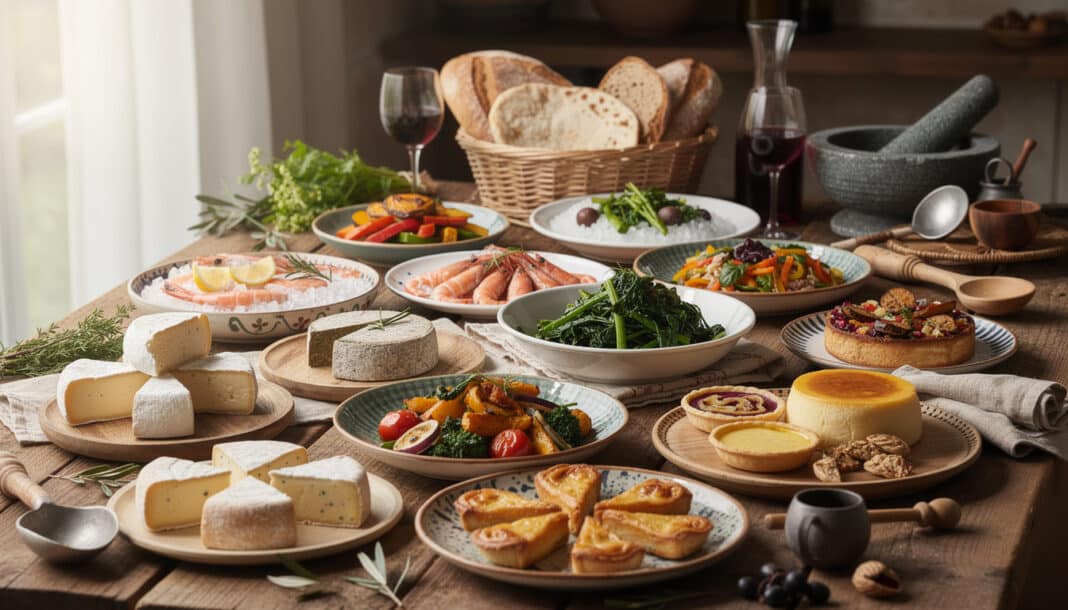
France is home to an inexhaustibly rich gastronomic heritage, where each region tells its story through its flavors. From Alsatian choucroute to Breton seafood, through Savoyard fondue and the cassoulet of the Southwest, the culinary specialties of each province reflect centuries of traditions, artisanal know-how, and attachment to the land. These dishes are not mere recipes: they are living witnesses of local cultures, gestures passed down from generation to generation, flavors that embody the soul of a place. Discovering French regional gastronomy means letting yourself be guided by the scents of a Provençal market, the warmth of a Norman inn, the conviviality of a Burgundian table. It also means understanding that behind each typical dish are passionate producers, chefs who honor this transmission, and landscapes that shape every bite.
🌾 The deep roots of French regional cuisine
Travelling through culinary France is to immerse yourself in a mosaic where time flows differently. Each province holds forgotten gestures, recipes that require patience, an attention to detail that only time can attest to. Like the pages of an old hand-bound book, each region accumulates layers of its history: influences from neighboring lands, the resources that nature provides, and the hands that have transformed them for generations.
The terroir is not just a fancy word—it's the signature of a place inscribed in every grain of salt, every drop of olive oil, every cheese that has matured in an old cellar. Provence breathes the Mediterranean, Alsace sings of Central Europe, Brittany smells of ocean salt. These geographic and climatic influences shape not only what is grown and what is fished, but also the very way of cooking, the rituals around the table, the essence of what is shared.
🏞️ How terroir shapes every flavor
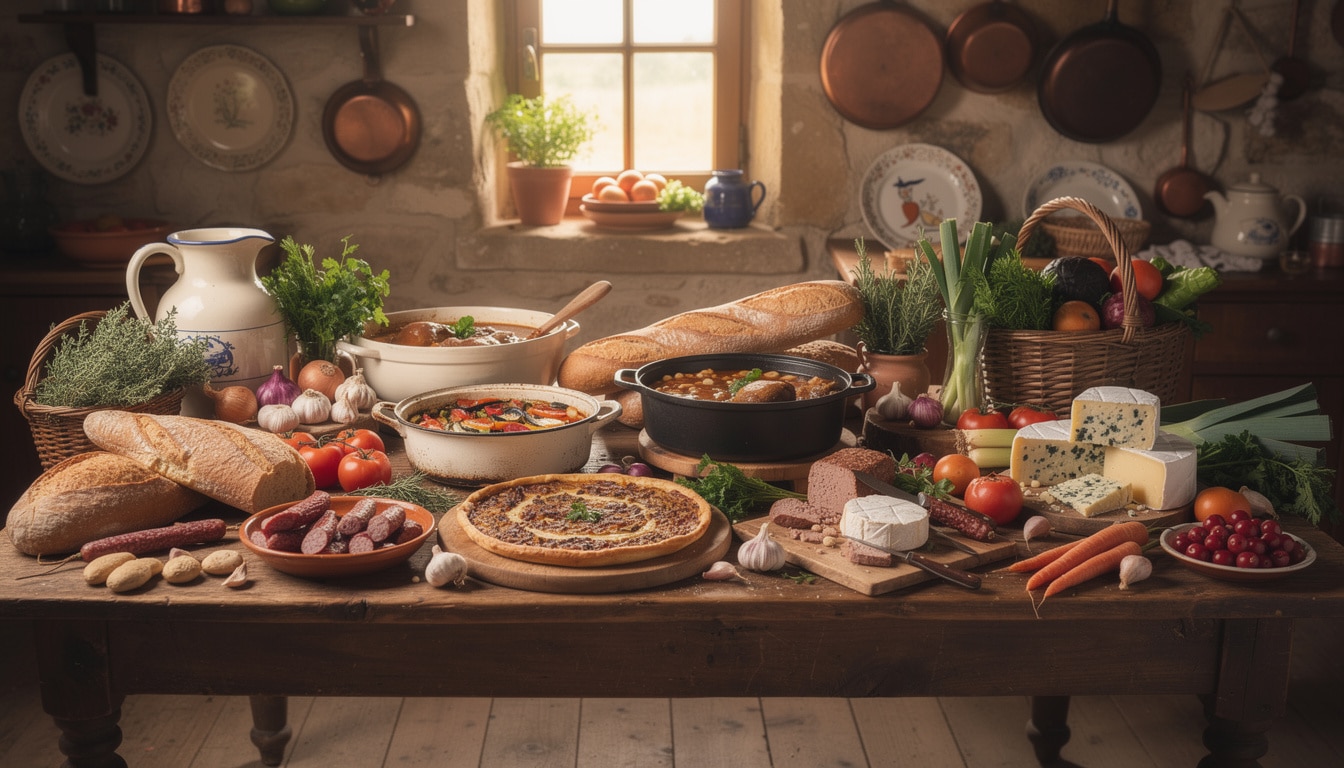
Imagine the grape harvests in Burgundy, mushroom foraging in the Vosges forest, seafood catches along the Norman coasts. These gestures, repeated century after century, create a kind of collective memory engraved in the recipes. Local products are never chosen by chance: they are born where soils, waters, and seasons come together to give their best.
That is why Camembert from Normandy never tastes the same anywhere else as it does on its cheese lands, why Provençal olive oil has that particular brightness, why Loire wines capture the clarity of the region. This authenticity, this sincerity of flavors, is what those who understand gastronomy beyond mere satiety are looking for.
🥘 The culinary specialties that define each province
Touring the culinary specialties of France is like tracing an invisible map of human passions. Each typical dish carries a name, a story, and often the well-kept secret of a family or village.
🍲 Alsace: between rigor and conviviality
Alsatian choucroute is not just an assembly of fermented cabbage and meats. It is an ode to patience, to slow fermentation, to the process that transforms the simple into the profound. Each layer of cabbage welcomes local sausages, smoked bacon, sometimes foie gras, in a sly harmony that speaks of ancestral trade exchanges between France and Germany.
Baeckeoffe, that peasant pie of meats and potatoes, tells another story: the economy of a region, the know-how of village bakeries that cooked residents' dishes after baking the bread. There is a kind of invisible poetry in these traditional recipes, the frugal and skillful gestures of women who stretched resources to feed their families.
🌊 Brittany: a dance with the ocean
Breton crêpes, thin as silk paper, symbolize a region that learned to turn little into much. Buckwheat flour, which came from the East via trade routes, took root in Brittany and found its true expression there. These galettes, sweet or savory, accompany every moment of life in Brittany—from breakfast to dinner, from the neighborhood market to the village festival.
Breton cider, a sparkling drink that plays on the tongue, embodies this maritime wisdom: wasting nothing of the apple, cultivating sweetness and acidity in perfect balance. The crustaceans and oysters of the Pink Granite Coast, the mussels of the Bay of Mont-Saint-Michel—these are Brittany's true riches, where the sea generously feeds those who respect it.
🥐 Normandy: dairy softness and bucolic terroir
Normandy was born of milk. Camembert, Livarot, Pont-l'Évêque—all cheeses that have shaped the region's gastronomic reputation well beyond its borders. These cheeses are not mass products: they are meticulous creations, where the relationship between milk, pressing, and cellar aging becomes a true chemical and poetic equation.
Norman cider, less effervescent than its Breton cousin, tells the story of the orchards that punctuate the hedgerow landscape. As for cream-based dishes—the sole with Norman cream, poulet vallée d'Auge—they testify to a region that understood that dairy richness can transform the simple into the refined, that the generosity of the terroir requires delicacy in the kitchen.
☀️ Provence: a symphony of light and herbs
Provençal ratatouille is a poem in colors. Tomatoes, eggplants, zucchinis, peppers—each vegetable brings its note to a composition that speaks of slowness, seasonality, respect for the product. No ingredient overwhelms another; they dance together under the Midi sun. Discover Provençal specialties, and you'll understand that Mediterranean cooking rests on a simple wisdom: let raw ingredients express their natural beauty.
Aioli, that emulsion of olive oil and garlic, embodies another kind of magic. It transforms the everyday into a celebration, accompanies dried cod, vegetables cooked in water, and on its own creates a moment of conviviality around the table. Herbes de Provence—thyme, rosemary, lavender—are not mere garnishes; they are the invisible walls of Provençal cooking, those that define its unique aroma.
🫘 The Southwest: a heritage of richness and generosity
Southwest foie gras carries a delicate duality. A product of respectful farming, where ducks are fed local corn, it also embodies a contradiction between tenderness toward the animal and the desire to create luxury. Creamy, light, able to melt on the tongue, foie gras becomes a celebration of what a regional product can offer at its most refined.
The cassoulet of Toulouse or Carcassonne, that white and robust stew, tells another story. Local beans slow-cooked, confit duck, smoked sausage—so many layers of flavor that require time, patience, and the conviction that true gastronomy is never rushed. Exploring Southwest flavors is to understand that here, people believe in the power of slow accumulation, in the development of flavors over time.
🧀 Rhône-Alpes: the art of cheese and the mountains
Savoyard fondue is more than a dish: it's a ritual. Melted cheeses, local white wine, toasted bread—everything combines to create a shared experience, a moment when diners gather around the same cauldron. Beaufort, Abondance, Reblochon—these Alpine cheeses attest to a mountain truth: altitude, cold, and specific pastures create cheeses that cannot be imitated elsewhere.
Gastronomic tourism in Rhône-Alpes is not a recent trend. It's the natural fruition of a region that has always known how to showcase its products as jewels to discover. Tasting workshops, artisanal cheese stalls, farms that welcome the curious—these are natural extensions of a regional passion for pure flavors.
🍞 Centre-Val de Loire: subtle wines and characterful cheeses
Sancerre, Vouvray, Chinon—these wines from Centre-Val de Loire possess a nervous elegance, as if they capture the chalky soils and the clarity of the continental climate. Dry white, semi-dry, or light red, each wine tells the micro-geography of its plot. These regional flavors become the framework of a gastronomy where subtlety outweighs power.
Crottin de Chavignol, that small dry goat cheese, pairs naturally with these wines. Sainte-Maure de Touraine, with its characteristic straw through the center, adds an artisanal dimension that only local producers truly master. Together, wines and cheeses create a dialogue where each element lets the other speak.
🗼 Île-de-France: crossroads of innovation and traditions
Paris concentrates the essence of French cuisine while constantly reinventing it. Michelin-starred restaurants transform local products into meticulous creations, where each plate becomes a statement of intent. But far from the starred luxury, Parisian bistros keep everyday recipes alive: onion soup, andouillette, pot-au-feu—dishes that speak of embraced simplicity.
Culinary innovation in Paris never renounces its roots. It unfolds them, recontextualizes them, invites them to dance with modern techniques. It's there that one understands how French gastronomy renews itself without losing itself: through a constant dialogue between yesterday and today.
🎭 Culinary art beyond the recipe
Cooking is a bit like binding a book. You accumulate pages, ingredients, in a certain order. You let patience do its work. The final result exists only if every preceding gesture has been respected, if every element has its reason to be. Regional culinary art in France reveals its beauty only if practiced with a certain slowness, a certain awareness.
Chefs who perpetuate traditions are like bookbinders of gustatory heritage. They do not reproduce mechanically; they keep alive what could become fixed. They know that transmitting is also daring to reinterpret, but always remaining faithful to the spirit of a region, to what makes its soul.
🤝 Passing on culinary knowledge
How does a Breton grandmother teach the recipe for her crêpes? Not by writing, but by repeated observation, a guided hand, adjusting proportions by feel. This oral, tactile, almost unconscious transmission remains the most effective. It creates a link between generations that transcends words.
Regional culinary schools, producers' associations, festivals that celebrate specialties—these are modern attempts to formalize what was long passed on differently. They play a crucial role in a context where lifestyles change and transmission is no longer guaranteed by simple family proximity or neighborhood.
🌱 From the land to the table: an invisible chain
Behind every authentic regional dish hides a complex chain. The producer who cultivates tomatoes using traditional methods, the farmer who respects animal welfare, the fishmonger who buys directly from sustainable fishermen—all these invisible actors create the conditions for living cuisine to exist.
Short supply chains are not a marketing trend; they are a return to a forgotten truth: the shorter the distance between producer and plate, the clearer the intention behind each gesture becomes. Farmers' markets, AMAPs, restaurants that proudly display the names of their producers—this is the regional gastronomy of the future, one that assumes its responsibilities.
🎪 Temples of tasting: festivals and markets
A gastronomic festival is never just a market where things are sold. It's a celebration where food becomes an excuse for meeting, transmitting passion, and celebrating a collective identity. The Choucroute Festival in Alsace, the Crêpe Festival in Douarnenez, the Fête de la Gastronomie that crosses France every autumn—these are moments where gastronomic tourism finds its true meaning: understand, taste, respect.
📍 Markets: the beating heart of regional cuisine
The Nice market, with its stalls overflowing with flowers, herbs, and colorful vegetables, offers a living lesson in what Provence is. The Lyon market breathes the richness of Rhône-Alpes and Italian influence. Each regional market is a school without walls, where you learn by watching, touching, tasting.
For anyone who truly wants to understand a region, spending a morning at the local market is worth more than ten gastronomic restaurants. There you meet producers, learn real seasonality, and understand why this tomato doesn't cost what that one does. The market is the direct link between the land and those who want to taste its authenticity.
🎊 Beyond consumption: immersive experiences
Culinary workshops, farm visits, meals in locals' homes—these experiences transform gastronomic tourism into something deeper. You don't just come to eat; you come to learn, exchange, and connect with a way of life different from the one you know.
These initiatives allow small producers to survive, traditional recipes to remain alive, and travelers to leave with much more than mere gustatory sensations. They leave with stories, faces, hands that created what they ate.
🔍 Quest for authenticity: how to recognize the real thing
In the age of counterfeits and standardization, how do you know you're truly tasting the authentic? Origin labels—AOC, AOP, IGP—offer a first layer of protection, but they are never a complete guarantee. True authenticity is recognized by other signs: the simplicity of the ingredient list, the absence of compromise on quality, the story told to you without being prompted.
🏷️ Certifications and their limits
Roquefort AOC can only be produced in Aveyron, with specific milk, according to strict methods. It's a protection, but it's also a restriction that some consider too rigid. Between the innovation producers desire and the preservation demanded by labels, tension always exists. Yet these certifications serve a just cause: preventing a region's name from becoming a mere marketing word.
Always prefer a producer who can speak about their work to a large industrial company that can only quote figures. Look for the faces behind the products. Find the best sources for typical dishes by region by also listening to what the local inhabitants say.
💭 Sensing the difference: training the palate
Learning to taste is developing a sensitivity that is often lost in accelerated modernity. Asking a simple question: where does what I eat come from? can already change your perspective. Tasting slowly, chewing thoroughly, letting flavors unfold gradually—this is to regain a form of awareness often forgotten.
Local producers, restaurateurs committed to transmission, chefs who honor traditions—they are all guides for this gustatory education. Their presence, their passion, their refusal to compromise is contagious.
🌍 Regional gastronomy facing contemporary challenges
In 2026, regional culinary traditions face unprecedented challenges. The homogenization of diets, the disappearance of small producers, rampant industrialization—so many threats weigh on the survival of these know-how. And yet, there is also a reverse movement: a renewed interest in the authentic, a growing demand for local products, an ecological awareness that gives new meaning to short supply chains.
♻️ Sustainability and transmission: a new model
Producers who succeed today are those who combine respect for tradition with environmental responsibility. Cultivating without pesticides, fishing sustainably, raising livestock with attention to welfare—these practices are no longer luxuries; they are the new standard that conscious consumers demand.
French regional cuisine has a major asset: it has always been, by essence, local and seasonal. It never needed exotic ingredients to express its beauty. Rediscovering this ancient wisdom is therefore not a break with modernity, but an intelligent return to a form of cooking that was already resilient and responsible.
📱 How younger generations perpetuate the heritage
New chefs, young producers, culinary influencers who speak about terroir with passion—they are the ones ensuring the heritage will not disappear. Some create restaurants where tradition and innovation dialogue. Others document old recipes on social networks, creating a new form of transmission. Others launch small artisanal productions that find local and online customers.
This new generation understands something that previous ones may have forgotten: authenticity is a commercial strength. People look for meaning in what they consume. They want real stories, products made by real hands. Discover how young chefs reinvent culinary specialties and make them relevant for today.
🎯 Access and inclusivity: democratizing tasting
Regional gastronomy should not remain the preserve of wealthy tourists or gourmet connoisseurs. How to democratize access? Through schools, first—teach children where the food they eat comes from. Through popular restaurants that offer real recipes at fair prices. Through markets and direct circuits that reduce intermediaries and make products more accessible.
A plate of cassoulet served by a small mother from the Midi in her two-table restaurant remains a more authentic and often cheaper experience than a three-star restaurant offering a “playful reinvention” of the same dish. It is that grandmother who should reconnect with young generations eager to learn, not the other way around.
French regional gastronomy remains a living treasure, a language the lands still speak to those who know how to listen. Each culinary specialty carries the weight of time, the wisdom of ancestors, and the promise of possible continuity if cared for. It's a heritage one cannot possess; one can only honor it, pass it on, and invite others to discover it with the same reverence given to an old book, its yellowed pages filled with secrets that only slowness allows one to truly read.
Profil de l'auteur
Derniers articles
 Electricity, Gas & Energy14 September 2026Gaz et électricité : ce que la hausse des tarifs va changer sur votre facture
- Agency, Webmarketing & SEO12 September 2026Fusion Omnicom-IPG : ce que la plus grande agence de publicité au monde change pour les marques
- Retirement & Senior Living10 September 2026Carte Avantage Senior SNCF : comment voyager moins cher en train après 60 ans
- Tech & Multimedia8 September 2026Objets connectés : la fin de la 2G et le nouveau Data Act vont rebattre les cartes




Table of Contents