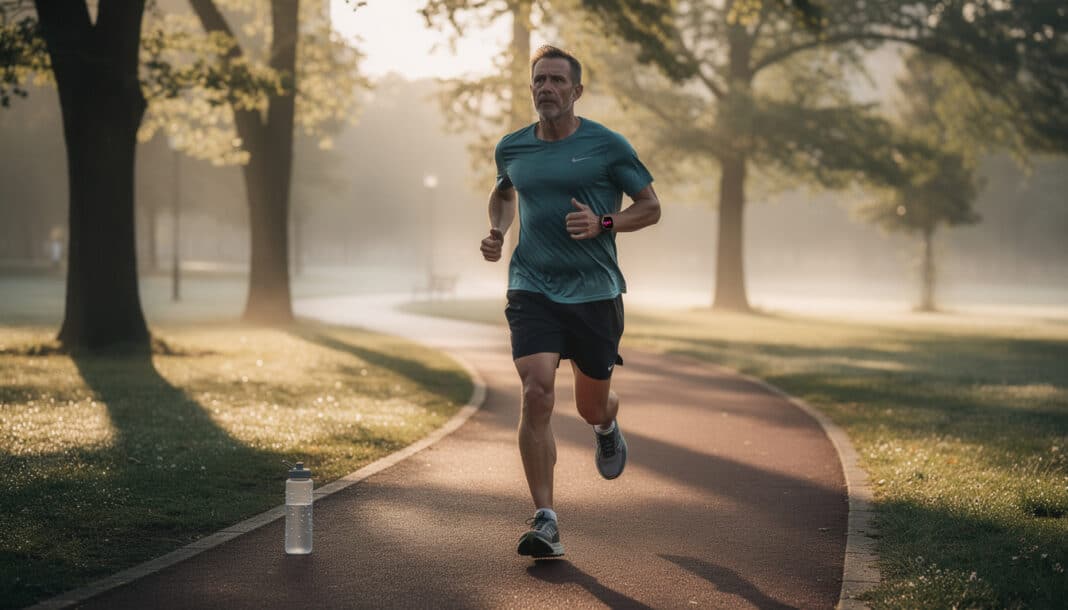
Summary : Those who maintain a regular sporting practice, even when tired, do not possess superhuman willpower. They have instead integrated systemic habits that turn effort into ritual, intention into automatism. Between strategic hydration, active recovery and time organization, discover how to build a sporting edifice as solid as a well-crafted artisanal binding.
In short : The key lies less in fleeting motivation than in the construction of immutable systems. Those who never miss their session have calibrated their hydration, structured their time as one binds a precious manuscript, and learned to listen to the subtle signals of their body. Protein-rich food becomes daily fuel, hydration an instinctive gesture, and above all, rest turns into a partner of effort rather than an enemy. It's not tyrannical discipline, but a patient learning of what nourishes body and mind.
🎯 When routine becomes the invisible architect of perseverance
Look closely at those who walk into the gym three times a week, week after week. They don't leap out of bed in an explosion of motivation. They have simply built something more durable: an everyday architecture that makes absence impossible, because it has become woven into the very texture of their week.
It's like binding a book. You don't create a masterpiece in a day; you place one thread, then another, you assemble the sections, you let everything rest. Through repeated gestures, the structure becomes unshakeable. People who never miss their training have done exactly that: they have scheduled their sessions as they would a can't-miss appointment. The slot is blocked, the location is known, the equipment waits in the same place.
But there's a subtlety. This rigorous organization does not crush joy — it frees it. By eliminating micro-decisions every day (“When will I go? Where are my things?”), you preserve mental energy for what really matters: physical effort and the pleasure of movement.

💧 Hydration: the invisible thread of performance
A minor dehydration — even just 2% — reduces physical capabilities by 20%. It's like sewing a book without enough glue: the binding will hold, but it will be fragile. Regular athletes have internalized this fact. They don't drink when thirst appears; they anticipate it.
Sipping small amounts regularly, before, during and after effort, transforms training. Beyond increased performance, good hydration reduces soreness and lowers the risk of tendinitis. It's a discreet insurance you take out with every sip.
Those who never miss their session know this instinctively. Their bottle is within reach, like a silent partner. Hydration ceases to be a chore and becomes an act of self-care, a conversation with one's body.
🔥 Fueling the engine: beyond calories
Proteins are the main fuel for muscles. Not just to gain size, but to maintain the machine, day after day. Those who build a sustainable practice do not just count abstract calories; they think about the nutritional quality that will support their effort.
They are mainly found in meats, eggs, dairy, fish and legumes. But balance matters more than excess. A hyper-protein diet without moderation exposes one to renal or cardiovascular risks. It's the wisdom of measured action, like in craftsmanship where restraint trumps excess.
For those who want to understand the common mistakes at the gym, nutrition often ranks high. A balanced, progressive approach, based on a basic understanding of the body-food-effort system, changes everything.
🍌 Small choices before effort
Eating a chocolate croissant before a workout is not a good strategy, even if it provides carbohydrates. Timing, quality, and type matter. A banana, rich in potassium, magnesium and simple carbs, offers what you need a few minutes before exercise. It's simple, effective, honest.
People who maintain a regular practice have learned to know their body — its preferences, its thresholds, what truly nourishes it. This knowledge is as valuable as a perfected bookbinding technique: it is acquired only through experience, repetition, and attention.
⏰ Time as the raw material of discipline
Exercising in the morning between 6 and 8 a.m. delivers a biological advantage: the hormones secreted massively at that hour favor exchanges and allow you to eliminate more circulating fats. But the benefit goes far beyond physiology.
Morning training locks the day in. Once the effort is done, you move through the following hours with acquired legitimacy, a lasting endorphin that carries you. Those who never miss their session have often chosen this specific slot, not out of dogmatism, but because it eliminates negotiation with oneself: at 6:30 a.m., you don't yet have a thousand good reasons to stay in bed.
That said, if you're a night owl, the secret of active people sometimes hides in their bedtime. What matters is consistency: choose your slot and stick to it, week after week, until it becomes second nature.
📅 Blocking time: a serious matter
Putting your session in the calendar as you would a professional meeting is not an exaggeration — it's the foundation of the system. Those who succeed treat this moment with the same respect as a commitment to someone else. Would you betray yourself as much as you would betray a friend? Rarely.
This simple discipline gradually transforms your relationship to time. The sports slot stops being a negotiable option and becomes an inviolable block of your week. And paradoxically, this lack of flexibility soothes, because it eliminates the energy wasted on deciding, justifying, postponing.
💪 Choosing your activity: the importance of pleasure
Take a pool membership because “it's good for your health,” but discover after three sessions that you're not comfortable in the water. You quit. That's logical. No external motivation can compensate for a fundamental discomfort.
People who never miss their training have, by contrast, often spent time finding the activity that resonates with them. Maybe it's boxing for catharsis, swimming for lightness, weight training for the feeling of control, dance for raw joy. The choice of activity outweighs any other consideration.
Without pleasure, discipline becomes punishment. With pleasure, it turns into a personal quest. And it is this quest that supports, week after week, those who never miss.
🎯 Diversify without getting lost
Doing exactly the same thing all the time creates mental wear. But varying doesn't have to mean changing sports completely. In swimming, alternating breaststroke and backstroke works different muscle groups. In weight training, changing circuit training keeps the mental challenge alive.
The idea is to stay engaged without falling into chaos. A stable structure with small variations — that's the secret. Like a classic binding, where each element has its place, but the patterns change slightly from one book to another.
🧘 Recovery: the other half of the work
We rarely talk about it, but recovery is one of the major keys to a sustainable sporting practice. The body does not get stronger during effort — it gets stronger afterward, during rest. It is during those hours of relaxation that muscles repair and biological adaptations crystallize.
Returning to a calm state after effort is essential. If the body remains on high alert, in constant tension, relaxation becomes impossible. Muscles don't recover properly, and the next session suffers. It's a vicious circle that resilient people know how to break by giving rest the place it deserves.
Discover how rest can prove as useful as sport itself to transform your practice in the long term.
🌙 Sleep as a foundation
Those who never miss their training pay particular attention to quality sleep. It's not a luxury; it's a metabolic necessity. Insufficient rest sabotages hormones, slows muscle recovery and weakens the very intention that drives you to train.
Going to bed earlier, even without sleeping longer in total duration, leads to more physical activity the next day. It's a simple empirical fact, but often forgotten. Fatigue is dishonest: it tells you that you are too exhausted to exercise, when in truth, exercise would help you sleep better.
📈 Tracking progress: making the invisible visible
Sport results are not always immediate or spectacular. It's frustrating. Those who persist have learned to document their small victories: distance covered, weight lifted, time improved. This turns raw effort into tangible, visible, gratifying data.
Using a smartwatch or an app to track performance is creating a progress journal. Each recorded number becomes proof that something is moving, evolving, improving. It is this small daily victory that feeds sustained motivation, far beyond the initial adrenaline.
📸 Visuals as witness
Beyond numbers, taking regular photos of your silhouette (ideally every two weeks, under the same conditions) reveals transformations that the daily mirror does not see. Changes are subtle, gradual, but when you compare a picture from two months ago with today's, the difference jumps out.
This visual method creates an embodied pride. It's no longer an abstraction — it's you, transformed, captured. And that pride feeds perseverance far better than any vague promise of “well-being.”
🔗 Building your ecosystem: the help of others
Having a training partner changes the dynamic. It's no longer a solitary affair between you and your fatigue — it's a commitment to someone else. It's always harder to stand up a friend than to stand up yourself.
Finding someone with a similar level and goals amplifies this dynamic. You encourage each other. On days when one wants to give up, the other pulls. Online communities, Facebook groups dedicated to athletes in your area, offer alternatives if your immediate circle does not share your passion.
This social ecosystem becomes an implicit safety net: you are never alone facing fatigue.
🎧 The sonic energy
A good playlist turns an ordinary session into an energizing moment. Music activates brain areas linked to motivation and pleasure. Those who never miss their training often have a soundtrack that accompanies them — an auditory ritual that marks the transition between everyday life and effort.
Building your playlist is not superficial; it's making your ritual personal, making it yours, turning it into a moment that belongs to you.
🎁 Honoring your efforts: gentle rewards
Rewarding each completed session or each achieved goal is not selfish — it's conditioning your brain to associate effort with something positive. A massage, a new sports outfit, a relaxing moment with a friend: it doesn't matter. What counts is creating a virtuous cycle where training brings something beyond fatigue.
For additional resources on sustained motivation, consult the strategies explained in how to cultivate authentic motivation for sport, far from miracle shortcuts.
🏆 Internalized pride
Beyond external rewards, those who persist develop an internal pride. Each session completed becomes proof to yourself of your ability to keep your word. This self-esteem radiates far beyond sport, influencing your approach to other challenges.
It's like learning a craft: each well-executed gesture strengthens confidence in your abilities. And gradually, you no longer do sport despite fatigue — you do it because it has radically changed your relationship with your own body, your time, your strength.
⚡ Intensity: knowing when to push
Making a session pay off means doing “more in a minimum of time.” Cardio workouts go in that direction, but excellent fitness and gradual progression are essential. Hopes of running 10 km in 45 minutes without prior practice are risky.
During exercise, a simple rule detects if intensity is appropriate: you should be able to hold a conversation. If that's not the case, the effort is too intense for your current condition. This talk test is an indicator professionals also use.
To finish each session, increasing intensity for a very short duration (even a few seconds) activates already warmed-up muscles more effectively. That requires as much mental strength as physical — pushing when fatigue makes itself felt.
🔄 Adapting is learning
Treating your body as an entity that communicates, rather than as a machine to obey, changes everything. People slim down naturally without going to the gym know how to listen to signals — true hunger, deep fatigue, need for rest. This active listening is a skill, not an innate gift.
Knowing your limits and adapting to them gradually is building a sustainable practice. No guilt if you need to reduce intensity some days. Long-term consistency trumps perfection in a single session.
The secret of people who never miss their workout, even when tired, lies here: they have turned fatigue into information, not a final verdict. They have built a system where effort finds its natural place, where rest honors the work, where each day brings a new opportunity, never a new defeat.
Profil de l'auteur
Derniers articles
 Electricity, Gas & Energy14 September 2026Gaz et électricité : ce que la hausse des tarifs va changer sur votre facture
- Agency, Webmarketing & SEO12 September 2026Fusion Omnicom-IPG : ce que la plus grande agence de publicité au monde change pour les marques
- Retirement & Senior Living10 September 2026Carte Avantage Senior SNCF : comment voyager moins cher en train après 60 ans
- Tech & Multimedia8 September 2026Objets connectés : la fin de la 2G et le nouveau Data Act vont rebattre les cartes




Table of Contents