
In short: In a society obsessed with performance and constant busyness, rest has become suspect. Yet science confirms it: slowing down is a winning strategy to perform better, create, and be happier. Distinguishing true restorative rest from digital anesthesia, learning to pause without guilt, is relearning to exist differently — and that's where true strength lies.
What to remember: Guilt around rest is born from a culture that values hustle. Rest is not an absence but a strategic action. From 26-minute naps that boost performance to micro-breaks that enhance focus, rest deserves to be treated like its own form of training — not as a reward you should feel guilty about.
🧠 Why rest is scary: decoding the guilt
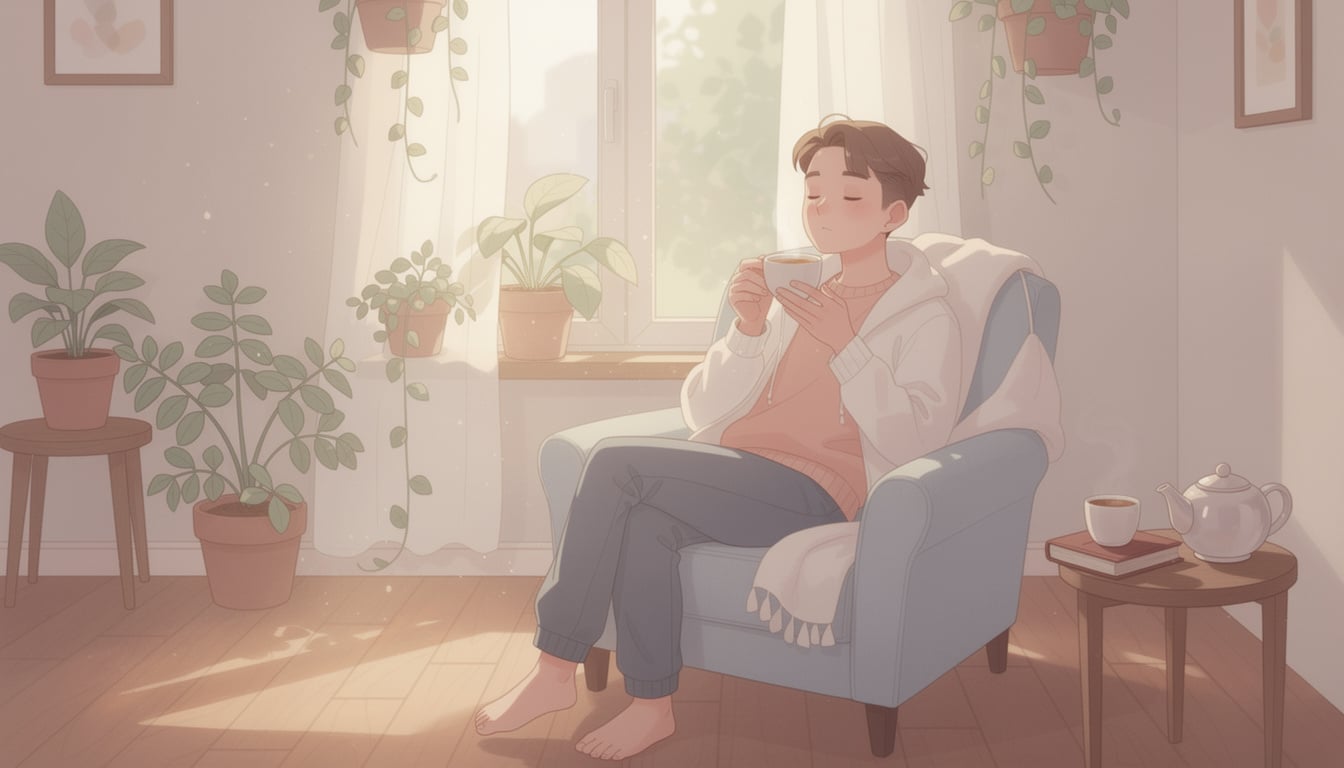
Sitting quietly, a cup in your hands, a small voice whispers: “You’re wasting time. You should be moving forward.” That voice is not a personal failing. It reflects an era where “being busy” has become a social status, where an overflowing calendar is admired even if it leads straight to burnout.
Since childhood, we are applauded for “working hard,” rarely for taking care of ourselves. This mechanism runs deep: rest = waste of time, therefore rest = guilt. And that’s how, even with the laptop closed, the brain keeps running.
The World Health Organization recognizes overwork as a major health problem. 🚨 It affects executives, entrepreneurs, freelancers and students alike. This is no longer a matter of ambition: it’s an epidemic of collective exhaustion.
💡 What science really says about rest
Contrary to the idea that only movement yields results, rest activates key areas of the brain that are often overlooked. When you stop, the “default network” kicks in — the very network that solves problems, generates creative ideas, and consolidates memory.
🎯 The 26-minute nap that changes the game
NASA measured it: a 26-minute nap increases performance by 34%. This isn’t a lazy pause. It’s a scientific strategy. Regular micro-breaks improve focus by 16%, according to research by the Draugiem group.
Working more than 50 hours a week? Hourly productivity drops. Conversely, integrating rest into your schedule is like regularly tuning an instrument: performance responds immediately.
🧪 How the brain really recovers
Rest is not dead time. It’s a process in which the body regenerates and consolidates its gains, just like an athlete alternating intense training with strategic recovery. Without this phase, there’s no real progress — only wear and tear.
🌿 Restorative rest vs. anesthesia: two different worlds
Here lies one of the biggest confusions: you can remain still and still be tense. Conversely, you can immerse yourself in an activity thinking you’re resting when you’re simply escaping. The difference? It’s measured by how you feel afterward.
⚫ “Anesthesia” rest: disappearing without healing
Endless scrolling on the phone. Videos on loop “just to unwind.” One game that leads to three more. These moments share a common function: to make you disappear. To stop feeling. To avoid inner silence.
The telltale sign? After these moments, you don’t feel lighter. You feel tense, often guilty, sometimes more tired than before. Digital anesthesia creates a cycle: easy stimulation, temporary relief, amplified guilt.
✨ Restorative rest: coming back to yourself
A walk without headphones or a phone. A book read “for pleasure,” without trying to get value from it. Time in nature where you have nothing to prove. Relational time where you are simply present.
After this kind of rest, something changes: more clarity, more groundedness, less inner critic. You return to yourself instead of evaporating.
🔄 Why your brain prefers easy stimulation
If you’ve spent years procrastinating, getting lost in screens, or repeating behaviors, your brain has learned a simple equation: stimulation = relief. When discomfort appears, it shouts: “Give me my fix.”
That’s why healthy rest can feel flat and irritating at first. No dopamine spike. No instant sensation. Just calm — and calm, for a brain starved of stimulation, can feel like danger.
That’s also why guilt intensifies: you feel you “should” keep moving, while you used to feel you “had to” distract yourself. Both mechanisms come from the same place: the inability to be present without judgment.
🛠️ Three concrete cues to really rest
1️⃣ The decisive test: am I relaxing or disappearing?
Ask yourself each time you “rest.” Do you come back to yourself (calmer breathing, more grounded body, increased presence)? Or do you fade away (forget where you are, time passes without feeling)?
This simple test clears the fog. No need to judge yourself: just observe. After a few days, you’ll recognize the difference immediately.
2️⃣ Rely on dosage, not motivation
Forget the idea of a big transformative retreat. Start with five minutes. Tomorrow, ten. The day after, maybe a thirty-minute walk. Small, regular, measurable.
At first, tension may rise during rest (it’s your nervous system wondering what’s happening). But if you stick it out, it comes down. And then you learn something huge: you can get through discomfort without diving into an escape.
3️⃣ Examine the after to validate
Healthy rest leaves a trace — not necessarily spectacular, but measurable. After that pause, are you more grounded or still fragmented? Less hard on yourself, or still critical?
That’s the real barometer. Not immediate pleasure, but the presence that remains afterward.
⏱️ Quick training: the three-minute ritual
No need for complexity. Here’s what works, without pretense:
🔸 Breathe deeply five times — inhale through the nose, exhale slowly through the mouth. It’s the signal you send to your nervous system: “We’re slowing down.”
🔸 Put your feet on the floor, feel the contact. Bring attention to the body rather than the swirling thoughts.
🔸 Notice three details around you — a color, a texture, a smell. This anchors attention in the present moment.
🔸 Savor: a sip of tea, a moment of silence, a pleasant sensation.
Less than three minutes. Yet you’ve just sent a clear signal to your brain: pause logged, nervous system calmed. Nothing magical, just pure efficiency.
🎨 Common traps and how to bypass them
Mistake 1: I “rest,” but I scratch time
You finally sit down… then you send “just” a message, you make “a little” progress on that project, you tick off a task. Result: you look like you’re resting, but you’re elsewhere. Present in body, absent in mind.
The solution: protect your rest. Phone away. Tabs closed. A clear decision: “During these X minutes, zero productivity.” It’s hard at first. After a week, the brain gets the message.
Mistake 2: The trap of “just a little bit”
A game round. A video. A quick scroll. You tell yourself it’s just an escape hatch. Then an hour passes and you’re empty. In the moment it felt sweet; afterward, it’s tension plus guilt.
To recover well without falling into excess, the key is to set a strict frame. Use a timer. Five to ten minutes, no more. The goal is to retrain yourself, not to punish yourself.
Mistake 3: Waiting for rest to be pleasant
Restorative rest does not deliver immediate euphoria. It can even be quiet, slow, slightly boring. Your brain seeks stimulation and doesn’t find it. That’s normal. It’s actually a good sign.
Aim for presence, not pleasure. Rest is training — it takes time for the muscles to adapt.
📌 The true nature of rest as an investment
Taking time for yourself is not a luxury of free moments. It’s a direct investment in your presence, creative energy, and capacity to be truly alive.
Every minute of authentic rest reduces accumulated tension and strengthens your resilience. Rest is not a reward you must earn, it’s an essential right — as important as food or hydration.
When you internalize this truth, everything changes. You stop seeking permission. You stop waiting until you’ve “finished everything” to sit down (spoiler: you never finish everything). You start resting because it’s indispensable, not because you’ve earned it.
🌱 Cultivating a new relationship with rest
True performance, the kind that lasts, doesn’t come from perpetual acceleration. It emerges from the ability to alternate tension and relaxation intelligently — just like a bookbinder who knows that each stitch can only be made if the binding has time to dry.
Here’s what changes when you truly understand it:
You stop seeing rest as a failure and integrate it as a strategy. You stop feeling guilty about every pause and start measuring them by real well-being. You give up the myth of constant motion and welcome the natural rhythm of the living.
This week, give yourself one thing: five minutes each day. Not to “do it right.” Not to tick a wellness box. Just to exist without performance. Breathe. Feel the moment.
Because sometimes, the best way to move forward… is to stop. And this simple truth — once it becomes habit — changes everything.
Profil de l'auteur
Derniers articles
 Smartphones & Mobile Phones14 October 2026The loyalty penalty on your mobile bill: why staying put costs you more
- Family, Babies & Children5 October 2026Airline family seating fees: what the planned ban will change for parents
- Everyday Life & Society23 September 2026Consumer confidence index: what the monthly mood check on British households really measures
- Agency, Webmarketing & SEO31 August 2026SEO : a Google bug skews visibility statistics in AI results




Table of Contents