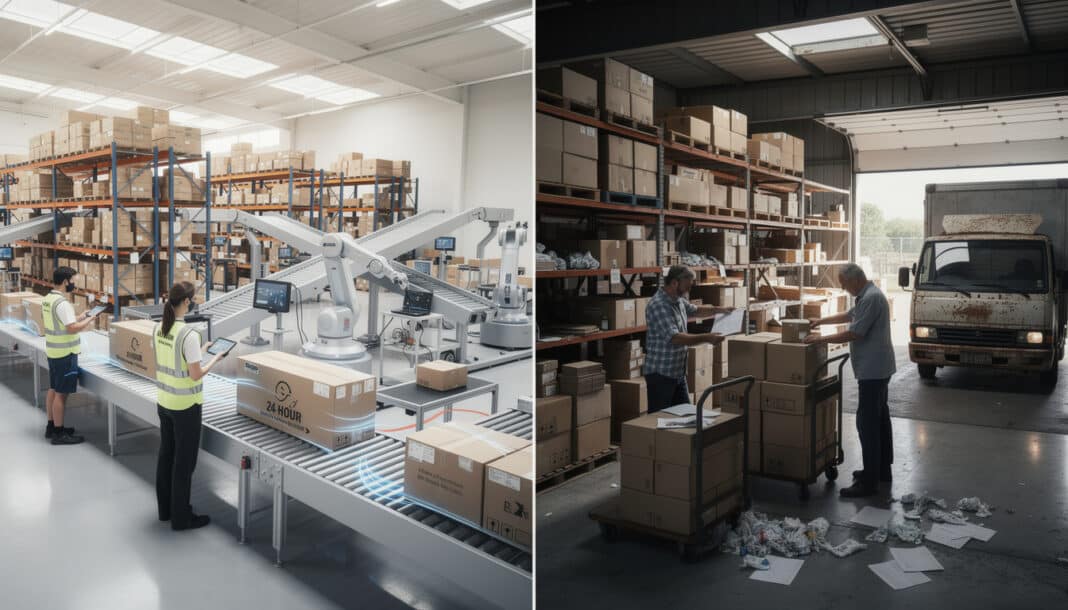
In short: E-commerce logistics is much more than just parcel delivery. It encompasses the entire supply chain, from inventory management to final shipment. Delivery times vary considerably depending on several factors: the customer's location, the type of delivery chosen, warehouse capacity and the logistics partners involved. Companies that master this complexity gain customer loyalty and competitiveness.
🎯 Key takeaways:
- 🚚 E-commerce logistics brings together all the essential processes for online selling: storage, order preparation, packaging and delivery
- ⏱️ Delivery times from 24 hours to 10 days depend on distance, type of shipment and warehouse optimization
- 📊 Inventory management and demand forecasting are critical to avoid stockouts or overstock
- 🔄 Returns and reverse logistics are a major issue for customer satisfaction
- 💡 Technologies (AI, RFID, WMS) are transforming the way companies manage their logistics operations
- 🌍 The environmental impact of deliveries and returns pushes companies to innovate
📦 Understanding e-commerce logistics and its decisive role
E-commerce logistics is the backbone of online commerce. It is not limited to shipping a parcel from your store to your door: it is an intricate system that includes inventory management, order preparation, packaging, transport and even returns management. Each step directly influences the customer experience and the economic viability of the business.
In recent years, the e-commerce sector in France has experienced remarkable growth. In 2022, turnover increased by 14 % according to data from FEVAD (Fédération de l'e-commerce et de la vente à distance), an indicator that reflects the growing importance of online commerce in the economy. This expansion has multiplied consumer expectations: faster deliveries, precise tracking, flexible options and frictionless returns.
The primary objective of any e-commerce logistics strategy is to guarantee a smooth and satisfying shopping experience. That means not only delivering quickly, but also reliably. A short delivery time without traceability creates anxiety for the customer; a punctual but slightly late delivery that is well tracked generates less frustration.
🎯 Key players in the e-commerce logistics chain
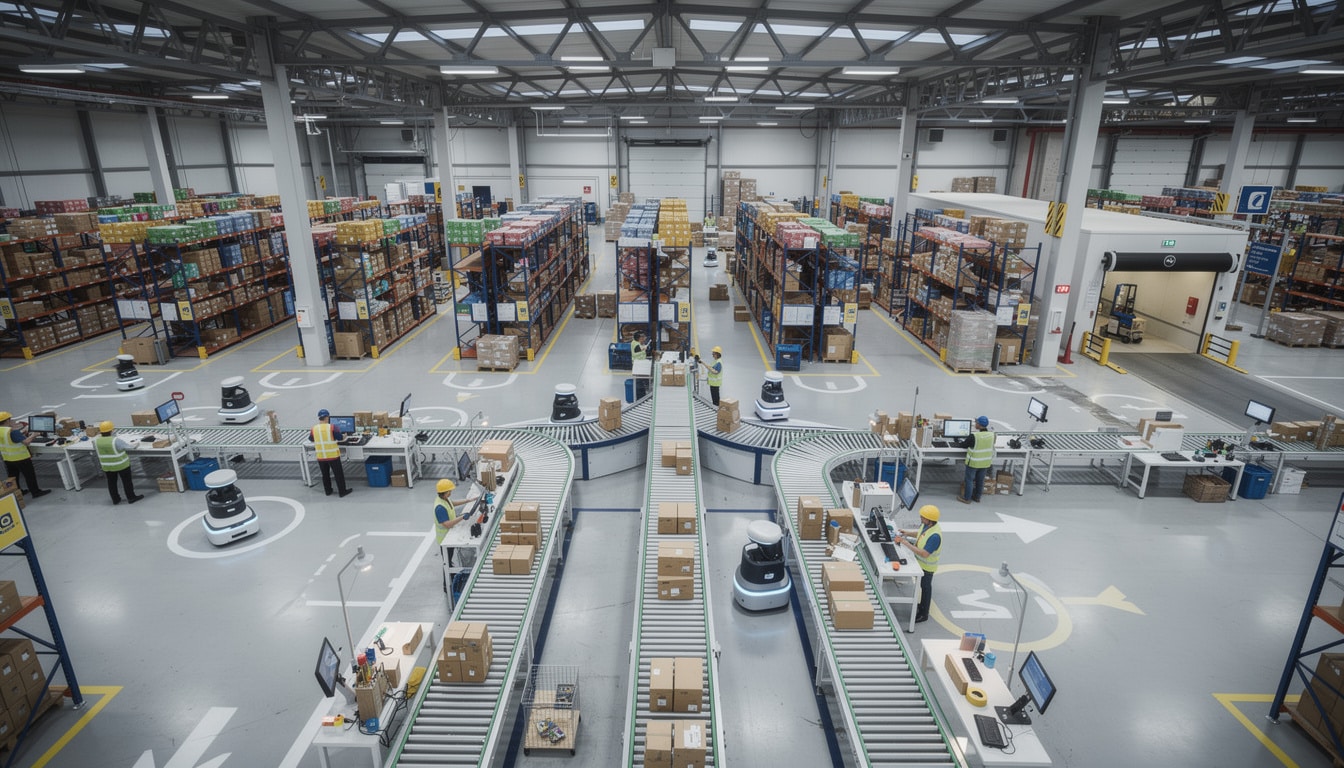
Several stakeholders play a crucial role in the success of parcel management. E-merchants themselves manage stocks on the front line and decide on procurement strategy. Next come specialized logistics providers, true experts in the sector, who offer a full portfolio: product storage, order preparation, packaging and even returns handling.
Carriers and distribution companies also form an indispensable link. They ensure the movement of products from warehouses to end customers' addresses, whether by road, rail or even air for express shipments. In France, partners like La Poste play a leading role in this distribution. To better understand how to optimize logistics management and the supply chain, many resources are available from industry experts.
Finally, technologies and information systems (ERP, WMS, tracking solutions) form the invisible cement that connects all these actors and provides total visibility over the operation.
⏳ Why some parcels arrive in 24 hours and others in 10 days
Variations in delivery times are never the result of chance. They stem from strategic decisions and operational realities that few customers truly understand. Demystifying these issues helps grasp the trade-offs companies make to serve their customers.
🌍 Impact of geographic location
The first determining factor is the distance between the warehouse and the customer. A parcel destined for a region close to the logistics site can be delivered within 24 hours, whereas delivery to a rural or remote area will take several days. This geographic reality pushes large e-commerce companies to set up regional warehouses strategically located.
For example, a company operating from the Île-de-France region can offer next-day delivery in Paris and its inner suburbs, but will need 3 to 5 days to reach mountainous or coastal areas. That's why some major online retailers invest heavily in multisite infrastructures. This strategy reduces transport and distribution times and improves overall satisfaction.
🚀 Type of shipping and pricing options
The customer also plays a role in this equation. When choosing a reduced-cost “standard” delivery, they implicitly accept longer times. In contrast, express shipping guarantees increased speed, but at a higher price. Companies calibrate their operations based on these pricing choices: an express order mobilizes different resources than a standard delivery.
Some platforms also offer click-and-collect or pickup points, options that remove the variable of long-distance package tracking but require customer involvement. These alternative models illustrate the diversification of modern logistics approaches.
⚙️ Optimization of warehouses and internal processes
Order preparation speed depends heavily on internal logistical optimization. Automated warehouses, equipped with robotic sorting systems and algorithm-driven optimized picking, reduce processing times by several hours. Conversely, manual or poorly mechanized structures require more time.
Technologies like WMS (Warehouse Management System) enable real-time inventory management and intelligent order prioritization. A good WMS can reduce picking errors and accelerate the process by 30 to 50%. That's why investing in high-performance e-commerce logistics has become a major differentiating factor.
🏢 The three e-commerce logistics models
Companies have several strategies to manage their logistics, each with its advantages and constraints. The choice depends on company size, budget and desire for control.
📤 Dropshipping: total outsourcing
Dropshipping is the most minimalist solution. The e-merchant stores nothing: suppliers ship products directly to end customers. This approach eliminates almost all storage and logistics costs, but greatly reduces control over quality and delivery times. For small merchants or those testing niches, it is an accessible entry point to e-commerce.
However, dropshipping presents risks: poor stock management by the supplier, unpredictable delays, inability to control packaging or presentation. Premium brands generally avoid this model in favor of better control over the customer experience.
🤝 E-fulfilment: strategic delegation
E-fulfilment represents a balance between control and efficiency. The e-merchant retains ownership of the stock but outsources all logistics operations to a specialized provider: receiving, storage, picking, packing and shipping. This model allows the merchant to focus on sales, marketing and product improvement.
Many SMEs and mid-sized e-commerce companies adopt this model. It offers formidable flexibility: during seasonal peaks (Christmas, Black Friday), the provider can mobilize additional resources without the merchant having to invest themselves. To better understand this option, discover how to organize and optimize the shipping of your online orders.
🔐 In-house logistics: total control
E-commerce giants (Amazon, Cdiscount, Auchan en ligne) often manage their own logistics infrastructure. This approach offers maximum control over the supply chain, continuous innovation and unmatched responsiveness. But it requires colossal investments in real estate, technology and human resources.
To justify these expenses, a considerable volume must be generated. Small and medium-sized companies generally cannot afford this option, except in very profitable niches or if they operate jointly.
📊 How e-commerce logistics differs from traditional logistics
E-commerce logistics differs profoundly from classic logistics (B2B, traditional distribution). These differences require distinct methods and tools.
Traditional logistics handles large volumes sent in full-truckload shipments to well-identified and loyal professional clients. Flows are regular and predictable. In contrast, e-commerce logistics manages thousands of small orders from individuals, with irregular flows, unpredictable peaks and very short customer wait times.
This means technological solutions and operational approaches are not interchangeable. A traditional warehouse optimized for pallets and large parcels is unsuitable for e-commerce requirements, where picking speed and piece-level accuracy are critical.
🎪 Managing seasonal peaks and promotions
E-commerce experiences dramatic activity variations. Black Friday can generate 10 times the traffic of a normal day. Christmas, back-to-school and marketing events create peaks that require formidable responsiveness. Companies must either size their capacity for these peaks (expensive during slow periods) or work with flexible external providers.
This volatility also creates psychological pressure on teams and a risk of failure if systems are not robust. Hence the critical importance of technology and reliable partners in this industry.
🔄 Inventory management: the difficult art of balance
One of the greatest sources of tension in e-commerce logistics is inventory management. Too little, and you lose sales and damage your reputation; too much, and you tie up money in storage and risk accumulating unsold stock.
📈 Forecasting demand intelligently
Modern technologies, notably artificial intelligence and predictive analytics, are transforming this management. These tools analyze sales histories, seasonal trends, online searches and even external signals (weather, events) to forecast demand with growing accuracy.
A good forecasting system can reduce stockouts by 20 to 30% while simultaneously decreasing overstock. These direct gains directly impact profitability and customer satisfaction. Modern ERP systems integrate these predictive capabilities as a standard feature.
🏷️ RFID technology for total visibility
RFID (Radio-Frequency Identification) allows real-time tracking of each product within the warehouse. Each item carries a tag that communicates its location at any time. This technology eliminates manual errors, reduces “lost” stock and speeds up inventory counts.
Although the initial investment is substantial, the return on investment proves rapid for companies handling tens of thousands of SKUs. Errors are costly: a wrongly picked item must be returned, re-sorted and prepared again, significantly increasing operational costs.
🚚 Optimizing deliveries and transport
Delivering quickly and at low cost: that is the perpetual quest of every e-merchant. Several operational levers simultaneously improve speed and economy.
🗺️ Route optimization and consolidation
Modern algorithms can calculate optimal delivery routes in milliseconds, taking into account traffic, geography and customers' preferred delivery times. This optimization reduces miles driven, fuel consumed and delivery times.
Order consolidation is also crucial: rather than delivering each parcel individually, companies group multiple orders destined for the same geographic area. This improves transport profitability and reduces environmental impact. It's a perfect example of how a better supply chain benefits everyone.
🤖 Warehouse automation
High-tech warehouses use autonomous mobile robots, automated sorting systems and intelligent conveyors to speed up order processing. These technologies can increase productivity by 50 to 100% compared to manual operations.
Amazon, for example, makes heavy use of Kiva robots to bring shelves to employees rather than the other way around, drastically reducing travel. For smaller operations, partial solutions (robotic arms for picking, sorting systems) offer tangible gains without a complete revolution.
🚛 Delivery partners: reliability over price
The choice of carrier directly affects delivery reliability and the quality of service perceived by the customer. Although the temptation is great to choose the cheapest provider, the best e-merchants prioritize reliable partners even if their rates are slightly higher. An unreliable carrier creates irritated customers and increased returns—hidden costs that are very real.
Many companies now work with multiple carriers to diversify risk and offer customers varied options (standard, express, relay). This diversification also improves resilience in case one partner fails.
↩️ Managing returns: a major financial and environmental challenge
Returns are an inevitable reality of e-commerce. Around 15 to 30% of items ordered online are returned, compared with 5 to 10% in physical stores. This difference reflects the nature of online shopping: no ability to touch before buying, more post-purchase “disappointments”.
💰 The economic impact of returns
Each return generates direct costs: parcel collection, sorting, reconditioning, refund. On average, the cost of a return represents 20 to 30% of the product's selling price. Multiply this figure by the millions of returns processed annually, and you understand why companies invest in reducing returns.
Strategies include more accurate product descriptions, 360° photos, detailed sizing guides and even unboxing videos. The quality of product information directly reduces the return rate. To better understand the legal framework and associated deadlines, consult information on legal withdrawal periods.
🌱 The environmental impact of reverse logistics
Each return generates an additional logistics trip, therefore increased carbon emissions. A returned order creates the equivalent of two delivery trips for the environment. This reality pushes responsible companies to innovate: offer returns in physical stores, set up collection points, or even financially incentivize customers not to return non-defective items.
Some companies also test the model of returns without refund: the customer keeps the product but receives store credit. This avoids a logistics trip and often generates repeat consumption.
📋 Clear process and customer communication
An often underestimated element is the clarity of the return process. A customer confused by the return process will leave a negative review, even if the item was defective. Clear instructions, a tracking number for the return and proactive communication reduce frustration.
Modern customer service must offer return tracking as sophisticated as initial tracking. This creates a consistent experience and reassures the customer that their return is being properly handled.
💻 Artificial intelligence and data: future pillars of logistics
Digitalization of e-commerce logistics is only just beginning. AI and Big Data open up considerable possibilities for continuous and predictive optimization.
🤖 AI for forecasting and optimization
Machine learning algorithms can analyze millions of transactions to identify patterns invisible to the human eye. They predict which products will be popular before you know it, allowing perfect stock anticipation.
Moreover, AI can optimize routing decisions in real time: at the moment an order is placed, the system instantly calculates the best shipping warehouse, the best route and the best transport mode based on dozens of variables (cost, time, staff availability, vehicle capacity, etc.).
📊 Big Data for customer understanding
Massive data analysis reveals buying behaviors by geographic area, by demographics, by season. These insights enable hyper-localized logistics: warehouses can be positioned precisely where stocks are needed to minimize delays and costs.
Trend prediction also allows adaptation to fashions: if data shows a rise in purchases of eco-friendly products, the company can anticipate this demand and pre-position stocks accordingly.
🔐 Data security and transparency
However, this avalanche of data raises legitimate security and privacy questions. Customers want to be tracked for their orders, but not on their personal habits. Companies must navigate this balance, in accordance with regulations like the GDPR.
Transparency about the use of customer data strengthens trust. A clear data policy and ethical practices differentiate responsible brands from those that exploit data without scruple.
🌐 The impact of marketplaces on e-commerce logistics
Marketplaces (Amazon, eBay, Cdiscount, etc.) have revolutionized e-commerce logistics. They concentrate millions of SKUs and different sellers within a single logistics ecosystem.
🎯 Complex coordination and high expectations
For sellers using a marketplace, logistics becomes simpler (the platform often handles returns and refunds) but also less controllable. You depend on the quality of the marketplace's logistics infrastructure. For more context, discover how marketplaces are transforming e-commerce logistics.
Customers now expect 24–48 hour delivery even on marketplaces, which has increased logistical pressures. The fulfillment centers of large marketplaces compete in innovation to meet these promises: delivery drones, hyperlocal pickup points, partnerships with traditional carriers.
🤝 Vertical integration: from supplier to customer
Some e-commerce sellers merge their logistics with that of marketplaces, creating an integrated supply chain from supplier to end customer. This approach reduces intermediaries and delays, but requires very fine coordination and mutual trust between partners.
🌍 The challenges of 2026 and beyond
E-commerce logistics in 2026 faces unprecedented challenges. Online commerce continues to grow (likely +10 to 15% annually), while customer expectations become more demanding and contradictory: faster but cheaper deliveries, choice of precise dates, eco-friendly packaging, free returns.
♻️ Sustainability as a strategic imperative
Consumers, particularly younger generations, take environmental impact into account in their purchasing decisions. Companies that do not drastically reduce their logistical carbon footprints risk losing customers. This drives innovation: electric vehicles, grouped deliveries, biodegradable packaging, optimized returns.
Regulations are also tightening. The European Union increasingly imposes environmental standards, notably on transport emissions. These legal constraints will turn into competitive opportunities for pioneering companies.
👥 Shortage of logistics labor
The logistics sector suffers from a chronic shortage of personnel, particularly in Europe. Working conditions in warehouses are often difficult and wages modest. Automation becomes a necessity, but also an opportunity to upskill logistics jobs toward more technical and less physical roles.
🎯 Personalization at scale
Customers increasingly demand flexibility: delivery on a precise date, narrow time slot, special packaging, personalized message. These requests fragment logistics flows and make optimization more complex. AI technologies and modular logistics will enable meeting these demands without exploding costs.
🔗 Supply chain resilience
Disruptions (pandemics, trade wars, natural disasters) have shown the fragility of globalized supply chains. Companies are reinvesting in safety stocks, supplier diversification and regional warehouses for better resilience. This is no longer optional; it is imperative.
💡 Optimizing your e-commerce logistics: best practices
If you run an e-commerce business, how can you optimize your logistics to offer competitive delivery times while controlling costs?
📍 Strategic positioning of warehouses
Analyze your customers' geography. If you primarily serve Île-de-France, a warehouse in that region gives you a competitive advantage on delivery time. If you are national, two warehouses (North and South, or West and East) drastically reduce average delivery times without doubling fixed costs.
🛠️ Invest in the right technology
A modern WMS may seem costly initially, but the return on investment (reduction in errors, increased picking speed) can be realized in less than a year. For small operations, affordable SaaS solutions exist and offer scalability without heavy investment.
👥 Build lasting partnerships
Rather than constantly switching carriers or logistics providers for a 5% reduction, cultivate lasting relationships. These partners know your specifics, continuously optimize services for you, and offer stability. Loyalty often leads to competitive prices in the long term.
For global expertise, see how to manage the performance of your e-commerce logistics through proven tools and strategies.
📊 Measure and analyze constantly
Track KPIs (key performance indicators): average preparation time, error rate, average delivery time, cost per parcel, return rate. These metrics reveal where problems hide and where improvements bring the most value.
💚 Communicate with your customers
Be honest about your lead times. Better to promise 5 days and deliver in 4 than to promise 2 days and deliver in 5. Package tracking in real time builds trust: even if the parcel has not yet been delivered, the customer knows where it is. It's a minimal communication investment that transforms perceived experience.
🌱 Integrate sustainability
From now on, ask yourself: how can you reduce the environmental impact of your logistics? Customers appreciate these efforts, and regulations will progressively make them mandatory. It's better to get ahead than to be forced.
Whether it's grouping deliveries, switching to electric vehicles for last-mile, or optimizing packaging, every action counts. These initiatives also strengthen your brand image among responsible consumers, particularly in France where the issue is gaining importance. To delve deeper, explore e-commerce trends in 2026.
Profil de l'auteur
Derniers articles
 Electricity, Gas & Energy14 September 2026Gaz et électricité : ce que la hausse des tarifs va changer sur votre facture
- Agency, Webmarketing & SEO12 September 2026Fusion Omnicom-IPG : ce que la plus grande agence de publicité au monde change pour les marques
- Retirement & Senior Living10 September 2026Carte Avantage Senior SNCF : comment voyager moins cher en train après 60 ans
- Tech & Multimedia8 September 2026Objets connectés : la fin de la 2G et le nouveau Data Act vont rebattre les cartes




Table of Contents