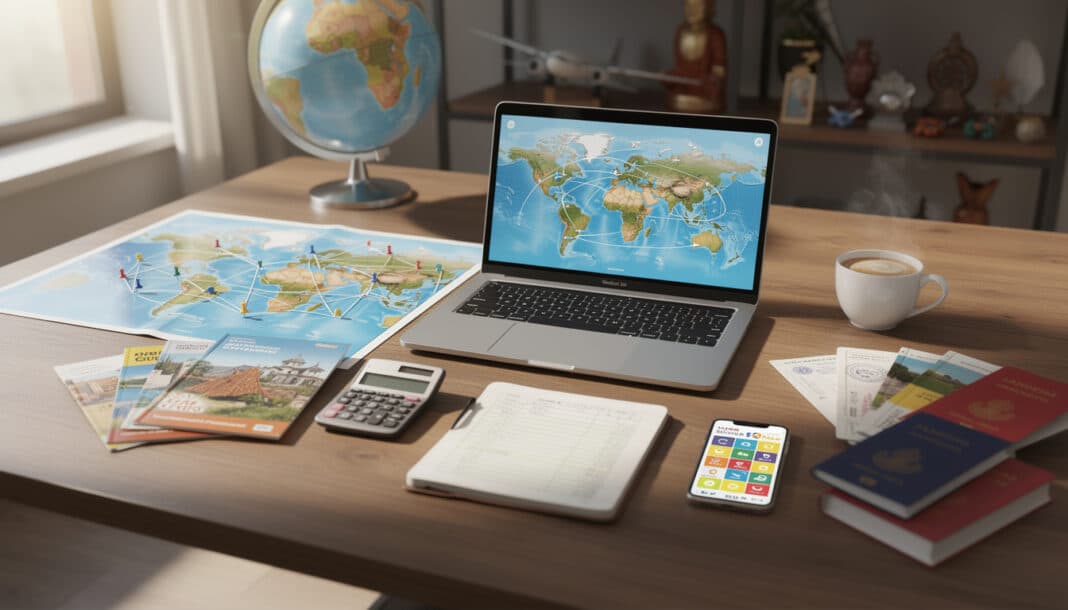
In short: Organizing a round-the-world trip in 2026 requires much more than a simple desire to leave. You must anticipate the budget (between 20,000 and 60,000 euros depending on the travel style), build a coherent itinerary, complete administrative procedures (visas, insurance, vaccinations) and accept a certain form of slowness in the preparation. As pages of a book were once sewn together, leaf by leaf, this is about weaving your travel project with patience and rigor, accepting that the most beautiful trips are built well before departure.
📍 Building an itinerary that stands the test of time
Plotting the route of a round-the-world trip in 2026 is a bit like composing a multi-volume narrative. You can't want to see everything, live everything. Travelers who succeed are often those who accept focusing on certain regions, certain rhythms, rather than trying to tick off a planetary checklist.
The ideal itinerary rests on three principles: geography (group nearby destinations), seasonality (adapt movements to local seasons) and above all, the authenticity of the experience. Spending two weeks in a city rather than three days as an express tourist changes everything. This slow travel approach is part of a broader movement where emerging destinations offer regenerative tourism with positive impact.
Regions to prioritize in 2026? Southeast Asia remains essential for its mix of culture, budget accessibility and tourism stability. Latin America is gaining attractiveness, while the emerging destinations of 2026 are redrawing the travel map. As for Africa, it is gradually opening up with increasingly reliable infrastructure.

🌐 Key regions to include in your route
Start by defining your non-negotiables: are there countries or landscapes without which this trip would lose its meaning? This question, often personal, becomes the guiding thread. For some, it's the temples of Asia. For others, the mountains of Latin America or African landscapes.
A coherent round-the-world trip generally follows a loop logic: head east or west, and return to the starting point. Around 6 to 12 months of travel allows discovering 4 to 6 continents without rushing. Those who aim for excellence allow themselves longer pauses: a month in one region, three weeks in another, rather than changing countries every week.
💰 Budgeting a round-the-world trip without getting lost
The budget for a round-the-world trip often scares before you've even opened a spreadsheet. Yet it follows a simple logic: the cost depends on three variables: duration, comfort style and chosen destinations.
A realistic estimate for a 10-month trip? Between 20,000 and 60,000 euros. Experienced backpackers who favor hostels, local transport and street food can drop to 2,000 euros per month. Travelers seeking more comfort, 3-star hotels and decent restaurants should budget 3,500 to 5,000 euros monthly. This topic of frugal travel connects to a broader reflection on financial freedom and frugality as a path to autonomy.
Expenses break down into six items: air transport (40 to 50% of the total budget), accommodation (20 to 30%), food (15 to 20%), activities (5 to 10%), insurance and visas (3 to 5%), and unforeseen expenses (10%). Setting a monthly budget and sticking to it requires discipline, but it's possible.
✈️ Distributing transport costs
Airline tickets are the major item. Three strategies coexist: specialized tour operators who offer multidestination passes (type round-the-world tickets), tickets bought individually as you go, or a combination of the two depending on fare opportunities.
A classic round-the-world ticket costs between 2,000 and 3,500 euros for a global loop and generally requires directional progression (east or west), without backtracking. It's structuring, but less flexible. The opposite strategy — booking at the last minute, watching for promos, using air miles — demands more mental flexibility, but can generate substantial savings.
🏨 Adapting accommodation to the route
Staying three days in Bangkok in a dormitory costs 60 euros. Three nights in Chiang Mai, 45 euros. Three weeks in the same place often 300 euros. This progression makes it possible to save by lengthening fixed stays. Savvy nomads alternate: a few main cities with decent hotels, then longer periods in small towns or rural areas to let the wallet breathe.
📋 Administrative formalities: the invisible foundation of the trip
A round-the-world trip without proper papers is like binding a book without thread: it might hold for a while, but it will collapse at the first jolt. The administrative procedures are the foundation of any peaceful trip.
Four areas require attention: identity documents, visas, travel insurance and vaccinations. Undertaking these procedures at least 6 to 8 months before departure remains prudent, even if some visas are requested on arrival.
🛂 Passport and visas: anticipate the deadlines
A passport must have at least 6 months' validity after the planned return date. If yours expires soon, renewing it without delay is necessary. Count on 4 to 6 weeks in France for a standard renewal.
Visas, for their part, vary by destination. Some countries (most second-tier Asian countries, many African countries) issue them on arrival. Others (China, India, Russia, Brazil) require a complex and costly prior application. Establishing a precise roadmap by destination — with timelines, fees and required documents — avoids unpleasant surprises six months beforehand.
A new trend is emerging: digital visas, faster to obtain. Most Asian countries already offer them, which greatly simplifies trip planning for 2026.
🏥 Mandatory insurance and vaccinations
Travel insurance is not optional. A medical evacuation in Southeast Asia can cost 50,000 euros. Opting for comprehensive coverage (repatriation, cancellation, luggage, liability) costs 1,500 to 2,500 euros for one year. It's negligible compared to the risk incurred.
On the vaccination side, yellow fever remains mandatory for certain African and South American countries. Diphtheria, tetanus, polio and hepatitis A are strongly recommended. An appointment with a travel medicine specialist three months before allows for effective planning.
It is also advisable to plan a digital copy of all important documents (passport, insurance, visas, vaccinations) stored online and accessible from anywhere.
📱 Final preparations: banking formalities and communication
Before leaving, notifying your bank that you will be traveling abroad for several months avoids sudden card blocks. Requesting a second card and keeping it with a close person in France: an insurance against loss or theft.
For communication, subscribing to a suitable international plan or accepting to operate with WiFi remains a personal decision. Some travelers keep a French line with reduced data, others switch to local SIM cards country by country.
🧳 Preparing your life in the background
Leaving on a round-the-world trip does not erase the life you leave behind. Canceling or suspending subscriptions, finding someone to look after your home, managing personal affairs: so many details that, if neglected, can ruin the ideal trip.
For housing, three solutions: rent it out entirely to cover costs, entrust it to a friend, or abandon it temporarily (which raises the question of what to do with your furniture during a round-the-world trip). The reflection on housing fits into a larger trend: in a context where durable objects are returning to our homes, abandoning possessions — even temporarily — raises questions. Some opt for storage, others for selling and a “light restart” upon return.
⏸️ Managing obligations before departure
Stopping unnecessary bills (subscriptions to services, gym, paper magazines) frees the mind and the wallet. Leaving an emergency contact number with relatives for administrative emergencies, informing your employer or clients of your prolonged absence — these gestures seem obvious, but forgetting them causes unexpected crises.
For those who retain professional responsibilities (freelancers, entrepreneurs), define how to handle requests received during the trip: delegation, temporary pause or an automatic responder system? This question deserves real thought.
🗺️ The art of traveling differently: beyond the checklist
Organizing a round-the-world trip ultimately means accepting a certain form of slowness. In our age of constant zapping, putting down your bags for a few weeks in the same place, returning to the same café three mornings in a row, conversing with the same people — it's already an act of rebellion.
Each traveler carries a hidden intention. Some seek escape, others self-discovery, others still absolution from a life that didn't resemble what was expected. No matter: a well-prepared round-the-world trip respects that intention instead of diluting it in a frantic race for Instagram photos.
Meticulous preparation — detailed budget, thoughtful itinerary, procedures carried out without haste — frees up the time to be present once on the road. It's the delightful paradox of any great undertaking: the more you anticipate, the more you can let go.
Whether this trip begins in 2026 or is postponed by a year, it doesn't matter. What counts is starting it properly, like opening a beautiful book after respecting all the steps of its making: pages neatly sewn, spine firmly bound, cover protecting the whole. Then you can turn the pages in peace.
Profil de l'auteur
Derniers articles
 Smartphones & Mobile Phones14 October 2026The loyalty penalty on your mobile bill: why staying put costs you more
- Family, Babies & Children5 October 2026Airline family seating fees: what the planned ban will change for parents
- Everyday Life & Society23 September 2026Consumer confidence index: what the monthly mood check on British households really measures
- Agency, Webmarketing & SEO31 August 2026SEO : a Google bug skews visibility statistics in AI results




Table of Contents