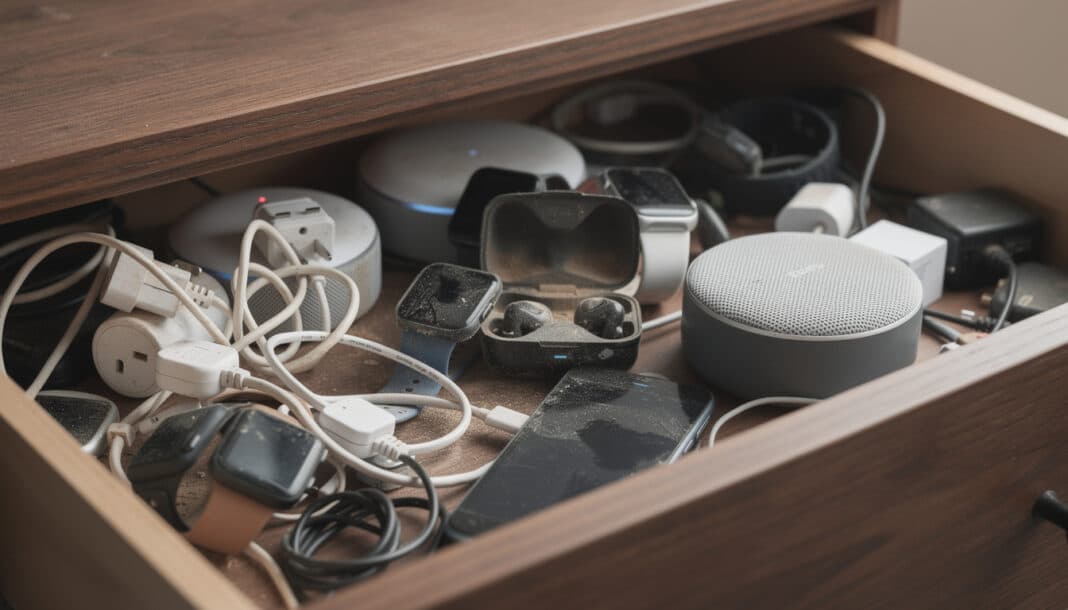
Summary : Each year, millions of consumers succumb to the lure of connected devices, technological promises that often end up forgotten at the bottom of a drawer. Between impulse purchases, gadgets with attractive designs and disappointed expectations, the phenomenon reveals a deep tension: how to distinguish true innovation from planned obsolescence? This article dissects the mechanisms of this frenetic consumption, explores the reasons why these technologies fail to satisfy us, and suggests ways to make more thoughtful choices in a market saturated with illusory promises.
In brief :
- 🛍️ Impulse buying dominates : Over 70 % of French households own at least one connected device, but many lie unused in drawers
- 💡 Gadget over usefulness : Consumers buy first for the technological “wow” effect, without checking if the device meets a real need
- 📱 Competition with the smartphone : Many of these devices are quickly overtaken by the growing capabilities of smartphones
- ♻️ Obsolescence problem : Software updates stop, apps become incompatible, and batteries wear out quickly
- 🔒 Security and data issues : Consumers often ignore where their data goes and what the real risks are
- ⚠️ Hidden ecological impact : Each discarded device represents rare materials, toxic batteries, and a carbon footprint that is often unknown
- 🎯 How to choose wisely : Interoperability, real usefulness, lifecycle and respect for privacy are essential criteria before purchasing
📦 Why so many connected devices end up at the bottom of drawers
Imagine the scene: you step through the door of an electronics store or scroll on an e-commerce platform. A connected scale with promise, a state-of-the-art smartwatch, a revolutionary robot vacuum… They all promise to transform your daily life. You click, pay, and wait for delivery with excitement.
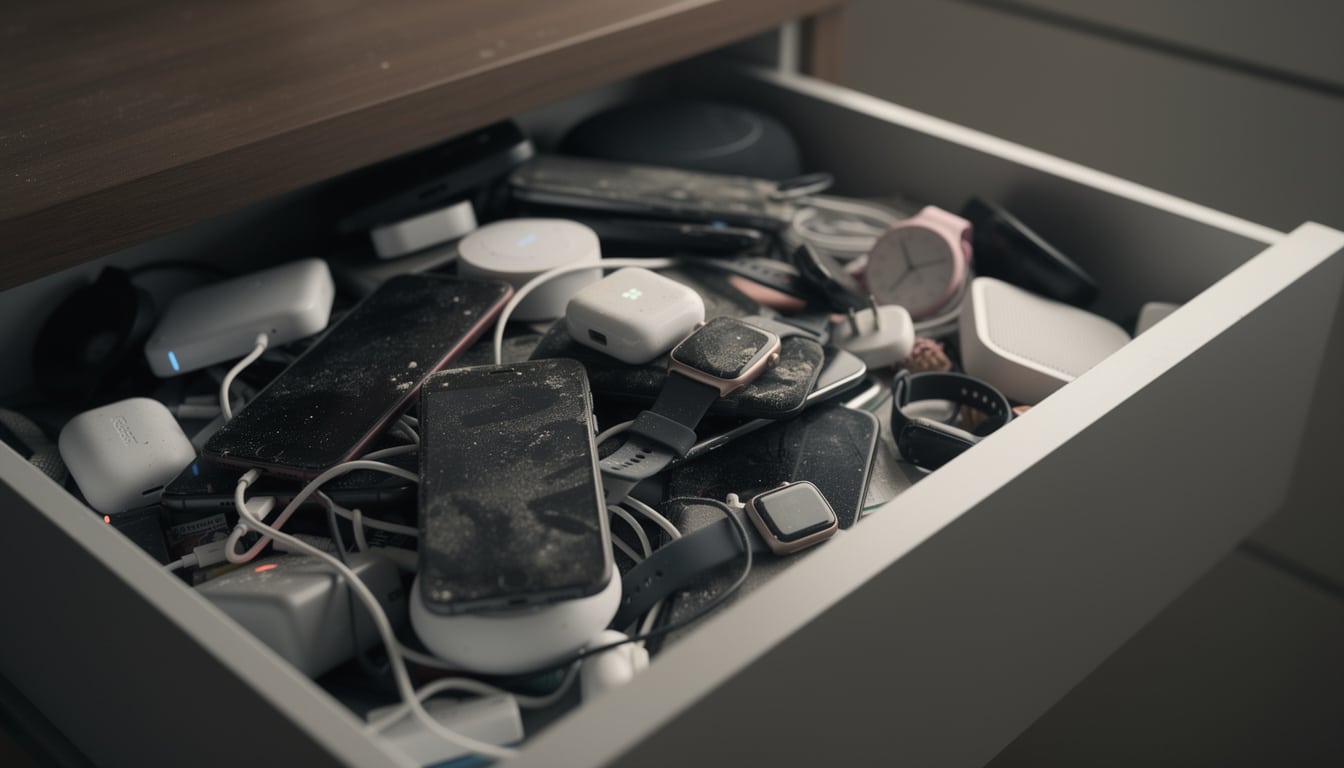
A few weeks later, the same device lies at the bottom of a drawer. No major guilt, just a silent reality: this gadget did not match your real needs. The phenomenon is universal, affecting millions of consumers each year, and it reveals an uncomfortable truth about our habits of technological consumption.
The primary reason? Impulse buying outweighs real usefulness. Faced with an innovation presented as revolutionary, consumers are attracted by the spectacular effect, the illusion that owning this device would make them more modern, more efficient, happier. But once the novelty wears off, reality sets in: the device does not solve any concrete problem, or proves more complicated to integrate into daily life than expected.
The market for connected devices exploded without really giving consumers time to think. Marketing pressure, FOMO (fear of missing out), and the accessibility of low prices create a perfect storm for thoughtless buying. Result: drawers full of dormant gadgets that, for many, will never see the day of their full activation.
🎯 The hidden pitfalls of technological promises
The illusion of simplicity and the clash with real complexity
A smart speaker promises to control your whole home by voice. Appealing. Except once at home, you discover that voice commands do not always work, that you must configure ten different settings, and that the interface remains less intuitive than a simple mobile app you already have on your phone.
This gap between the marketing promise and the reality of use causes immediate frustration. Consumers imagine seamless integration, but find installation manuals as thick as phone books and a learning curve much steeper than expected. The technological magic quickly fades, replaced by disappointment.
The silent competition from the smartphone
Your smartphone now does almost everything: take high-resolution photos, record your steps, measure your pulse, control the lights, play music… Why buy an action camera, a connected scale, or low-end Bluetooth earphones when these devices replicate the same functionalities, often less well and with less convenience?
The smartphone has become the universal connected object, the one you already had. Anything that claims to add to this ecosystem must truly justify its presence. Yet many do not. They become redundancies, superfluous objects that clutter more than they serve.
Planned obsolescence: when technology becomes disposable
A portable solar charger seems ecological and practical. Until the manufacturer stops software updates, the battery only lasts two hours, or new phones are no longer compatible with the old interface. Suddenly, the device is nothing more than waste, too old to be useful, too new to have nostalgic value.
Obsolescence, whether planned or natural, is a reality that accelerates the migration of these devices to the back of drawers, then to the trash. Some manufacturers are transparent about support duration; many are not. And it is precisely this uncertainty that makes consumers hesitate before investing.
For further study, Que Choisir offers a comprehensive dossier on connected devices and their challenges, offering a critical perspective on the durability and the real value of these devices.
🔴 Devices that promise a lot and deliver little
Smartwatches and fitness trackers: gadgets or real companions?
A smartwatch should be your personal secret agent. Stylish, connected, capable of capturing every detail of your digital existence. The reality? You wear the device for a few weeks, then it joins the drawer. Why? Because you realize that notifications are intrusive, the battery lasts two days at best, and a simple glance at your phone is more than enough.
Fitness trackers have a similar fate. They promise to revolutionize your athletic performance, to motivate you daily. But if you are not a competitive athlete, those small statistics remain little motivating. Annoyed by persistent reminders, you gradually abandon the accessory to run or walk freely, as before.
Robot vacuums: promise of autonomy, reality of assistance
A robot vacuum was supposed to free up your time. No more chores! In theory, brilliant. In practice? This autonomous device regularly gets stuck under a sofa, remains blocked on rug fringes, or cannot access certain spaces in your home. You end up having to retrieve it and reposition it manually, which completely cancels out the promised time savings.
Worse, for the robot to work efficiently, you must prepare the ground by removing all obstacles, cables and small objects. It's exactly what you would do with a conventional vacuum. The robot then becomes a complication rather than a solution, an object that demands as much effort as it saves.
3D printers: innovation without practical usefulness
The 3D printer? It should revolutionize your creative hobbies. You will be able to create anything you imagine! Except a 3D printer requires two things: models to print and time to design or find them online. For most people, searching for a model on the Internet and ordering an already-made object proves simpler and less costly.
Initial enthusiasm quickly fades when you realize you would spend more time configuring the device, managing materials and solving printing problems than actually enjoying its capabilities. The 3D printer therefore ends up among the garage machines that no one touches.
🌍 The invisible cost: electronic waste and ecological impact
Each connected device thrown away contains an electronic chip, a lithium battery, rare earths, printed circuit boards and plastic materials that end up in the trash. Multiplied by the billions of devices in circulation worldwide, the environmental account becomes dizzying.
A wireless charger forgotten in a drawer represents the emblem of this careless consumption. This object consumed energy to be manufactured, transported, and stored at your home. If it remains unused for years, then thrown away, all that carbon footprint becomes wasted. And how many households host dozens of such technological artifacts?
Planned obsolescence worsens the problem. A connected air purifier becomes useless the day the manufacturer stops software updates and the sensors wear out. Impossible to repair, impossible to recycle properly, it becomes waste that is difficult to treat. According to recent studies, only 15 % of electronic waste is properly recycled globally. The rest pollutes the soil, water and air.
Some manufacturers are beginning to offer repairable devices, replaceable components, or take-back programs for recycling. But this is far from the norm. Most brands still prioritize ease and immediate profit over environmental responsibility.
For an in-depth analysis of the issues, this article details the advantages and disadvantages of connected devices in 2026, including their environmental impacts.
🔐 Hidden risks: data, security and privacy
Where do your data really go?
Each connected device is fundamentally a data collector. Your connected scale records your weight, your clothes, your habits. Your smart speaker listens constantly. Your watch tracks your location, your heart rate, your sleep. But where do all these personal informations end up?
Often, you accept them during installation without having read the terms of use. These data are transmitted to cloud servers, sometimes unencrypted, sometimes shared with commercial partners, or sold to marketing agencies. You have given up your privacy for a gadget that, in the end, did not please you.
Cybersecurity: a persistent blind spot
Many manufacturers of cheap connected devices neglect security. A default password, lack of encryption, an update never performed… and your surveillance camera becomes accessible to any hacker on the dark web.
The implications are serious. A hacked baby monitor? Someone watches your child. A compromised smart lock? A potential intruder knows every detail of your routine. A manipulated connected scale? Altered health data that could lead to incorrect medical treatment. The risks go far beyond the simple “not a big deal”.
The security disparity between high-end and low-cost products is enormous. But even expensive devices are not exempt from flaws. Responsibility therefore falls to the consumer to remain vigilant, change default passwords, apply updates regularly, and question the legitimacy of every permission granted to these devices.
✅ How to make informed choices before buying
The five essential selection criteria
Before succumbing to the charm of a connected device, ask yourself these essential questions:
🔗 Interoperability : Does it work with the other devices you already own? Does it use an open standard like Matter, or stay locked in a closed ecosystem (Apple, Google, Amazon)? An isolated device is a device doomed to obsolescence.
💡 Real usefulness : Does it meet an identified daily need or is it a gadget with a “wow” effect? Ask yourself the blunt question: were you worse off before without this device? The honest answer should guide you.
♻️ Lifecycle : Is it easily repairable? Does it receive regular updates? Does the manufacturer commit to supporting the device for at least 3 to 5 years? A product without a longevity roadmap is waste in waiting.
🔒 Respect for privacy : Where do the collected data go? Does the manufacturer offer granular control over what is shared? Read privacy policies, even if they are indigestible. If the company gives vague answers, walk away.
📞 Support and follow-up : Is there a responsive customer service? Is there an active community around the product? Are security patches published regularly? The absence of post-purchase support is a bad sign.
Questions to ask the seller or in user reviews
Before clicking “Buy”, check detailed reviews. Look for questions like: “Do people still use this device after a year?” or “Does it have compatibility issues?”. Negative reviews are often more informative than praise.
Contact the seller or manufacturer with your specific doubts. A company that responds quickly and honestly to your concerns is generally a better partner than one that ignores inquiries.
Finally, ask yourself the ultimate question: would you be willing to pay twice as much for this device if that were its true market price, without tempting promotions? If the answer is no, you already know it will end up at the bottom of a drawer.
🏠 The rare connected devices that are really worth it
Not all connected devices deserve the fate of the drawer. A few categories stand out for real usefulness and seamless integration into daily life.
Adaptive thermostats and smart heating systems
A connected thermostat learns your habits, adjusts the temperature based on your presence and weather conditions, and achieves substantial energy savings. Unlike many other gadgets, it works silently in the background without demanding your attention, and the return on investment is measurable on your electricity bill.
These devices justify their price by undeniable daily utility, a long lifespan (often 10+ years) and growing compatibility with open standards.
Water leak sensors and smart security systems
A small connected sensor that detects a water leak before it floods your house? That's an investment that pays for itself with the first avoided leak. Likewise for smart locks that allow you to access your home in case you forget a key, or alarm systems that trigger automatically in case of intrusion.
These objects solve concrete problems and are justified beyond doubt.
High-end smartwatches dedicated to health
Unlike cheap bands, premium smartwatches with ECG, fall detection and medical alerts offer real value for elderly people or those with chronic conditions. Here, the device can literally save a life.
🛡️ Best practices for living with connected devices
Basic security hygiene
Disable unnecessary functions. If your connected bulb doesn't need a microphone to work, ask yourself if permanent listening is really necessary. Fewer active sensors = fewer vulnerabilities.
Change default passwords immediately. It's annoying, but indispensable. Use a password manager to avoid reusing the same codes.
Set up regular maintenance: software updates, periodic reboots, battery checks. It's basic, but it's the foundation of lasting security.
Ecosystem management
Centralize your connected devices in a single app or platform if possible (Home Assistant, Google Home or Apple Maison). This simplifies control and limits redundancies.
Clean up your access permissions regularly. Who still needs to read your sleep data? Remove forgotten accounts and dormant connections. A monthly review is enough to avoid progressive information leaks.
Finally, ask yourself regularly: do we really use this device? If the answer has been no for three months, sell it second-hand or give it to someone else. Drawers are scarce, and technological accumulation does not bring the promised happiness.
💭 The ultimate question: should everything really be connected?
The real issue is not technological, but philosophical. In a world where almost every object can be connected, the real question becomes: should everything really be connected?
Connecting a device means accepting a dependence on electricity, software updates, the cloud, and collected data. It also increases the complexity of a life that often needs it less. Sometimes, a simple bulb is better than a “smart” bulb that refuses to turn on because the Wi-Fi is down.
For a broader perspective on this phenomenon, this top 20 of technological objects bought but never used offers an amused yet biting reflection on the subject.
True innovations are those that solve an identified problem, integrate without friction, will last a long time, and respect your privacy. Everything else falls under marketing illusion, intended to fill manufacturers' pockets and consumers' drawers — well-intentioned but naive.
The future is not about connecting everything, but about connecting intelligently. And that intelligence begins by saying “no” to 95 % of the connected devices offered.
Profil de l'auteur
Derniers articles
 Everyday Life & Society23 September 2026Consumer confidence index: what the monthly mood check on British households really measures
- Agency, Webmarketing & SEO31 August 2026SEO : a Google bug skews visibility statistics in AI results
- Tech & Multimedia29 August 2026Earbuds that transcribe your meetings without a smartphone : how Plaud One changes things
- Home Appliances & Equipment28 August 2026Home appliances: the durability index extends to four new appliances




Table of Contents