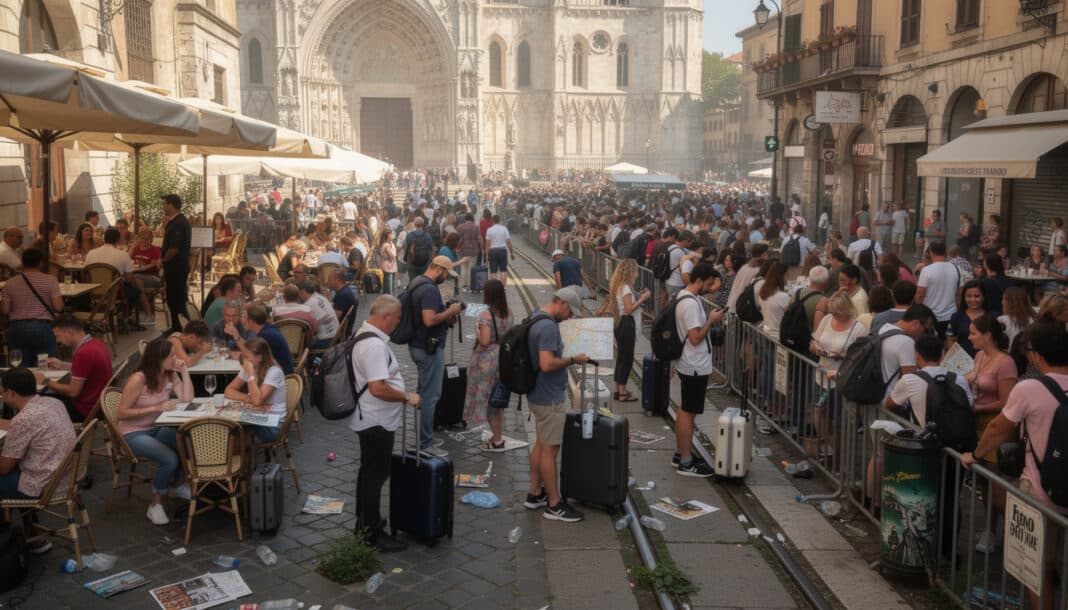
In short: Each year, Fodor's guide reveals the destinations where mass tourism is irreparably damaging the environment and local communities. Bali, Venice, Barcelona, Mount Everest and Koh Samui are among the places where tourist saturation has exceeded sustainable limits. These destinations, once paradisiacal or culturally rich, are suffering a true ecological and social apocalypse. Faced with this phenomenon, rethinking travel choices becomes an act of responsibility toward the preservation of sites.
🌍 When tourism success becomes a curse for destinations
Imagine an ancient, fragile manuscript whose pages are turned without care, whose ink fades under the hurried fingers of millions of readers. That is exactly what is happening in the world's major tourist hubs: accelerated wear, progressive destruction of a heritage that took centuries to build. Overtourism is no longer a statistical curiosity; it is an ecological and human emergency.
Originally, these destinations attract precisely because they have something rare: unspoiled natural beauty, a living culture, authentic traditions. But as soon as they become popular, they begin to burn out. Infrastructure cracks, resources are depleted, residents flee. This paradox of mass tourism reveals an uncomfortable truth: scarcity and authenticity disappear as soon as they are commercialized on a large scale.
🏝️ Bali: the island of the gods emptied of its substance
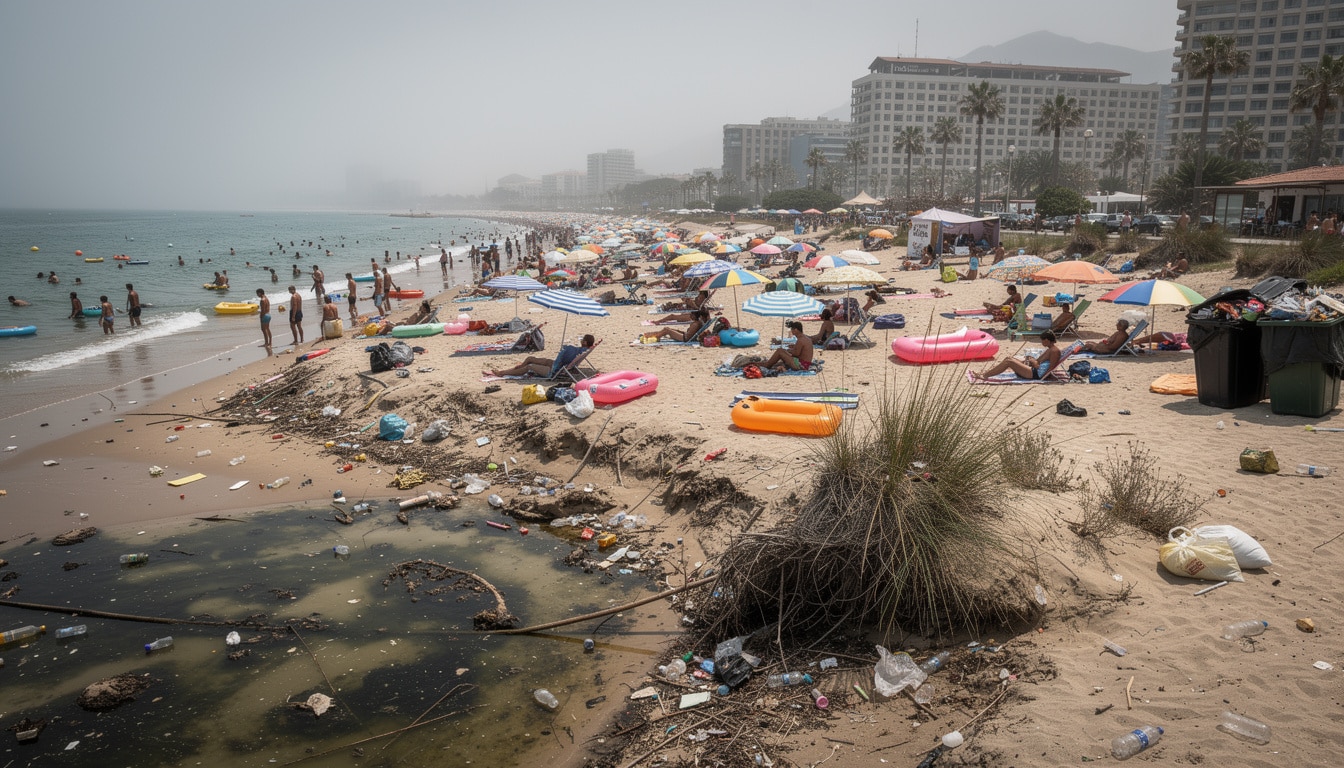
Bali now receives flows of visitors that would have seemed unimaginable a decade ago. In 2024 alone, the Indonesian island recorded 3.5 million foreign tourists in the first seven months of the year, an increase of 22% compared with the same period in 2023. This influx far exceeds the island's capacity for resilience.
The symptoms of this overload are visible everywhere. The beaches of Kuta and Seminyak, once preserved, now groan under mountains of waste. A true ecological disaster in which plastic accumulates day after day, year after year. According to a WWF expert, “the rapid expansion of Bali has had severe environmental consequences. Tourism here has evolved with minimal foresight and investment in sustainability, leaving Bali's ecosystems extremely vulnerable.” Without significant intervention, the island's most precious natural areas risk disappearing completely.
Beyond visible pollution, it is a millennia-old irrigation system called subak that is falling apart. These terraced rice paddies, listed as a World Heritage site, represent much more than an agricultural technique: they are a balance between humans and nature that the diversion of resources toward tourism infrastructure directly threatens. How can Balinese culture be preserved when there is no water for the rice fields, while pools at resorts overflow?
🇪🇸 Europe on the brink of exasperation: when residents demand a stop
The phenomenon of overtourism is not limited to tropical islands. In Europe, the most emblematic cities are experiencing a veritable backlash from residents against the tourist influx. In Barcelona, during the summer of 2024, residents sprayed tourists with water pistols as a sign of protest. That gesture, both symbolic and exasperated, sums up the atmosphere of growing tension in European metropolises.
Majorca, the Canary Islands and Venice are seeing similar gatherings where local populations express their anger. These cities, which bet their entire economic development on tourism, are now discovering that this short-sighted strategy destroys precisely what made them attractive. Infrastructure collapses, prices soar, authenticity evaporates.
In Lisbon, the situation is taking an even more dramatic turn: 60% of housing is now dedicated to tourist rentals, while long-standing residents are pushed to the peripheries or into exile. Since 2013, 30% of the population has left the city. Rent prices are exploding; local life becomes impossible. Lisbon is now one of the least affordable capitals in the world. This is no longer tourism; it is a silent economic colonization. Discover which tourist destinations you should absolutely avoid if you want to help preserve these sites.
⛰️ Asia under pressure: when nature gives way under the weight of visitors
Far from Europe, other exceptional sites are enduring their own ordeal. Mount Everest, the ultimate symbol of human adventure, has been turned into an open-air dump. Some 30 tons of waste and huge quantities of human excrement litter its slopes, turning this sacred place into a true ecological nightmare.
The villages in the surrounding valleys, once lively rural communities, are becoming giant hotels where farmland is converted into restaurants for tourists. Authenticity disappears, replaced by a commercial spectacle. The ecological balance of the entire region is severely threatened, and inadequate infrastructure can no longer absorb the flow of climbers.
Koh Samui, the Thai island prized for its dream beaches, generates between 180 and 200 tons of waste daily. Waste management remains an unsolvable problem: tourists and residents alike produce an amount of waste the island simply cannot process. Dr. Wijarn Simachaya, president of the Thai Environment Institute, admits: “We still cannot find a sustainable solution.” Worse, the upcoming broadcast of the series The White Lotus, filmed on the island, promises a new wave of visitors, inevitably worsening the ecological crisis.
🚨 Destinations in danger: before it's too late
Fodor's does not stop at denouncing past ills; it also warns about places that are beginning to crack under pressure. Agrigento in Sicily is preparing its year as Italian Capital of Culture in 2025, which is likely to attract hordes of additional visitors. Yet the region is already suffering from a severe water crisis, a situation that could become critical with the arrival of millions more tourists.
In the Caribbean, the British Virgin Islands are suffering the onslaught of cruise tourism. In only six months of 2024, they welcomed more than 683,000 passengers, a 17% increase compared with the same period the previous year. The problem? These cruise tourists spend very little locally, unlike those who stay in hotels. The positive economic impact is limited while environmental degradation progresses.
Other destinations are also beginning to show warning signs: Kerala in India, Kyoto and Tokyo in Japan, Oaxaca in Mexico, and the North Coast 500 in Scotland. Each of these regions represents a case study of failed responsible tourism, where environmental consciousness arrives too late. Check the destinations to avoid this year to limit your impact if you are planning a trip.
🤔 Rethinking your relationship with travel: beyond the simple blacklist
Fodor's blacklist is not a boycott; it is an invitation to reflect. It doesn't say “never go to Bali”; it says rather: “if you go there, you will contribute to its destruction.” That's a fundamental nuance, because it asks travelers to take responsibility.
Choosing a less crowded destination, adopting sustainable tourism practices, staying with locals rather than in standardized complexes: these are gestures that, multiplied by millions of travelers, could entirely redraw the map of global tourism. Every travel decision is a vote for the kind of world we want to build.
Like in the ancient art of bookbinding, where each stitch must be thought out before being tied, travel requires intention. One cannot travel the world as an indifferent spectator. The threatened biodiversity, the weakened communities, the denatured sites: all are consequences of repeated individual choices. Reversing this trend requires the same accumulation of conscious acts, voluntary renunciations, and paths abandoned in favor of quieter adventures.
The beauty of a destination lies as much in its preservation as in its discovery. Perhaps the true journey consists in seeking forgotten places, tranquil villages, landscapes that have not yet cracked under the weight of millions of eyes. What remains to be explored is not so much new lands, but a new way of respecting them.
Profil de l'auteur
Derniers articles
 Everyday Life & Society23 September 2026Consumer confidence index: what the monthly mood check on British households really measures
- Agency, Webmarketing & SEO31 August 2026SEO : a Google bug skews visibility statistics in AI results
- Tech & Multimedia29 August 2026Earbuds that transcribe your meetings without a smartphone : how Plaud One changes things
- Home Appliances & Equipment28 August 2026Home appliances: the durability index extends to four new appliances




Table of Contents