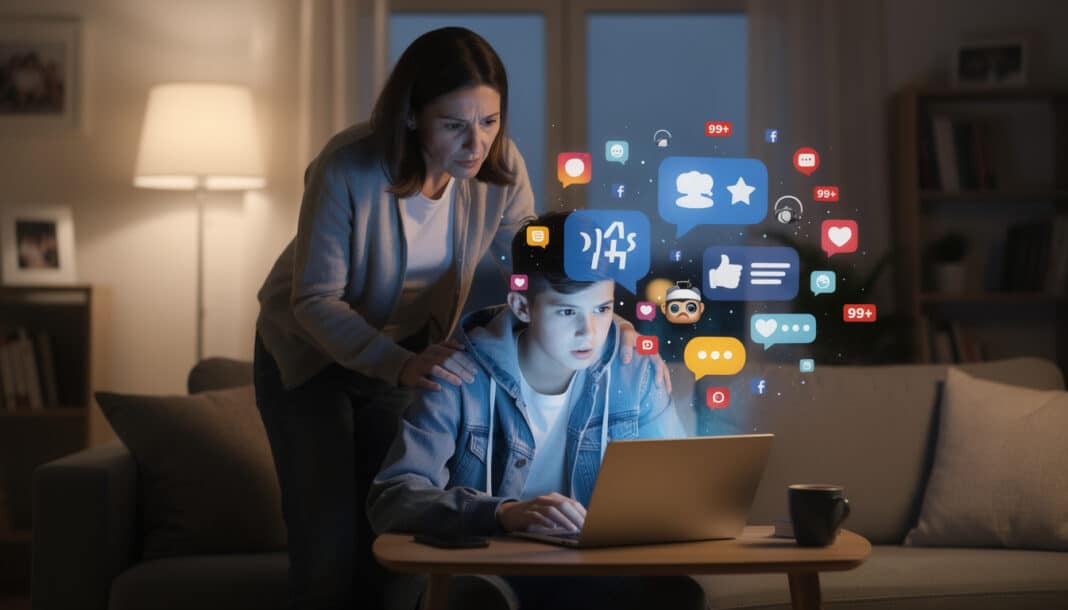
In short: French teenagers receive their first smartphone as early as age 9 and are exposed daily to digital risks: cyberbullying, theft of personal data, online scams. In the face of this reality, structured prevention and awareness measures are being deployed for young people, their families and the educational community. Illustrated booklets, mobile applications, educational games and online resources form a genuine protection strategy to cultivate a responsible and conscious use of digital technology. The challenge is no longer limited to parents: educators, platforms and public institutions are committed to building a new generation capable of navigating the web without excessive fear, but with discernment.
When the screen becomes a daily companion: understanding young people's early exposure
Childhood has changed. Where once one waited until high school to discover computing in class, today a nine-year-old child already holds a tablet in their hands, and by around eleven, a personal phone is entrusted to them. This phenomenon, very real in 2026, raises a delicate question: are we truly prepared for this digital acceleration?
This early access to digital tools shapes habits before critical judgment is fully developed. Adolescents encounter a web of varied risks there: cyberbullying that enters bedrooms, theft of personal data via deceptive forms, accounts hacked without warning. Paradoxically, many of them feel cautious online — a confidence sometimes excessive, born of familiarity with technology rather than a real understanding of the dangers.
The formation of digital behaviors takes place precisely during this period. It is now that reflexes are engraved, gestures repeated a thousand times: sharing a photo, clicking on a link, ignoring a warning. These routines, good or bad, will remain long after adolescence.
Invisible risks: beyond the surface of screens
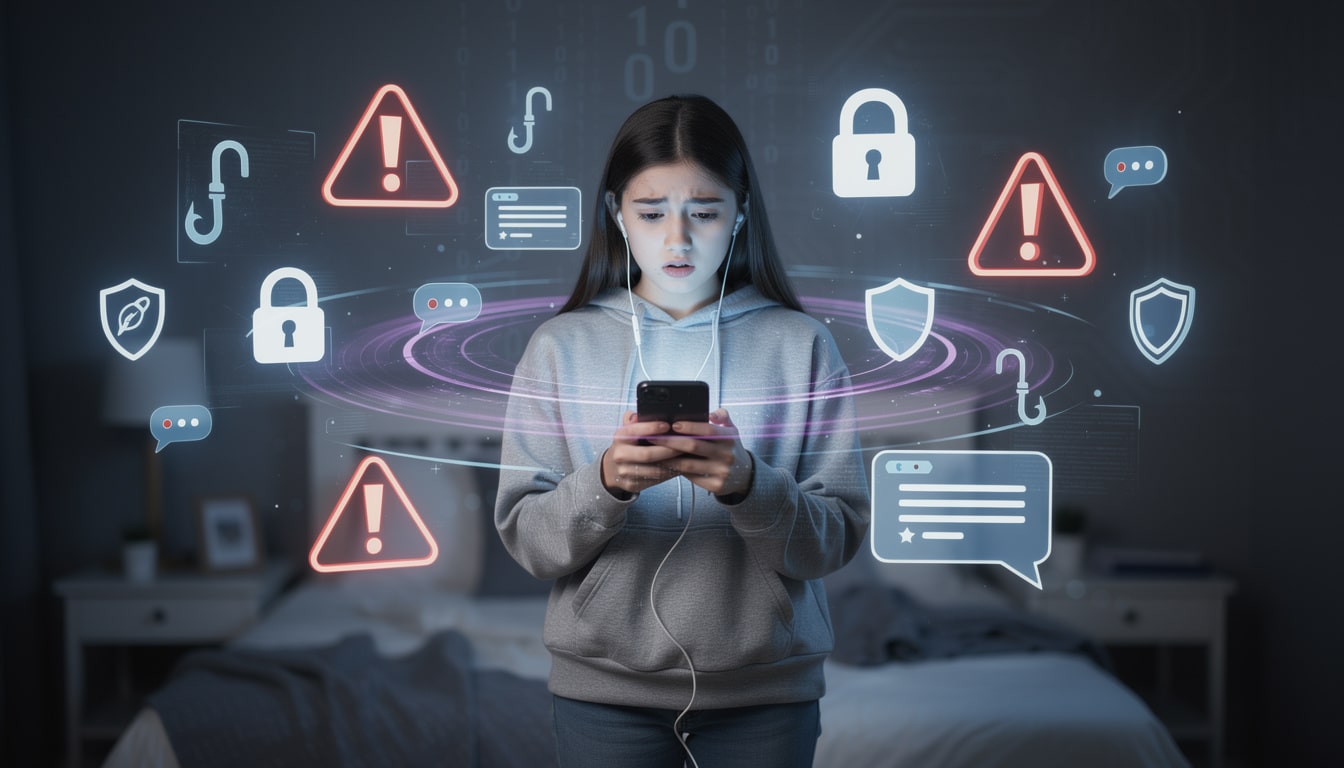
Surfing the internet without perceiving the perils is like walking in a forest without knowing the paths. Social networks in particular concentrate a range of vulnerabilities that young people do not always see clearly. Between the quest for social recognition and the need to belong, they are exposed to psychological dynamics designed to keep them, even to captivate them beyond reason.
Digital addiction is a direct manifestation of this. It is not a simple weakness: platform algorithms are designed to maximize engagement time. Each notification is a small reinforcement, each like a dose of validation. For an adolescent forming their identity, these mechanisms exert a subtle but real pressure.
Beyond addiction, the dangers of the web take many forms. Phishing arrives via private message, presented as an opportunity or an emergency. Identity thefts are woven from information gleaned here and there on a profile. Blackmail exploits images shared in confidence. Each of these threats arrives in a relational context that makes them more believable, more difficult to identify for a developing mind.
The impact on adolescents' mental health
Scientific research converges on one point: intense use of social networks has a lasting influence on how young people will perceive the world as adults. This influence first acts on self-image, shaped by constant comparison and exposure to others' gaze. It also affects anxiety, depression, sleep — fundamental dimensions of psychological balance.
What makes this dynamic particularly insidious is that it unfolds in the background, normalized, invisible. An adolescent can spend two hours on their screen without perceiving the real cost: cognitive fatigue, the absence of quiet moments, the fragmentation of attention. These costs accumulate, day after day.
Building defenses: the prevention strategy being deployed
Faced with these challenges, an articulated protection strategy is emerging. It does not rely on a single solution, but on a set of resources designed for different ages and contexts — an approach that the bookbinders of old would well understand: assembling distinct elements to form a coherent whole.
The starting point rests on a simple conviction: good practices in digital security are acquired from a very young age. That means intervening before habits crystallize, when it's still possible to influence the trajectory. That's why educational tools are flourishing, designed to speak the language of young people rather than to preach at them.
Educational resources: when learning becomes playful
The booklet « Le numérique, pas de panique ! » offers a good example. Published in 2025 and designed for 9-12 year olds, this tool mixes colorful comics and practical advice in an A5 twelve-page format. The situations covered — cyberbullying, fraudulent sites, online games, viruses — are precisely those a child of that age will encounter. The tone is never moralizing: the aim is to equip, not to guilt.
This logic extends to other media. « L'Agence Privacy », a four-volume manga by the CNIL, speaks to the sensibilities of 11-15 year olds using the graphic codes that attract them. « FantomApp », a mobile application, supports young people in protecting their data and understanding their rights. Each tool is conceived as an entry window, not as a barrier.
Games like « 1, 2, 3 Cyber ! » or « Cyber-Enquête » turn learning into a collective adventure. The family game « L'Odyssée du numérique » creates a space where parents and children exchange practices and confront viewpoints. These important moments remain etched in memory in ways that a frontal lecture never could.
Supporting families: creating a dialogue
Families constitute a frontline often underestimated. They account for a growing share of help requests to services like Cybermalveillance.gouv.fr. Yet many parents feel overwhelmed, less comfortable than their children with technology, and therefore unable to exercise relevant supervision.
The « Cyber Guide Famille » directly responds to this distress. In ten practical recommendations, it covers everyday gestures: how to protect account access, back up data, shop online safely, stay vigilant on social networks. These tips do not assume technical expertise from the parent — they rely on common sense applied to the digital context.
The approach highlights a forgotten truth: the child learns as much by example as by instruction. If a parent shares their own questions about technology, if they acknowledge not knowing everything, they create a space where asking becomes acceptable. It is in this dialogue, not in prohibition, that good reflexes germinate.
Schools on the front line: weaving a prevention curriculum
The national education system has understood that ignoring the phenomenon would amount to abandonment. Programs like « Permis Internet pour les enfants », designed by the Gendarmerie Nationale and AXA Prévention, intervene just before entering middle school — that critical moment when behaviors and risks change significantly. The analogy with the rules of the road is telling: behaving cautiously on the internet follows the same logic as conducting oneself in traffic.
Awareness videos integrated into the Pix pathways for sixth graders address specific skills: recognizing phishing, choosing a robust password, identifying personal data, detecting cyberbullying. These learnings are part of a certification recognized by the State, which values them for adolescents. Acquiring a digital skill becomes an achievement, not a punishment.
Pix.fr, in partnership with ANSSI and Cybermalveillance.gouv.fr, has developed a cybersecurity framework. From the age of thirteen, students learn to identify and react to threats, protect their devices, and browse safely. Integrating this into the curriculum transforms prevention into an expected, normal, embedded skill.
Beyond the screen: turning usage into responsibility
Protecting adolescents from the dangers of the web does not mean keeping them away from the internet — that would be as futile as banning fire because it can burn. It is rather about equipping them with a fine understanding of the mechanisms at work, cultivating their critical thinking toward content, requests, and solicitations.
A campaign like « Cyber en Clair », launched during Safer Internet Day, directly asks the questions a young person wonders about: what does cybersecurity mean concretely? Are downloads really safe? How to browse without being scammed? These questions, phrased simply, open spaces for reflection. The answer does not come as a prohibition, but as a welcome clarification.
Responsible use is built through the accumulation of small learning moments. Each interaction with a tool, each situation encountered, each conversation with an adult who takes the time to explain rather than to condemn — all are bricks that build an authentic digital citizenship.
When expertise becomes accessible
What characterizes the ongoing strategy is the democratization of expertise. Previously, the only sources of information came from specialized articles or technical speeches. Today, public organizations like CNIL, Cybermalveillance.gouv.fr, and Arcom make structured, free knowledge available in varied forms: booklets, mangas, applications, games, videos, podcasts, formats adapted for people with dyslexia.
This multiplicity of formats responds to a pedagogical certainty: not everyone learns the same way. The adolescent who hates textbooks will find FantomApp appealing. The one who loves stories will immerse themselves in a manga. Another will find their fit in a board game where discussion takes precedence over technology. No format is better — they are simply different, suited to different minds.
This wealth of resources is itself a form of protection. It means that a curious young person, a worried parent, an engaged educator will never feel isolated. The tools exist, free and accessible. The political will to produce and disseminate them is explicit.
The invisible architecture: who is truly building this protection?
Behind each resource hides a silent orchestration. Partnerships between ministries, cybersecurity organizations, child protection associations, technology companies. Cybermalveillance.gouv.fr catalogs and makes available content produced by its members — an approach that recognizes no single actor can cover the entire territory.
The association e-Enfance, with its helpline 3018, completes this ecosystem. It receives calls from young people in distress, alarmed parents, and observes the evolution of the dangers of the web in real time. This proximity to the field directly informs the design of educational tools. One does not create “for” young people: one creates “with” them, nourished by their real questions.
This collaborative architecture recalls what is unknown in manual trades: producing quality requires a constellation of know-how. A bookbinder never creates his masterpiece alone. He collaborates with papermakers, publishers, artisans who work the leathers. Similarly, effective protection of adolescents does not arise from solitary will, but from a fabric of actors who talk to each other, feed each other, and recognize their respective limits.
The challenge of sustainability
A question remains, silent but pressing: how to maintain this mobilization? Resources are created, campaigns launched, partnerships established. But technologies evolve, risks transform, and today's adolescents will invent unpredictable uses tomorrow. The strategy cannot be frozen. It must remain alive, capable of adapting.
This requires continuous attention, an honest evaluation of what works, humility in the face of limits. It also means that responsibility does not rest solely with experts. Every parent who talks with their child about what they encounter online, every educator who takes the time to listen rather than to punish, every young person who explains to a younger friend how to protect themselves — all participate in this collective architecture.
Internet addiction and social networks will not disappear. The screen will remain a companion of childhood and adolescence. But the trajectory young people follow with this companion depends on the care with which we build the conditions for a conscious, thoughtful, protected — and ultimately free — encounter.
Profil de l'auteur
Derniers articles
 Electricity, Gas & Energy14 September 2026Gaz et électricité : ce que la hausse des tarifs va changer sur votre facture
- Agency, Webmarketing & SEO12 September 2026Fusion Omnicom-IPG : ce que la plus grande agence de publicité au monde change pour les marques
- Retirement & Senior Living10 September 2026Carte Avantage Senior SNCF : comment voyager moins cher en train après 60 ans
- Tech & Multimedia8 September 2026Objets connectés : la fin de la 2G et le nouveau Data Act vont rebattre les cartes




Table of Contents