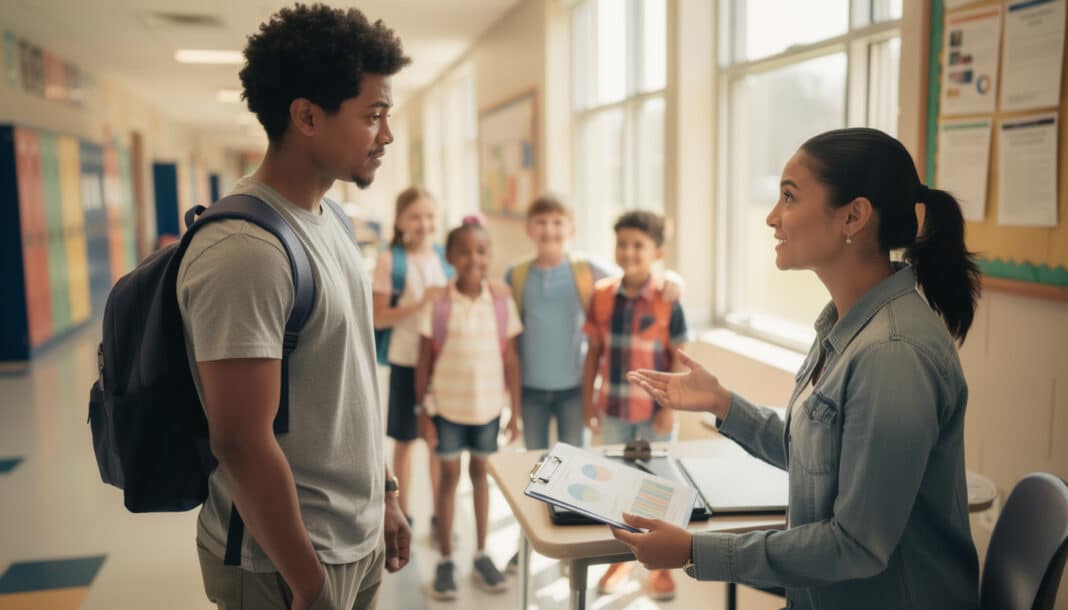
In brief — School bullying remains one of the most silent and destructive realities in our schools. Far from being a simple quarrel between children, it is a form of structured violence that leaves lasting scars. Parents often find themselves helpless faced with this phenomenon, oscillating between doubt and guilt. Yet, legal frameworks exist, support resources are multiplying, and above all, concrete actions can be taken today. Understanding the mechanisms of bullying — including its digital form, cyberbullying — helps to detect it better and act appropriately. Because protecting a child from bullying also means weaving around them a vigilant community, capable of seeing what hides between the lines.
Recognizing the hidden signs of school bullying
Bullying at school doesn't always announce itself with shouts or visible bruises. Like those old bindings where the damage first appears on the inside — on the pages — before showing on the cover, the suffering of a bullied child can remain invisible for months. A progressive withdrawal, growing anxiety before class, a loss of interest in activities once loved: these are the first threads that come undone.
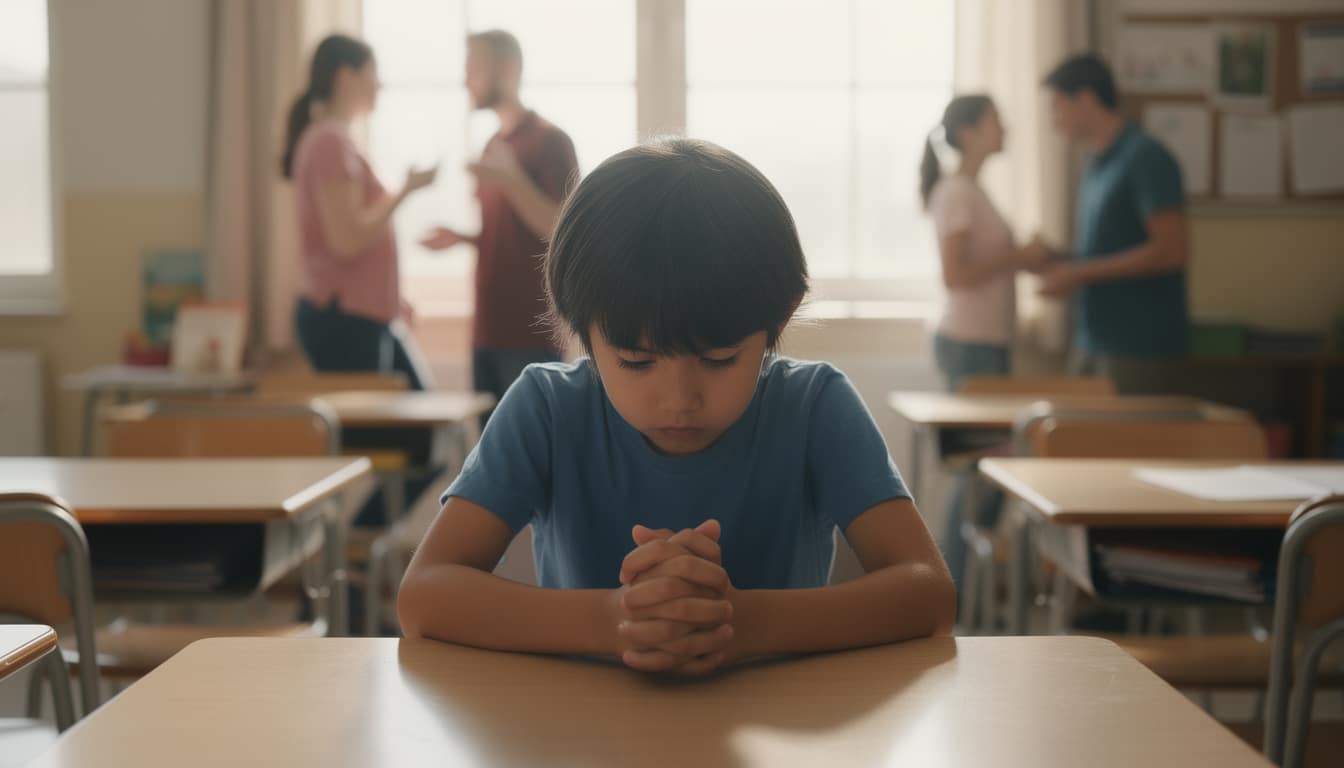
Behavioral changes deserve particular attention. A bullied child may refuse to go to school, invent excuses of illness or display new irritability. Some withdraw completely, while others develop sleep disorders or a noticeable drop in academic performance. Silence sometimes becomes the worst response: the child does not speak, convinced that speaking would make things worse or that they would be judged.
In the digital age, bullying no longer stops at the school gates. Cyberbullying — online insults, sharing humiliating photos, exclusion from messaging groups — extends the suffering into the bedroom, with every notification, with every browser refresh. A parent who discovers these elements online would do well to document the facts with screenshots, because this evidence becomes essential in the face of the child's legal rights that must be protected.
Understanding the legal framework and the child's rights
In France, school bullying is not just an educational problem: it is also a legal matter. The law protects you and your child through precise texts that recognize the seriousness of the phenomenon. The Code pénal qualifies bullying as an offense punishable by prosecution, while the Code de l'éducation imposes on institutions an obligation of vigilance and action.
A child's right to a safe environment is not a kindness: it is a legal obligation of the State and the school. Since the strengthening of the texts, school principals must report cases, investigate and implement disciplinary measures. Parents also have recourse: school mediation, a complaint to the académie, or filing a report if the facts constitute a criminal offense.
For understanding how to effectively fight school bullying, you must first grasp that this battle is never that of a single parent, but of an institution required to react. A written request to the administration, a copy to the rectorat, a consultation with a specialized lawyer: so many actions that turn speech into documents, concern into a file.
Immediate support resources to help your child
When the suffering becomes apparent, the urgent task is to place the child in emotional safety. Psychological help forms the foundation of any response: a school psychologist, an external therapist or a helpline such as 3018 (dedicated to children victims of cyberbullying) can offer a compassionate voice, free from judgment or guilt.
These resources are not luxuries: they are concrete supports. Listening to your child, reassuring them that the responsibility does not lie with them, creating a space where shame no longer overrides trust — this is the patient work that begins at home. At the same time, associations like SOS Amitié offer continuous support services, while some schools provide mediators or adult liaisons specially trained for these situations.
Prevention as an act of transmission
Preventing bullying means building an environment where empathy becomes the rule, not the exception. It resembles the meticulous work of bookbinding: creating a structure where each element supports the others, where no page is sacrificed. Schools that invest in programs promoting kindness, emotional education and citizenship see bullying behaviors decrease.
Parents have a crucial role to play at home. Educating children to respect differences, teaching them to recognize bullying behavior even when they are not directly affected, cultivating the idea that speaking out is not betrayal — all this builds a generation capable of defending their peers. Transmission also passes by example: showing how to handle a conflict without violence, how to apologize, how to change one's mind.
Digital tools require new attention. Talking with your child about online responsibility, setting social media privacy settings, checking contacts — this is not intrusion, it's prevention. Cyberbullying thrives in indifference and the absence of dialogue. Who checks? Who asks? Who takes the time to look for the invisible traces?
Acting in a situation: concrete steps
The first step remains listening without judgment. A child who confesses bullying has crossed a wall; contradicting or blaming them risks consolidating silence for years. After this listening comes documentation: keeping records of dates, facts, potential witnesses, screenshots in case of cyberbullying.
The second step is to alert the school. A meeting with the teacher or the administration makes it possible to understand what is happening and what has already been observed. A written request addressed to the head of the institution creates an administrative record: it commits the school and establishes legal responsibility. This letter should be precise, factual, without aggression, but firm in the request for action.
The third step mobilizes outside supports: psychologist, school mediator, or, if necessary, law enforcement for acts constituting an offense. At the same time, protection measures must be put in place for the child victim: change of class if possible, increased supervision, creation of safe spaces.
Rebuilding trust after bullying
Healing from bullying is not a matter of weeks, but of months, sometimes years. The rebuilding of self-esteem requires patience and consistency. A child who has experienced bullying often carries guilt they should not bear: the work of parents and professionals is to tell them, tirelessly, that the violence suffered was never their fault.
Small victories count: gradually reintegrating into social activities, reconnecting with forgotten pleasures, slowly weaving new friendships. Some children benefit from reinforced academic support to catch up on learning lost during the period of bullying. Others find meaning in getting involved with classmates in difficulty, transforming their experience into strength.
This reconstruction is like the work of a bookbinder faced with a damaged book: one never hides the scars, one integrates them. The child who survived bullying does not forget, but they can learn to live with the memory without letting it define their future. The role of adults is to maintain a vigilant, warm presence, capable of seeing when doubt resurfaces.
Profil de l'auteur
Derniers articles
 Electricity, Gas & Energy14 September 2026Gaz et électricité : ce que la hausse des tarifs va changer sur votre facture
- Agency, Webmarketing & SEO12 September 2026Fusion Omnicom-IPG : ce que la plus grande agence de publicité au monde change pour les marques
- Retirement & Senior Living10 September 2026Carte Avantage Senior SNCF : comment voyager moins cher en train après 60 ans
- Tech & Multimedia8 September 2026Objets connectés : la fin de la 2G et le nouveau Data Act vont rebattre les cartes




Table of Contents