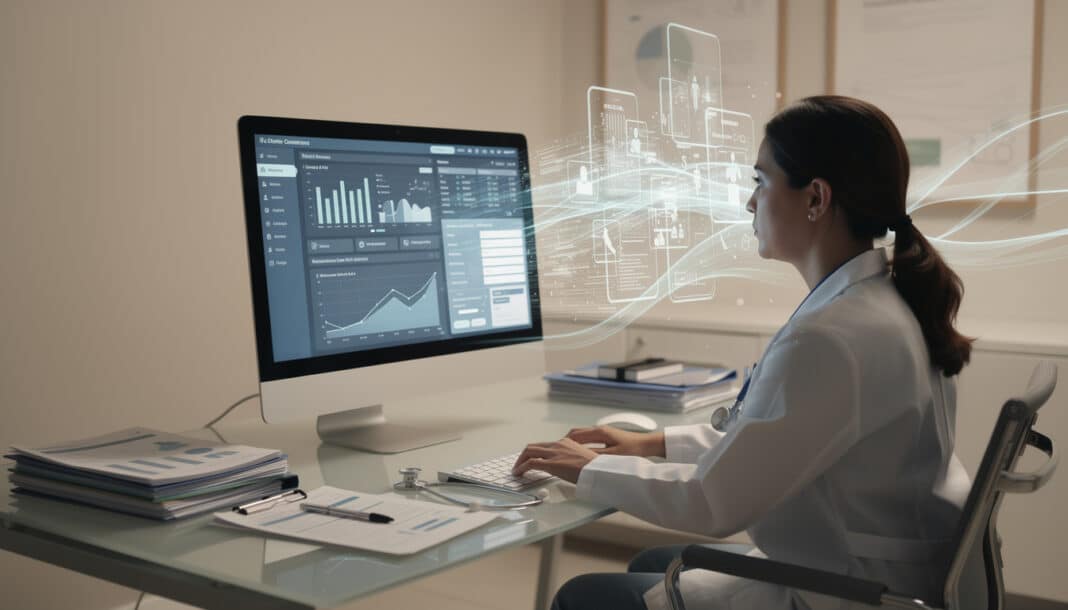
In short — The Noémie teletransmission has transformed the administrative landscape of healthcare in France. This system of electronic transmission automates the sending of claim forms to health insurance and mutual insurers, eliminating paper delays and speeding up reimbursements. For patients as for professionals, it is a quiet but profound simplification: fewer hassles, more fluidity in the management of reimbursements.
Understanding the Noémie teletransmission and its role in processing care
There is a certain poetry in small administrative revolutions — those that go unnoticed but which, quietly, change everyday life. The Noémie teletransmission is one of them. Named after an acronym that became a proper name (Mandatory Exchange Standard for Managing Exchanged Information), it embodies this desire to automate, to streamline, to make transparent what was once a succession of manual gestures: printing a claim form, sending it to the Sécurité sociale, waiting for reimbursement.
Before this transition, each consultation left a paper trace. The patient filled it out, corrected it, sometimes forgot. The document traveled by post, occasionally got lost, waited in sorting trays. Now, all of that happens in the background, almost naturally. It is like moving from manual binding to assembly-line binding: the result is similar, but human energy is freed for what matters most.

How this electronic transmission system works
The mechanism appears simple, but relies on a robust technical architecture. When a patient visits their doctor, the physician records the consultation information in their management software. Thanks to teletransmission, these data — diagnosis, procedures performed, amounts — are sent automatically to the secure servers of the assurance maladie and the mutuelle, without passing through paper.
This electronic transmission operates according to a standardized protocol that guarantees the security of sensitive patient data. Information is encrypted, timestamped, and a record of each exchange is kept. It is a bit like old ledger books, where every intervention was entered in the register: one knew exactly who had done what, and when.
The patient no longer needs to keep their claim form as a relic. It now exists in the digital flow, quietly awaiting processing by the reimbursement IT systems.
The impact of Noémie on reimbursement speed and the patient experience
Before the generalization of this system, reimbursement times ranged between three and four weeks. Today, thanks to automated reimbursement management, patients see money return to their account much more quickly. Some electronic transmissions are processed in just a few days — an acceleration that seems minor on paper, but that reshapes each person's real experience.
Imagine the craftsman waiting for reimbursement of his healthcare expenses to pay his medical debts. Every day counts. Or the mother managing a tight household budget. This regained administrative fluidity is also a form of respect: people no longer have to wait for what is rightfully theirs.
Security, compliance and trust in the exchange of sensitive data
Data security is not a cosmetic detail in this system. Health information is among the most sensitive a person possesses — it reveals our fragilities, our bodily secrets, our vulnerability. The protocols for electronic transmission therefore rely on high-security encryption standards and regular audits to ensure that no link in the chain fails.
Each transmission is authenticated: the doctor sending the data must prove their identity, and the recipient must confirm receipt. It's like a signature affixed to an old document — the gesture that creates authenticity, that says: “It's me, I take responsibility for this act.”
Regulatory compliance is constantly evolving. Legislators, aware of the stakes, are tightening requirements. For medical practices and mutual insurers, this means continually investing in their infrastructures. Choosing a single, integrated software to manage these data thus becomes a strategic issue, reducing the blind spots where security could fail.
The role of healthcare professionals in the system's effectiveness
Although automation is at the heart of Noémie, the human remains indispensable. Doctors, nurses and other professionals must accurately enter information into their patient records. An error, even minor — a missing procedure code, an incorrect amount — can slow down or block processing.
That is why ongoing training remains essential. Practices invest in training their teams, so that everyone understands the importance of this smooth exchange. There is nothing romantic about ticking the right boxes, and yet it is an action that, repeated thousands of times a day, weaves the safety net of reimbursement for millions of people.
For demanding practices, using a unified software platform facilitates this rigor, by centralizing workflows and reducing the risk of omission or duplication.
Noémie and the relationship between patient, practitioner and health insurance
Teletransmission has redefined the relationships between the three actors in this chain. Previously, the patient was at the heart of the process: they handed over their claim form, they waited, they followed up if necessary. Now, they are at the periphery — which may seem strange, but which is actually liberating. Their role is simplified: they receive care, they use their Vitale card, and the rest happens without them.
The practitioner, meanwhile, gains administrative responsibility. They must now precisely complete fields that will feed directly into reimbursement systems. It is an increased burden, but also a certain pride: their administrative actions have a direct and measurable impact.
As for health insurance and mutual insurers, they benefit from unprecedented visibility. Data arrive pre-structured, verifiable, auditable. This allows better fraud prevention, optimized flows, and ultimately, a healthier and fairer system for all.
Emerging challenges and the future of electronic transmission
Despite its advances, Noémie faces lasting challenges. Some small rural practices, less well equipped or less familiar with technologies, struggle to adapt. Regional disparities persist. How can we ensure that this modernization does not create divides between those who master the tools and others?
Interoperability between different systems also remains a point of tension. Each medical management software implements Noémie slightly differently. Compatibility errors can slow down transmissions. As the system ages and new uses emerge, the challenge will be to maintain coherent evolution, without leaving some actors behind.
And then there is the philosophical question: how far should automation go? At what point does the patient stop understanding what happens with their own data? This administrative fluidity, while improving the experience, does it not also create a certain opacity? These questions will remain relevant in the years to come, as other domains follow the paths that healthcare opens.
Profil de l'auteur
Derniers articles
 Electricity, Gas & Energy14 September 2026Gaz et électricité : ce que la hausse des tarifs va changer sur votre facture
- Agency, Webmarketing & SEO12 September 2026Fusion Omnicom-IPG : ce que la plus grande agence de publicité au monde change pour les marques
- Retirement & Senior Living10 September 2026Carte Avantage Senior SNCF : comment voyager moins cher en train après 60 ans
- Tech & Multimedia8 September 2026Objets connectés : la fin de la 2G et le nouveau Data Act vont rebattre les cartes




Table of Contents