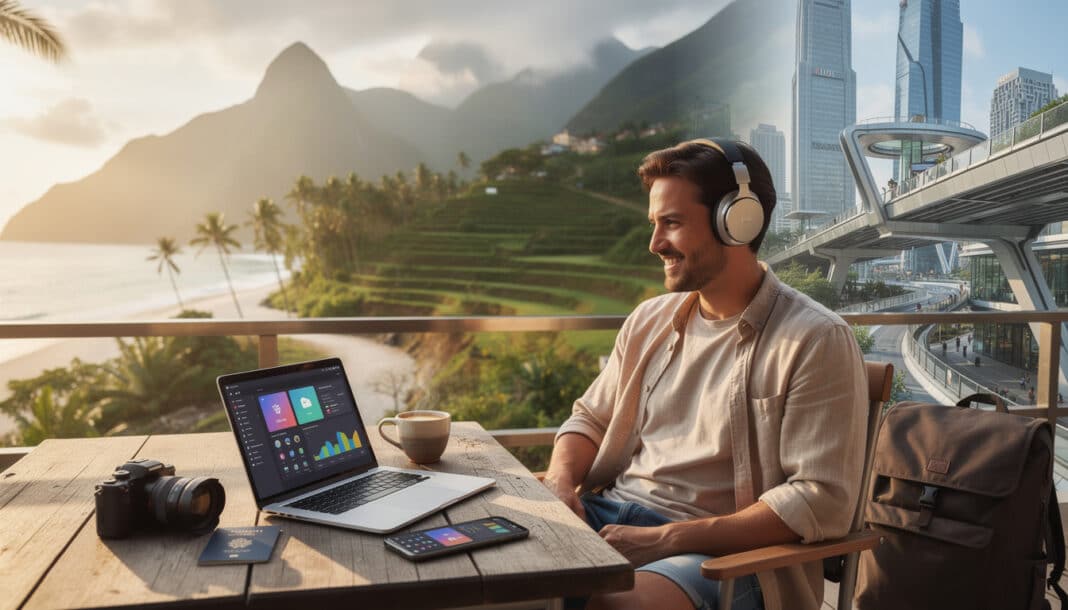
Summary : Digital nomadism has transformed into a structured global phenomenon. Sixty-six countries now offer dedicated visas, replacing the era when people juggled tourist visas. The 2026 trend leans toward Slomading — staying 3 to 6 months in the same place to build a real routine. Between Thailand and its five-year validity, Spain and its competitive taxation, or Portugal reinventing its incentive regimes, choices are becoming clearer. But behind the postcards lie concrete issues: stable internet connection, a clear tax framework, safety, and local integration. This strategy to become a digital nomad requires less romance and more rigor.
Key takeaways:
- 🌍 More than 66 countries offer a digital nomad visa, compared with only a few in 2020
- ⏱️ Slomading (staying 3-6 months) replaces monthly country-hopping
- 💻 A stable Wi‑Fi connection of at least 20 Mbps is non‑negotiable for remote work
- 💰 Living costs range from €900 to €5,000 monthly depending on the destination
- 🏛️ Taxation changes everything: some countries offer exemptions, others apply flat rates
- 📋 The European EES system (October 2025) strengthens checks at Schengen borders
- 🛡️ International health insurance is mandatory in almost all the best countries for this adventure
- ✅ Plan 2-3 months ahead: visa administrative delays are often longer than expected
The digital nomad visa revolution: when the world organizes to welcome you
In 2020, there was only Estonia. Today, sixty-six nations have understood that remote workers represent a source of sustainable economy without mandatory permanent residence. It's a silent but profound transformation: digital nomadism is no longer a gray area, but a legitimate strategy for international living.
This change did not happen by chance. The pandemic accelerated the normalization of remote work, and governments quickly seized the economic opportunity. A nomad who settles for three months in a city rents an apartment, eats at restaurants, pays for internet connections, frequents cafés. It's an economic presence without long-term tax commitment — exactly what post-tourist regions or countries undergoing digital transition are looking for.
But there is also an administrative dimension that changes the game. The EES (Entry/Exit System) deployed by the European Union since October 2025 now precisely traces each crossing of Schengen borders. Gone are the days of slipping from one country to another without questions. In 2026, legal clarity is no longer optional, it's imperative.

The best countries to work remotely: a hierarchy emerges
🇹🇭 Thailand and its Destination Thailand Visa: unlimited flexibility
If Thailand dominates the nomad destination rankings, it's not by chance. The Destination Thailand Visa (DTV) offers what no other country does: five years of validity with multiple entries. A single visa runner can stay 180 days, then exit and reenter for another equivalent period. No more calendar stress.
Costs remain unbeatable: €1,200 to €2,000 monthly in the city, with fiber regularly exceeding 100 Mbps. Chiang Mai still stands as the historical heart, but the 2026 trend moves toward an intelligent seasonal distribution. November to February in the mountains for cool climate, then migration to the southern islands (Ko Lanta, Ko Phangan) to escape the burning season of March–April.
One caution: Thailand tightened its tax rules in 2024. If you regularly repatriate money from abroad and stay more than 180 days per year, you risk local taxation. Consult a tax advisor before committing long term.
🇪🇸 Spain: the clever European mix
Spain remains the perfect balance for those who want Europe without sacrificing their budget. The telework visa allows residence for one year renewable up to five years. But the real asset is the Beckham Law: under certain conditions, you pay a flat 24% tax on your income — comparable to the best regimes in Western Europe.
The Canary Islands play a different game. Subtropical climate year‑round, GMT time zone perfectly aligned with London for English‑speaking clients, and the ZEC (Economic Expansion Zone) with additional tax benefits. Tenerife and Gran Canaria are gradually becoming hubs for nomads seeking climatic stability and strong professional networks.
But Europe means higher prices. Barcelona has exploded in rents in recent years. Valencia offers the same Mediterranean setting with 30% less — a logic experienced nomads have long internalized.
🇵🇹 Portugal in its new coordinates
Portugal had to reinvent its offer after the closure of the famous NHR regime in January 2024. The D8 visa for nomads now requires a minimum income of four times the Portuguese minimum wage — about €3,480 monthly. The new ITS regime offers a 20% flat rate, less universal than its predecessor but still attractive.
Lisbon and Porto remain cosmopolitan cities with a thriving tech scene. But the island of Madeira has turned its isolation into an asset. The specific program “Digital Nomads Madeira” creates a truly structured community with reliable internet infrastructure and a lower cost of living than Lisbon. It's Portugal's strategy to capture long‑term nomads: get off the beaten tourist tracks.
🇭🇷 Croatia: transparency as a weapon
Few countries publish their admission criteria with such clarity. Croatia offers up to 18 months of stay (vs. 12 previously) with an explicit threshold: €3,295 monthly income, or alternatives in saved capital (€39,540 for 12 months). After expiration, you can request a new permit after 6 months' absence.
Dubrovnik and Split attract the crowds, but Rijeka represents the smart alternative: a lively port city with reasonable rents, quick access to the islands of Krk and Cres for weekends, and an authentic local vibe far from tourist circuits. The Adriatic without the postcard destination price tag.
Croatia also joined the eurozone and the Schengen area in 2023, offering reassuring administrative stability for extended stays.
🇬🇷 Greece: the most affordable Mediterranean access
The Greek Digital Nomad Visa requires a minimum income around €3,500 monthly, with low administrative fees (€75 + €150). The “Work From Greece” program simplifies procedures and provides detailed guides in several languages.
Thessaloniki completely changes the perspective. The country’s second city offers daily life starting from €1,050 monthly on a budget — a real city with a university, port, restaurants, far from Cyclades tourist pressure. The trap? The islands in summer: unstable wifi, inflated prices, crowds. The winning strategy remains: city in spring/autumn, micro‑island stays off season.
🇪🇪 Estonia: the digital pioneer looking toward 2030
Estonia launched the world's first digital nomad visa in 2020, and keeps its technological lead. The Digital Nomad Visa exists in two versions: short (type C, 90 days, €80) or long (type D, 1 year, €100). Income thresholds are demanding: €4,500 gross monthly over the 6 months preceding the application.
But the real treasure is the e‑Residency program (distinct from the visa). It allows creating and managing a 100% online European company — an ideal complement for freelancers seeking a legal structure. Tartu, a university town, offers a quiet alternative to Tallinn with affordable rents and calm coworking spaces. Internet is among the fastest in Europe. The climatic challenge: harsh winters from November to March.
🇨🇴 Colombia: 2 years and an inclusive policy
The Colombian Visa V Nómadas Digitales offers one of the most generous terms in the world: two years of validity with one of the lowest entry thresholds (~$900 monthly, i.e., 3 legal minimum salaries). Medellín proclaims itself the nomads' capital thanks to its perpetual spring climate, its cafés, and a cost of living that allows a comfortable lifestyle for €1,000 to €1,500 monthly.
Be careful, however: beyond 183 days per year, you become a Colombian tax resident. The UTC‑5 time zone aligns perfectly with the American coast — strategic for freelancers working with US clients. Coffee region cities (Manizales, Pereira) offer more authentic alternatives than El Poblado, which has significantly gentrified.
🇮🇩 Indonesia and the E33G visa: finally a legal framework
Bali was the iconic nomad destination, but in a legal gray zone. The E33G “Second Home” visa changes everything: one‑year residence renewable with access to the entire archipelago. It's the official end to visa runs to Singapore.
Canggu remains the international hub with its legendary coworkings (Dojo, Outpost), but saturation pushes toward Ubud (quieter, spiritual vibe) or Lombok (less touristic). Internet has improved: fiber exists in the main nomad areas. The lifestyle remains luxurious: villa with pool, scooter, daily restaurants for €1,500 to €2,000 monthly.
🇲🇾 Malaysia: DE Rantau and its three categories
The DE Rantau program, managed by MDEC, is one of the most structured in Asia. Fees are minimal (MYR 1,000, about €200) for the main applicant, with the possibility to include dependents. Income thresholds vary: $24,000 annually for tech profiles, $60,000 for others. Validity? 3 to 12 months renewable.
Kuala Lumpur offers affordable luxury: infinity pools, air‑conditioned malls, English widely spoken. Penang (George Town) seduces with its UNESCO heritage and exceptional gastronomy. In 2026, the program extended its certified hubs to Langkawi on the east coast — reliable internet infrastructure in an island setting.
🇨🇷 Costa Rica: zero tax and exuberant nature
Costa Rica stands out for a major tax advantage: the Estancia for Remote Workers program provides a tax exemption on declared income. The visa is valid for 1 year, renewable once (180 days minimum the first year). It's a massive argument for high earners.
Biodiversity changes everything: volcanoes, rainforests, beaches on two oceans. The Central Valley (San José, Cartago) offers internet stability and access to services. The coasts (Santa Teresa, Tamarindo) attract surfers but suffer from fragile connections. Winning strategy: base in the Central Valley with weekend nature getaways.
🇦🇪 Dubai: zero tax, premium prices
Dubai plays in a category of its own. The Virtual Working Programme offers zero income tax — combined with a global infrastructure (ultra‑fast internet, security, transport, hospitals), it's the premium choice par excellence. Entry threshold? $5,000 monthly, which filters profiles but guarantees a high‑end professional environment.
The cost of living is high (€3,000 to €5,000 monthly to live comfortably), but for high incomes, tax savings more than compensate. Dubai is a strategic crossroads: halfway between Europe and Asia with direct flights worldwide. The main drawback? Temperatures from June to September regularly exceed 45°C, making outdoor life nearly impossible.
🇯🇵 Japan: intensive 6‑month immersion
Japan has chosen an elitist model: Digital Nomad visa limited to 6 months, not immediately renewable, requiring an annual income of ¥10 million (~€60,000) and equivalent minimum insurance. It's a visa for intense productive immersion in one of the most fascinating cultures.
Fukuoka is the well‑kept secret: designated “Startup City” by the government, it offers rents 30% cheaper than Tokyo, a vibrant tech community, direct access to the sea and Kyushu countryside. Japanese internet is among the fastest in the world. The challenge: no resident card (Zairyu Card) for this visa, so opt for share houses or short‑term furnished rentals.
Navigating pitfalls: taxation, insurance and concrete strategies
The 183‑day rule: when do you become a tax resident?
It's the question that annoys. The general rule says that if you stay more than 183 days in a country, you become a tax resident. But “general” hides subtleties that can be costly if misunderstood.
Some countries explicitly exempt foreign‑source income — that's the case for Costa Rica, Cape Verde, and Dubai with zero income tax. Croatia specifically excludes digital nomads from local tax. But in Colombia, exceeding 183 days means local taxation. In Spain and Greece, you must check double taxation treaties with your country of origin.
The real strategy? Consult a specialized international tax advisor before any long‑term commitment. Real tax savings can reach €15,000 to €25,000 annually for a freelancer earning €6,000 monthly — but only if the legal structure is well set up.
Health insurance: mandatory and often underestimated
Almost all countries require proof of international health insurance covering the duration of the stay. Japan requires minimum coverage of ¥10 million (~€60,000). Italy asks for at least €30,000. Other countries are more flexible, but lack of insurance can jeopardize visa approval.
The market leaders in 2026 are SafetyWing (Nomad Insurance, ~ $45/month), Genki (Europe/Asia specialist), and World Nomads. Always check that your policy covers the destination country, medical evacuations, and repatriation. For long stays (>6 months), an expatriate contract can be more advantageous than standard travel insurance.
Internet connectivity: non‑negotiable
A minimum of 20 Mbps download and 5 Mbps upload is enough for videoconferencing (Zoom, Teams). For video streaming or large file sharing, 50 Mbps+ is preferable. All destinations listed here offer fiber optic (100+ Mbps) in major cities.
Experienced nomads' best practice: always have a plan B. A local eSIM with 4G/5G data, a backup coworking space identified in advance, and even Starlink as a backup for rural areas. This redundancy prevents disasters when the primary internet collapses during a deadline.
Slomading: the big 2026 trend
Slomading (slow nomading) completely transforms the mental equation of digital nomadism. Instead of changing country every month — fatigue, constant relocations, impossible optimization of housing budget — nomads stay 3 to 6 months in the same place.
Advantages are multiple: better productivity (no travel‑related fatigue), savings on long‑term rent, deep local integration allowing you to discover a city beyond tourist trails, and reduced carbon footprint. This approach is even encouraged by the visas themselves: Thailand's DTV (5 years), Colombia's visa (2 years), Croatia's permit (18 months).
Slomading turns nomadism from a “permanent tourist” mode into a structured international life strategy. You establish routines, build local professional relationships, learn the language gradually, participate in community life. It's less spectacular on Instagram, but infinitely more viable emotionally and professionally in the long run.
Building your personal strategy: key questions
Which time zone to prioritize?
If most of your clients are in Europe, destinations like Cape Town, Dubai, or even Greece limit frustrating time differences. If you work with the United States, Colombia (UTC‑5) or Thailand (UTC+7) offer overlapping business hours. Asia and Japan are for those who accept very early morning or very late evening calls.
Budget or taxation: which to prioritize?
A destination with a very low cost of living (Colombia, Thailand, Greece) may suffice if you earn €1,500 monthly. But if you earn €5,000+, taxation becomes the main equation. Dubai or Costa Rica can save €20,000+ annually in taxes — making a high cost of living a non‑issue.
Family, couple, or solo?
Nomadic families have different priorities. Neighborhood safety, proximity to a reliable hospital, international schools, internet for children — the list grows. Most visas now allow dependents, but with increased income thresholds. Traveling with three people imposes logistics incomparable with solo travel.
For more resources on traveling as a couple or family, explore slow travel and structured travel strategies that frame this adventure.
Cultural immersion or maximum productivity?
Some nomads target destinations offering the best coworking and expat vibes (Chiang Mai, Medellín, Bali). Others seek authentic immersion off the beaten path (Manizales, Tartu, Rijeka). These two visions are not mutually exclusive, but they strongly influence the final choice.
Pitfalls to avoid: lessons from the field
The three main causes of disappointment or visa refusal are: non‑compliant insurance (insufficient amount, territory not covered), poorly documented income (incomplete statements, vague freelance contracts), and ambiguous employment contracts (the employer must not explicitly forbid remote work).
Prepare your file 2 to 3 months in advance. Have all documents translated and apostilled. Consult the official consulate website for exact requirements. Administrative delays are often much longer than announced — better to have extra time than to stress at the last minute.
Another common mistake: test a destination on a 2–3 week vacation, then rent for 6 months without checking actual wifi stability or long‑term safety. A destination can be beautiful in summer and impossible in the rainy season. Explore before committing. Facebook expat groups for each city are a goldmine of information on real challenges and local solutions.
Finally, never underestimate social isolation. Even destinations with large nomad communities can create a feeling of uprootedness. Consistently join coworking spaces, attend local events, maintain virtual ties with your home network. Your mental health is priceless.
🎯 The essential : becoming a digital nomad in 2026 is no longer a utopian dream, it's a realistic strategy if you prepare your departure rigorously. Stable internet, clear visa, understood taxation, local community — these four pillars support any sustainable nomad adventure. Consult the detailed guides on the best destinations and digital nomad visas to refine your choices according to your personal priorities. Geographic freedom awaits those who know how to plan it.
Profil de l'auteur
Derniers articles
 Electricity, Gas & Energy14 September 2026Gaz et électricité : ce que la hausse des tarifs va changer sur votre facture
- Agency, Webmarketing & SEO12 September 2026Fusion Omnicom-IPG : ce que la plus grande agence de publicité au monde change pour les marques
- Retirement & Senior Living10 September 2026Carte Avantage Senior SNCF : comment voyager moins cher en train après 60 ans
- Tech & Multimedia8 September 2026Objets connectés : la fin de la 2G et le nouveau Data Act vont rebattre les cartes




Table of Contents