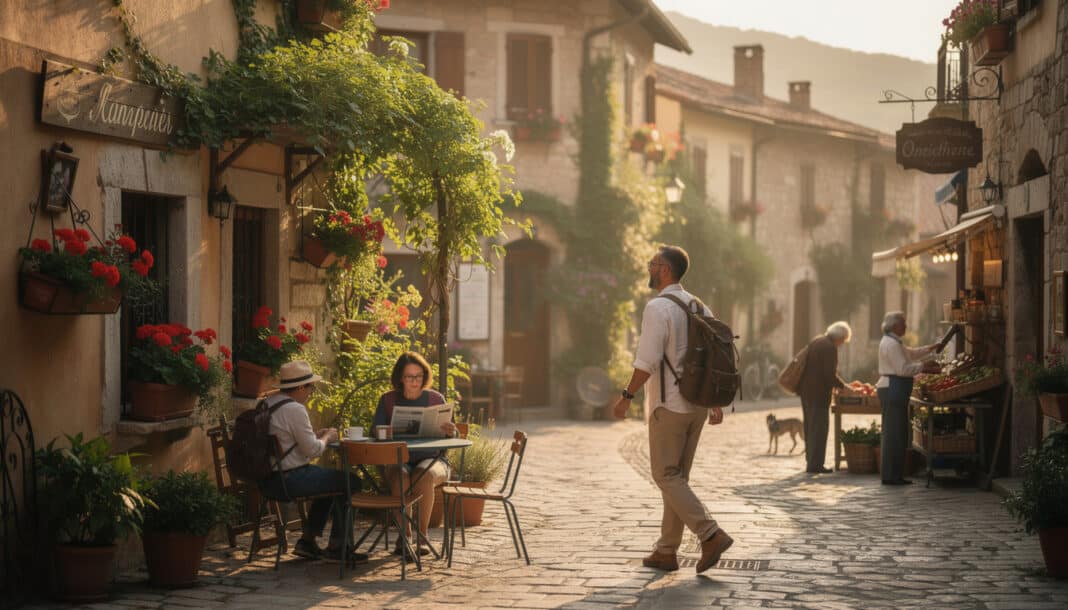
Understanding Slow Travel : a travel philosophy that favors slowness, authentic immersion and respect for the territories visited. Far from the frenzy of standardized tourist circuits, traveling slowly invites a rediscovery of the meaning of movement, giving time to meeting, observation and personal transformation. An approach where each stage becomes a destination, and where quality takes precedence over quantity.
🌍 Key points of slow travel : an authentic experience away from beaten paths • a deep cultural immersion with local people • a responsible travel that minimizes environmental impact • discovering local flavors and traditions rather than globalized monuments • a calm relationship with the travel time, without guilt about “missing out” • a reconnection with the everyday gestures in unfamiliar places
What is slow travel : definition and philosophy
Slow travel is not a simple alternative to rushed holidays. It is a philosophical reaction to an age where everything accelerates, where lists of « must-sees » proliferate and where the success of a trip is measured by the density of photographs. 🐢 Traveling slowly means accepting that some places deserve to be savored rather than consumed.
This approach draws on a simple intuition: travel transforms when it allows time for transformation to take place. A village discovered on a secondary road, crossed on foot, where you stop to talk with a craftsman, where you share a meal without looking at a watch – that is where true memories are forged. It is an inversion of priorities: it is no longer “what to do” that matters, but “how to be” in a place.
The notion of cultural immersion is central. Rather than skimming ten cities in fifteen days, slow travel proposes visiting two or three in depth, allowing yourself to be surprised by detours, encounters, and the small shops closed on Sundays that tell the soul of a region.

The origins of slow travel : a reaction to modern paradoxes
The slow travel movement emerged in the early 2000s, in direct reaction to mass tourism and the chronic acceleration of our lives. ✈️ It follows on from slow food, the Italian movement born in the 1980s to preserve culinary traditions in the face of the standardization of fast-food chains.
This awareness arises from a paradox: we have more means than ever to travel far, fast, and cheaply – and yet many return from their holidays as exhausted as before. Bus tours, anonymous buffets, interchangeable hotel rooms create the illusion of travel without offering substance. Slow travel then poses this disturbing question: what good is crossing the world if it is to remain trapped in a tourist bubble?
The pioneers of this philosophy understood that responsible travel is not measured by distance covered, but by the depth of the encounter. Choosing to stay three weeks in a small region rather than running after monuments is a political act: saying no to tourist extractivism, no to consuming places as one consumes goods.
The benefits of slow travel for the traveler
Setting off slowly first and foremost gives your mind a true rest. 🌿 Contrary to what one might think, it is by taking your time that you return from vacation regenerated, not numb from jet lag and logistical fatigue.
The first benefit is psychological: slowing travel time reduces stress. No frantic races from one station to another, no rushed check-ins, no constant anxiety about “missing something.” Instead, a breath. Positive psychology researchers confirm it: serenity emerges in slowness, and it is serenity that opens the way to genuine curiosity.
Then there is the quality of local discovery. When you stay long enough in a place, you see the same faces, you become a regular at the corner café, you learn to recognize the market seasons. Locals begin to speak to you as peers, not as tourists. That is when real knowledge begins: understanding how people live, work, entertain themselves, and what concerns them.
Personal enrichment and inner transformation
There is a striking parallel between slow travel and bookbinding. 📖 When you bind a book, you cannot rush the gestures: each section of pages must be sewn with care, each fold made with intention. It is precisely this patience that creates something lasting, worth preserving.
Slow travel operates on the same principle. A week spent learning a region’s culinary traditions, visiting artisan workshops, listening to locals’ stories – this creates authentic memories, intimate transformations. You return changed, not merely relieved of a leisure obligation.
This personal enrichment often comes with a kind of accumulated wisdom. 💡 Slow travelers develop an ability to perceive nuances, to appreciate the small details that escape the hurried tourist: the smell of cobbled alleys after rain, the particular light of dusk in a valley, the specific taste of a local honey produced for three generations.
The impact of slow travel on environmental respect
If slow travel appeals to lovers of slowness, it also interests environmentalists. 🌱 Responsible travel and environmental preservation are closely linked, and this connection reveals something essential: traveling less often means often traveling better.
The issue is concrete. Mass tourism generates colossal carbon emissions: repeated short-haul flights, transfers in air-conditioned cars, accumulation of nights in over-equipped hotels. A slow traveler who stays two months in a region instead of skimming ten countries drastically reduces their ecological footprint.
But there is more. When you settle in a place for a while, you develop a awareness of environmental respect that transcends tourist guilt. You live with locals, you understand their direct ecological challenges: water shortages in summer, forest degradation, soil exhaustion. This embodied knowledge creates real responsibility, not a posture.
Reducing your carbon footprint : transport choices
The choice of transport is fundamental. ✨ Travel time spent on a train, coach or even on foot is based on a philosophy: valuing the duration of the journey rather than its speed. The advantages of choosing a train trip to discover the world are not limited to ecology: it is also a window onto the landscape, an opportunity to read, reflect, and meet other travelers.
A train journey through the countryside allows for an incomparable local discovery. You see villages pass by, you understand the geography, the gradations of the landscape. It is already travel, not mere transport.
Avoiding internal flights, preferring land travel, staying long enough to justify the trip to the destination – these are the trade-offs that define a slow traveler conscious of their environmental impact.
How to practice slow travel : tips and methods
Putting slow travel into practice first requires a change of mindset. 🧭 It is not a question of budget (although flexibility helps), it is a matter of permission: the permission to take time, to give yourself the right to “do nothing” in the tourist sense.
The first step? Forget lists of must-see sites. Instead, identify a region that calls to you, a suitable season, a generous duration. Three weeks minimum, ideally a month. This length allows the superficial layers of tourism to fall away and for real encounters to emerge.
Choosing the destination and duration : the art of immersion
The choice of destination in slow travel follows different criteria. 📍 It doesn't matter if it is a “famous” place. What counts is that it is alive, that it allows authentic connections, that it offers enough to occupy time without an agenda. A wine region with its villages, a mountainous area crossed by trails, a coast with its small ports – places where local life continues independently of your presence.
Duration should be generous, without a predictable check-out limit. The first two weeks serve to decompress and understand the rhythms of the place. Only from the third week does deep cultural immersion really begin: you recognize the market regulars, you have your small habits, you start speaking the language beyond polite formulas.
This paradigm stands in radical opposition to classic tourism where each day must “count” and bring tangible souvenirs. Here, days without a special program are victories.
Adapting to the local rhythm and authentic encounters
Once on site, the art lies in listening. 👂 The best local discoveries rarely come from guidebooks, but from conversations: the baker who recommends a small private museum, the neighbor who invites you to a village party, the antique dealer who speaks passionately about the region's history.
Traveling slowly also means accepting disappointments and detours. A museum closed the day you expected? Perfect – it frees time to wander, observe, and chat. A local friend who leads you in an unexpected direction? Often that is where unforgettable moments are found.
This adaptability also creates a form of very local environmental respect: you follow shop hours, you don't pressure people for photos, you let places breathe instead of saturating them with tourist presence.
The best regions and seasons for a responsible trip
Certain destinations lend themselves particularly well to slow travel. 🌍 They are not necessarily the most exotic, but those where tourist infrastructure exists without having crushed local life, where public transport allows soft mobility, where prices remain reasonable for residents.
Europe offers ideal bases: the French Provence with its lavender and stone villages, Tuscany with its castles and cypresses, the still-preserved Balkans, rural regions of Spain or Portugal. In Asia, Laos, some Indonesian islands, the mountains of Vietnam. Latin America offers rural Peru, the Andean Colombia, Mexico away from the resorts.
Seasonality and responsible travel : when to go?
Season plays a major role in the authentic experience. 🍂 Avoiding high tourist season is not just an economy: it is an ethic. Visiting a destination in the low season means your presence actually benefits residents, you help maintain employment, and prices reflect the true local economy.
Autumn and spring offer ideal conditions: pleasant temperatures, fewer tourists, generous light for observing and learning. A Provençal village in June is an open-air museum; the same village in September regains its soul.
Financing your slow travel : budgets and financial strategies
Contrary to popular belief, slow travel does not require a fortune. 💰 On the contrary: staying long in one place generally costs less than flitting between transient hotels and tourist restaurants.
The keys are simple: a long stay allows negotiating advantageous monthly rents, cooking for yourself, using local transport instead of privatized tourist services. A couple paying 50 euros per night in a hotel during high season can find a charming apartment for 800 euros per month, i.e. 26 euros per day for two people.
Responsible travel also offers hidden savings: fewer impulse purchases, fewer “must-do” restaurants, a life more aligned with the real cost of things. You buy a tomato at the market, not a plastic salad at an inflated price.
Remote work and slow travel : new opportunities
Since 2020, a silent revolution has changed the relationship to slow travel. 🖥️ The possibility of remote work allows thousands of people to settle elsewhere for several months, to generate income from a small Tuscan village or a Greek island.
This symbiosis creates hybrid ecosystems where digital nomads live as semi-residents, participating in local life, renting stable-priced housing, creating economic dynamism without the usual tourist predation.
Of course, this raises challenges: silent gentrification, increased land pressure, community transformations. But it also opens doors: people who otherwise would have had little access to slow travel discover that it is possible, that this freedom exists, that traveling differently is not a dream reserved for the wealthy.
The human aspect : encounters and language learning
Slow travel culminates in human encounters. 🤝 This is where it fundamentally differs from tourism: it is no longer a consumption of experiences, it is a creation of bonds.
Learning a few words of the local language changes everything. Not to impress, but because this effort at communication creates reciprocity. You show that this place deserves your mental time, your vulnerability, your well-meaning awkwardness. People respond to that sincere interest.
Cultural immersion manifests in those small moments: having coffee with the guesthouse owner who tells you forty years of local history, visiting a carpenter’s workshop where ancestral techniques are taught, taking part in a village festival where you are suddenly friends, not strangers.
Creating lasting friendships and exchanging knowledge
Friendships born from slow travel have a particular quality. 💝 They grow in authenticity, without a tourist agenda. A friend met during slow travel becomes a guiding thread: you return to that region, you meet that person again, you deepen mutual knowledge.
These connections also enable true responsible travel: your local friends guide you to meaningful places, away from tourist traps, and your spending benefits people you know and respect directly.
There is also the exchange of knowledge. Maybe you are a musician, writer, photographer, craftsman – your skills interest locals. These exchanges create a balance: it is no longer a pure commercial transaction, but a real human commerce.
One question deserves asking: what if the meaning of travel lay less in what we see than in who we become by traveling? 🌟 There might lie the true essence of slow travel.
Profil de l'auteur
Derniers articles
 Everyday Life & Society23 September 2026Consumer confidence index: what the monthly mood check on British households really measures
- Agency, Webmarketing & SEO31 August 2026SEO : a Google bug skews visibility statistics in AI results
- Tech & Multimedia29 August 2026Earbuds that transcribe your meetings without a smartphone : how Plaud One changes things
- Home Appliances & Equipment28 August 2026Home appliances: the durability index extends to four new appliances




Table of Contents