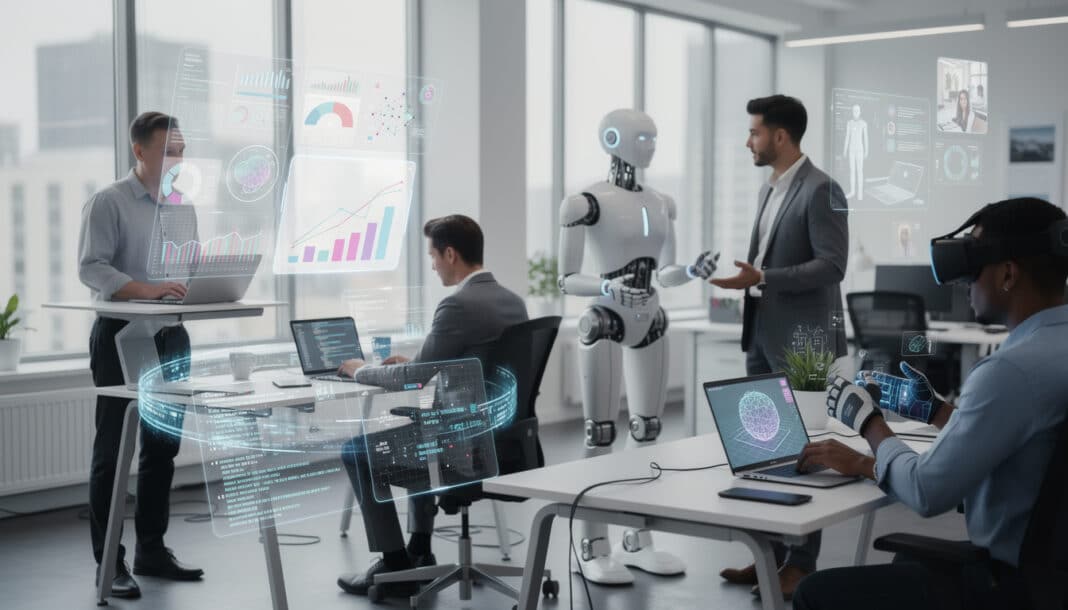
🌍 In short — Artificial intelligence is transforming jobs at a dizzying speed. While routine tasks like data entry or video editing are gradually being automated, the real issues lie elsewhere: in creativity, critical thinking, and the ability to collaborate intelligently with machines. Instead of fearing obsolescence, the goal is to cultivate those human skills that will make the difference. Companies are now looking less for performers of basic tasks and more for thinkers able to lead innovation and imagine what automation cannot design on its own.
🤖 When AI takes over the obvious tasks
For several years now, a recurring question has been heard: “Will AI replace me?” Bernard Marr, a well-known futurist, soothes fears with a relevant nuance: AI will not eliminate jobs, but will profoundly transform the way they are practiced. Take writing as an example. A conversational robot can generate simple reports, product descriptions, social media posts. But can it imagine a story that moves you, grasp the subtlety of a complex issue, or adapt the tone to a specific audience? No.
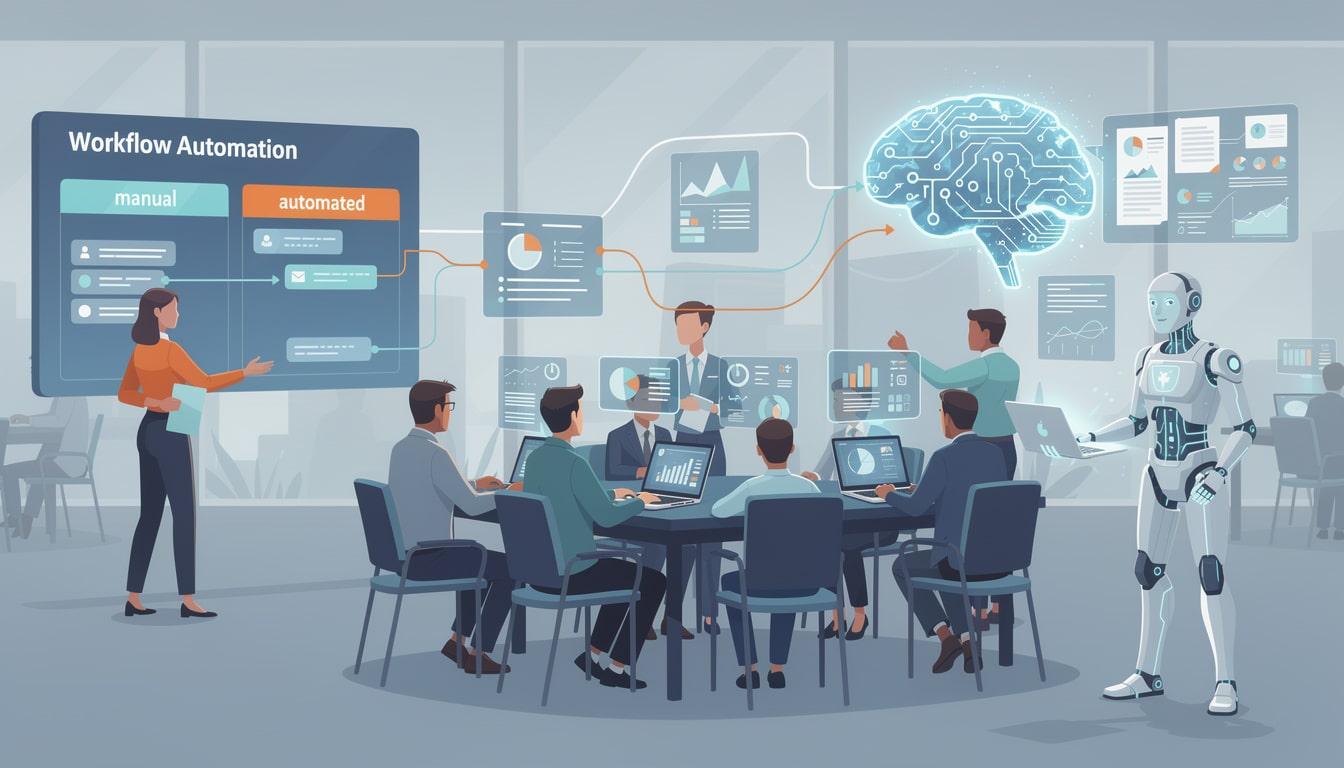
Data entry and processing illustrate this shift well. Machine learning algorithms equipped with optical character recognition (OCR) convert in seconds what used to take humans hours. Data analysis follows the same path: AI detects patterns in massive volumes that our brains could never process. Yet, the strategic interpretation of that data, the decisions drawn from it, the courage to question an apparent trend — that remains in the human domain.
📊 Areas where automation is progressing fastest
The artistic design field is experiencing a troubling shift. Tools like Midjourney or automatic colorization systems are transforming the creative process. A photographer recently gained tens of thousands of followers by posting AI-generated portraits, retouched in Photoshop — until the moment he admitted the truth. 🎨 This anecdote reveals a tension: technology democratizes creation, but it also unsettles our certainties about the value of a work.
Video editing follows a similar trajectory. Yesterday, it was a craft that required years of learning — learning rhythm, feeling where to cut, assembling shots to tell a story. Today, AI systems automatically select the best sequences, add transitions, adjust audio levels, and even propose color corrections. With no prior experience, someone can produce a visually acceptable result in a few clicks.
💡 The skills that are becoming truly valuable
Here lies the paradox: as machines master repetitive tasks, our value is redefined around what makes us human. Creativity, critical thinking, synthetic thinking — these qualities are becoming the rarest currencies on the job market.
Bernard Marr puts it this way: “If we can give machines the low-value work and devote our time to what truly creates value — creativity, critical thinking, problem solving — the world can only improve.” 🧠 This vision does not minimize the difficult transition for some sectors, but it points to a reality: the safest jobs tomorrow will be those where humans bring a perspective no algorithm can simulate.
The collaboration between humans and machines resembles that of a pilot and an airplane on autopilot. The plane flies itself, optimizes its route, manages routine variables. But the pilot remains necessary: faced with unexpected turbulence, a complex ethical decision, or a situation never encountered before, human intelligence takes the controls. 🛩️
🎯 Develop constant adaptability
Adaptability is no longer a bonus — it is a fundamental skill. The technological landscape changes so fast that today’s technical knowledge risks becoming obsolete in three years. But those who know how to learn, who cultivate curiosity, who remain flexible in the face of change — they will survive every revolution.
That means staying curious about new technologies, taking part in continuous training, and exploring domains adjacent to one’s profession. A writer must understand how content generation tools work — not to be subjugated by them, but to use them strategically. A designer must master the algorithms that generate images to push their limits. Learning becomes lifelong.
🔗 Building a resilient career in the face of AI
Several paths open for those who want not only to survive but to thrive in this changing environment. The essential skills to stand out involve understanding AI and its impact, but also constantly strengthening what makes each person unique.
The first is AI literacy. It’s not about becoming a machine learning engineer, but about understanding the fundamental principles: how a query to a generative AI works, what its limits are, and what biases it can contain. This literacy allows you to work with tools rather than fear them. Five essential skills now structure the most agile career paths.
The second is critical thinking. Knowing how to question the data an AI produces, identify its errors, spot its hallucinations, and refuse to follow its recommendations blindly. A financial analyst who understands that machine learning can predict trends, but that an unforeseen geopolitical crisis will overturn all models, has a form of wisdom that an algorithm will never possess.
🎓 Pathways for training and continuous learning
Contrary to fears, resources for training are not lacking. From free MOOCs to intensive bootcamps, from self-directed learning via GitHub and personal projects to specialized university degrees — the doors are many. The challenge is not access to training, but choosing the right one according to your goals.
Self-directed learning remains a powerful route for those who can discipline themselves. Building concrete projects, participating in online communities, consulting case studies, and reading the latest research papers — all of this is freely accessible. UNESCO has moreover developed a framework of AI competencies for learners, reflecting the awareness that this literacy must become universal.
For those retraining or seeking a more structured professional transformation, bootcamps offer intensive immersion. For those already working, modular training allows acquiring specific skills without disrupting an established career. 📚
🌱 Knowledge transfer and mentoring: an underestimated asset
Often forgotten in discussions about AI, the ability to transfer knowledge and mentor becomes a considerable asset. Someone who can clearly explain how to use an AI, who helps others navigate this transition, who preserves traditional know-how while enriching it with new tools — that person becomes irreplaceable.
This creates an interesting paradox: in the age of automation, professions based on relationships, transmission, and human presence gain value. A consultant who helps an SME integrate AI into its processes, a trainer who supports teams in this transition, a mentor who guides younger people — all embody a dimension only humans can offer. 🤝
⚡ The urgency of preparation: a computer virus, a reminder of vulnerability
Bernard Marr poses a troubling question that should haunt every organization: “What would happen if a massive computer virus made all our systems unusable tomorrow?” 🦠 This question is not pure science fiction. It highlights a growing dependence on fragile infrastructures.
It also urges cultivating human resilience: the resilience of judgment, of creativity that does not depend on an electrical outlet, the ability to invent solutions in the face of the unexpected. Paradoxically, the more we rely on AI, the more we must strengthen our capacities to operate without it. This could mean preserving traditional know-how, maintaining a certain cognitive diversity, and not letting automation erode our critical faculties.
🔐 Data security and ethical responsibility
As we delegate more decisions to AI, the question of security and ethics becomes central. Protecting data, ensuring that algorithms do not amplify discrimination, and taking responsibility for every decision delegated to a machine — these issues require a new competence: ethical awareness applied to technology.
Those who can navigate this tension between innovation and responsibility, between efficiency gains and the preservation of human values, will possess a rare and highly sought-after skill.
🎬 Beyond technical skills: the question of purpose
There is one last dimension, often overshadowed by discussions about skills and training. It is the question of purpose. Why do it? For whom? With what values? 💭
A person capable of generating a thousand articles thanks to AI, but unable to answer the question “What do I really have to say?” remains hollow. Conversely, someone who deeply understands their field, knows which questions to ask, and has a vision — that person will always find ways to use technological tools to amplify it.
The smartest organizations will be those that combine technical excellence with clarity of vision. AI amplifies what you already are: a powerful tool in the hands of someone who knows what they are looking for is a wonder; in the hands of someone asking the wrong questions, it’s just very fast noise.
🌟 Cultivate uniqueness rather than competing with machines
Here is perhaps the most essential advice: stop competing with machines on their turf. You will never beat an AI at its processing speed, consistency, or absence of fatigue. It’s a battle already lost.
Instead, cultivate your uniqueness. What do you see that no one else sees? Which intuition guides you when all the data is ambiguous? What dream do you carry for your profession, your industry, the world? These questions are never asked of a machine. The answer you give — that is what matters.
True innovation often emerges at the intersection of deep expertise and a unique perspective. A bookbinding specialist who understands AI may see how machines could preserve artisanal gestures while making the craft more accessible. A doctor who masters AI diagnostics can better serve patients by combining machine precision with human empathy. 🧵
We are not at the end of an era. We are at the beginning of another. The rules are being rewritten, professions are being reinvented, but the space for those who think, create, and dare to remain fully human — that space has never expanded so much.
Profil de l'auteur
Derniers articles
 Smartphones & Mobile Phones14 October 2026The loyalty penalty on your mobile bill: why staying put costs you more
- Family, Babies & Children5 October 2026Airline family seating fees: what the planned ban will change for parents
- Everyday Life & Society23 September 2026Consumer confidence index: what the monthly mood check on British households really measures
- Agency, Webmarketing & SEO31 August 2026SEO : a Google bug skews visibility statistics in AI results




Table of Contents