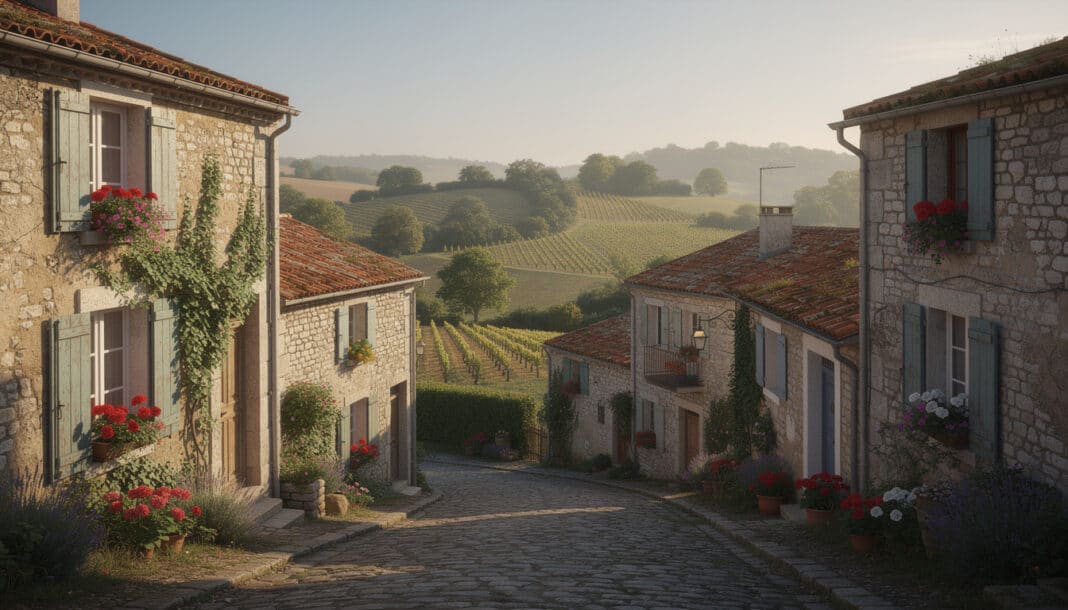
📍 In short : Far from tourist routes, five French villages embody a form of raw, almost cinematic beauty. Rochefort-en-Terre in Brittany, Lyons-la-Forêt in Normandy, Baume-les-Messieurs in the Jura, Castelnau-de-Montmiral in Occitanie and Fourcès in the Gers unfurl their medieval architecture and cobbled streets like living sets. These destinations offer travelers seeking authenticity an escape to a preserved heritage, where time seems suspended and where the local culture still breathes in every stone.
🎬 The heart of the matter : These little-known French villages are not frozen museums, but places where craftsmanship endures and traditions are still lived. They increasingly attract those who flee urban bustle to rediscover a sense of slowness and authenticity. Each tells a different story: a medieval fortress, a Benedictine abbey, a circular bastide or a rocky spur. Together, they form a quiet plea for respectful rural tourism, sensitive to the heritage and the rhythms of the inhabitants.
🏛️ Rochefort-en-Terre : when Brittany turns cinematic
In the heart of Morbihan, Rochefort-en-Terre rests on its rocky spur like a ship moored above the land. The half-timbered houses press against Gothic facades, medieval ruins whisper forgotten secrets, and the cobbled alleys invite endless strolling. This village does not content itself with being beautiful; it unfolds a kind of natural theatricality, that of places that seem designed to be looked at.
Hydrangeas overflow from window boxes every summer, tinting the facades blue and pink. This floral abundance is not accidental: it responds to a genuine culture of local beautification. Strolling its alleys is like passing through an impressionist painting, where each architectural detail enriches the overall portrait.
Beyond the village, hiking trails invite exploration of the typical Breton moorlands and forests. It’s a way of understanding that these cinematic settings are never isolated: they are set within broader landscapes, living ecosystems where nature plays as important a role as architecture.
🌲 Lyons-la-Forêt : Normandy in a beechwood
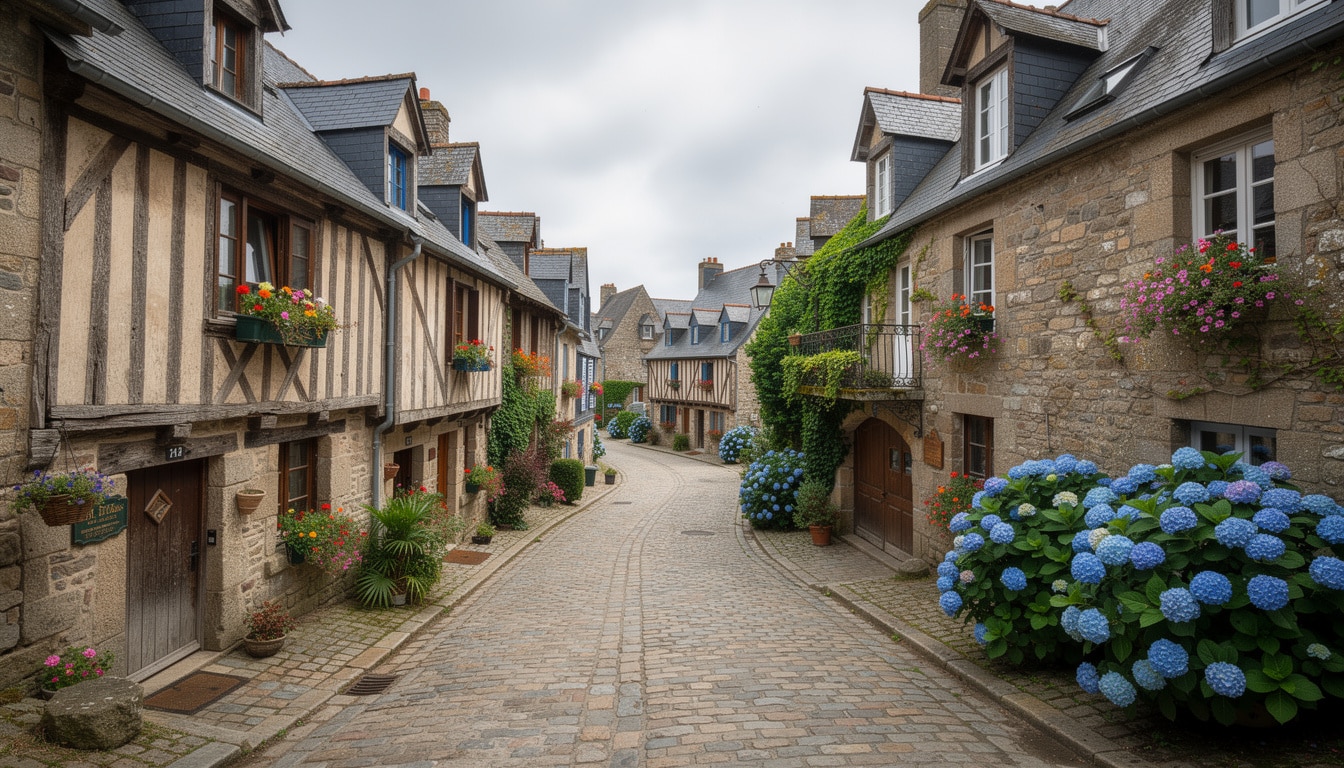
A stone’s throw from Rouen, Lyons-la-Forêt displays its half-timbered houses in a green setting that few visitors truly know. The name alone sounds like a promise: “Lyons,” urban lightness; “la Forêt,” sylvan immersion. The historic center concentrates the 16th-century market halls, former convents converted for new uses, and small flowered squares where a form of village life still takes root.
This Norman bastide has managed to preserve a distinct traditional architecture, far from the pastiches that disfigure so many tourist villages. The timber framing is not painted scenery, but testimony to a local architecture conceived by the artisans of the time.
One of the hidden riches of the place: proximity to one of the most beautiful beechwoods in France. Walking beneath these giant trunks, listening to the crunch of dead leaves, is to rediscover a kind of silence that modernity has erased. A few kilometers away, the arboretum offers the chance to discover nearly a hundred species of trees from around the world, turning a simple walk into a botanical quest.
⛰️ Baume-les-Messieurs : oblivion as protection
Fewer than two hundred inhabitants, limestone cliffs towering above, a 9th-century Benedictine abbey, a waterfall, a cave. Baume-les-Messieurs exists somewhat apart, like a cul-de-sac village the world has forgotten—which is precisely its strength. Geographic isolation has preserved what might have been eroded by massive tourist influx.
Climbing to the viewpoints overlooking the Jura valley, one understands how heritage is also built by geography. Those cliffs, those plunging views over the village, those landscapes that seem hand-drawn: these are the layers on which the place’s identity rests.
The Tufs waterfall and the neighboring cave offer a striking contrast: in this region where heat can be oppressive in summer, these underground refuges become almost ritualistic. The water that flows year-round, that enduring coolness, reminds that these places possess their own ecological logic, where every element has its role.
🏰 Castelnau-de-Montmiral : the bastide of the monk-vintners
In Occitanie, at the heart of the Gaillac vineyards, Castelnau-de-Montmiral dominates the valley from its promontory like a forgotten sentinel. It was once an impregnable stronghold; today, the three medieval gates remain, passable on foot, inviting the wanderer to slip into another time.
Passing through the Garric gate is to abandon modern daily life and enter a world governed by slowness and the geometries of the Middle Ages. The cobbled alleys inevitably lead to the central square, the village’s beating heart where local traditions still find expression.
Less touristy than its neighbor Cordes-sur-Ciel, quieter, Castelnau-de-Montmiral enjoys a benevolent discretion. This tranquility has a price: it makes each encounter with a resident more authentic, each moment of pause on a local terrace. The surrounding trails connect the village to the vineyards and woods, offering ever-renewed perspectives on the valley.
Discover other little-known and charming French villages to enrich your understanding of Occitan heritage.
🔵 Fourcès : the perfect geometry of the Gers
Rare are round villages. Fourcès is, and that architectural detail changes everything: the streets, the circulation, the very perception of space. Built in a circle around an old castle now gone, this Gascon bastide embodies a form of urban perfection that few recognize at first glance.
The central shaded square breathes a kind of natural theatricality. It is there that the year’s events unfold, notably the festival « Marciac in Fourcès » in August, which turns the alleys into an open-air gallery for music lovers and local culture.
A 15th-century bridge, a Clock Tower that marks the hours, half-timbered houses packed like theater spectators: these are the details that structure the experience of the place. Walking in Fourcès is letting yourself be guided by an ancient geometry which, far from seeming rigid, offers a sensation of circular freedom.
For those seeking even more authenticity, also explore the hidden gems of France offering unique low-cost vacations.
🌋 Polignac : the fortress that dominates
Just a few kilometers from Puy-en-Velay, Polignac rises like a perched fortress on a basalt rock. The geological detail matters: it is not just any stone, but a volcanic formation that dates back millions of years. Building fortifications on this base was a statement of power inscribed in geological timescales.
Climbing through the village alleys requires patience. The Saint-Martin church offers a contemplative halt before the final ascent to the ramparts laid out over more than eight hundred meters. Up there, the view extends to Mont Mézenc: one understands why this place was chosen to observe and defend.
Four hiking loops start from the village, plus a long crossing to La Chaise-Dieu through volcanic landscapes: this is how Polignac opens onto the picturesque landscapes of its hinterland. Each trail tells of geology, rural history, and the inhabitants’ practices.
🛤️ Rural tourism: between preservation and transformation
These five villages face an equation that defines our era: how to welcome visitors without destroying what draws them? Rural tourism has exploded in recent years. According to recent data, nearly sixty percent of French people actively seek to get off the beaten track during their vacations, turning to rural France, forgotten villages, and slow experiences.
This trend is beneficial in many ways: it creates local jobs, revalues artisanal know-how, and encourages the restoration of old buildings. But it also carries risks: silent gentrification, the erosion of traditions through their folklorization, and rising property costs that push out native residents.
The best villages—those that truly thrive—are the ones that manage to balance openness and preservation. Rochefort-en-Terre, with its residents passionate about flowers; Fourcès, with its music festival; Castelnau-de-Montmiral, with its wine producers: they have all found an authentic anchoring capable of resisting commodification.
✨ Architecture as the language of time
Observing these villages is reading a kind of history written in stone, wood and tiles. Each half-timbered house tells a choice: to use available wood, to combine the frame with wattle-and-daub or brick infill. Each Gothic facade murmurs religious or feudal allegories.
This traditional architecture is never frozen. It evolves with the seasons, with maintenance—or lack thereof—and with restorations more or less faithful. A bookbinding workshop, a gaze accustomed to layers, understands this patience: every architectural detail requires time, knowledge of materials, a transmission often forgotten.
Many French craftsmen regain a form of dignity in restoring these villages. Carpenters respectful of old techniques, masons who know mortars and squaring techniques, become the guardians of a built memory. Without them, these sets would crumble.
🌍 Authentic vacations: far beyond the photos
The word “authentic” has been so emptied of meaning that it becomes almost comical. Yet there is something real in these villages: the possibility of living at a different pace, of meeting residents who know every alley, of eating a cheese produced a few kilometers away.
Authentic vacations are never reduced to an Instagram photo gallery. They pass through a slowly sipped cup of coffee, a conversation with a craftsperson, a walk without a set destination, a nap on a sunlit square. It is in these seemingly insignificant moments that authenticity truly exists.
Staying in Baume-les-Messieurs is not simply admiring the cliffs: it is also hearing the abbey bells, encountering the monks who still live there, understanding how faith shaped this village for centuries. Eating a local specialty in Castelnau-de-Montmiral is tasting the grapes of the very soil that has fed the village since the Middle Ages.
To deepen your understanding of these destinations, consult the guide to cinematic villages in France, which explores the filming locations that have sublimated the seventh art.
🎭 These sets that become reality
Why do so many directors choose these villages as settings? Because they possess a kind of truth that cannot be built in a studio. Aged walls, eroding alleys, lights that change with the seasons: these are the elements the best filmmakers seek.
These natural film sets are never perfect—that is precisely what makes them powerful. A poorly restored facade, a narrow alley where the light plays oddly, a church with unexpected proportions: imperfections create raw beauty.
By choosing to visit Rochefort-en-Terre, Lyons-la-Forêt or the other villages mentioned here, one does not escape to a dream world. On the contrary, one roots oneself in the material, architectural and sensual reality of deep France. That is authenticity: not a utopia, but an anchoring in the concrete.
🚶 Walking as a means of understanding
Each of these villages invites walking. It is not accessory: it is central. Walking slowly allows the eye to settle, the mind to decompress, and details to emerge. The cobbled streets slow the pace, invite looking upward, toward flowered balconies, decorated chimneys, and old wooden doors.
Hiking around these villages enriches the experience. Seeing Rochefort-en-Terre from the paths that circle it reveals how it integrates into the landscape, how it dominates or humbles before the surrounding spaces. The Jura trails around Baume-les-Messieurs, the vineyard paths around Castelnau, the volcanic loops around Polignac: all offer perspectives that deepen understanding of the place.
Walking is also meeting the inhabitants. A farmer returning from the field, a craftsperson taking a breath of air, a grandmother walking her grandson: they are the ones who give flesh and meaning to the villages. They tell, often without intending to, how places are maintained, transformed, and survive.
💎 Why these villages rather than others
Why do these five villages deserve special attention? Because they embody different forms of French beauty: medieval Brittany, sylvan Normandy, monastic Jura, feudal Occitanie, circular Gascony. Together, they form a map of France’s architectural and landscape diversity.
But also because each has managed, in its own way, to remain authentic without falling into the trap of becoming a frozen museum. Rochefort-en-Terre lives through its residents, its floral traditions, its inhabitants. Lyons breathes through the forest that surrounds it. Castelnau pulses from the wine that emanates there. Fourcès dances to the music that fills its round square.
There are more famous, perhaps more photogenic villages. But these possess a rare quality: the fragile balance between tourist accessibility and deep rooting in local life. It is this balance that makes them truly worthy of a visit.
Profil de l'auteur
Derniers articles
 Smartphones & Mobile Phones14 October 2026The loyalty penalty on your mobile bill: why staying put costs you more
- Family, Babies & Children5 October 2026Airline family seating fees: what the planned ban will change for parents
- Everyday Life & Society23 September 2026Consumer confidence index: what the monthly mood check on British households really measures
- Agency, Webmarketing & SEO31 August 2026SEO : a Google bug skews visibility statistics in AI results




Table of Contents