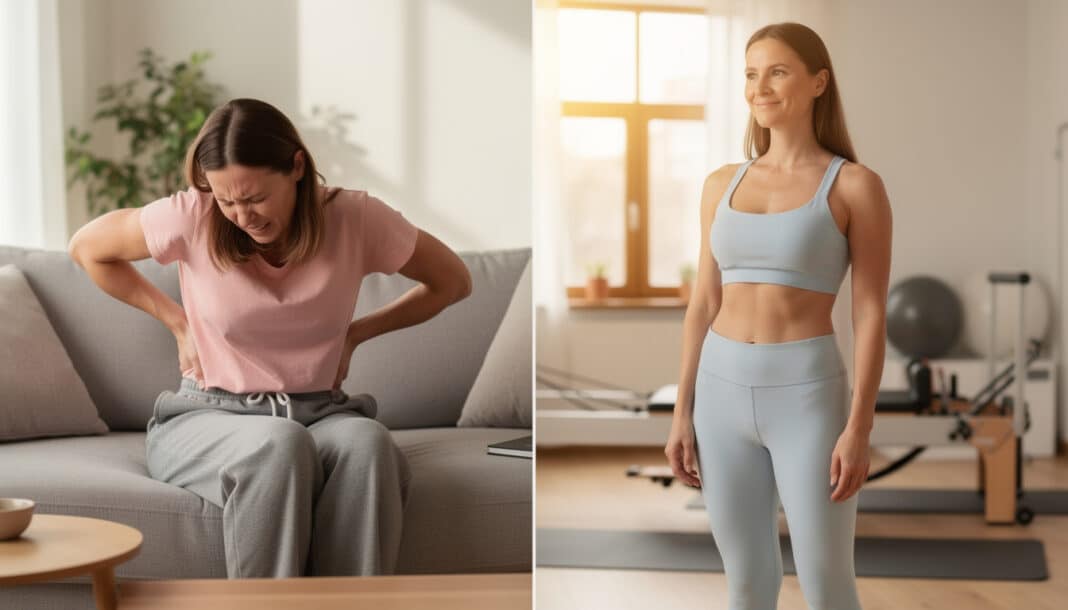
🧘 In short: Four weeks of regular Pilates are enough to transform one's relationship with back pain. Results begin with an improvement in posture and a better awareness of alignment, before consolidating through lasting strengthening of the deep muscles. Contrary to expectations of a dramatic metamorphosis, this practice works gently, layer by layer, like the patient assembly of a bound book.
The assessment after one month: Increased flexibility in everyday movements, a notable reduction in lower-back tension, and above all, a calming of the mind often as valuable as the physical relief. Back pain, that unwelcome companion, begins to loosen its grip within the first weeks if one commits with regularity and self-compassion.
When Pilates becomes a remedy for back pain 🎯
Back pain has become a constant in our contemporary lives — from slouched postures in front of screens to repetitive motions that wear down our vertebrae. For many, discovering Pilates feels like a window opening onto a room they thought was closed off. This method, born from Joseph Pilates's need to re-educate his own body, directly addresses what our era mistreats: trunk stability and spinal alignment.
What surprises is the gradual re-education: Pilates does not promise miraculous healing, but rather a patient rebuilding. Like in a bookbinder's workshop where each gesture prepares the next, every session lays the foundations for better posture. The deep back muscles — those invisible guardrails — awaken gradually, finally offering the support the spine silently demands.
The first changes: posture and body awareness 📍
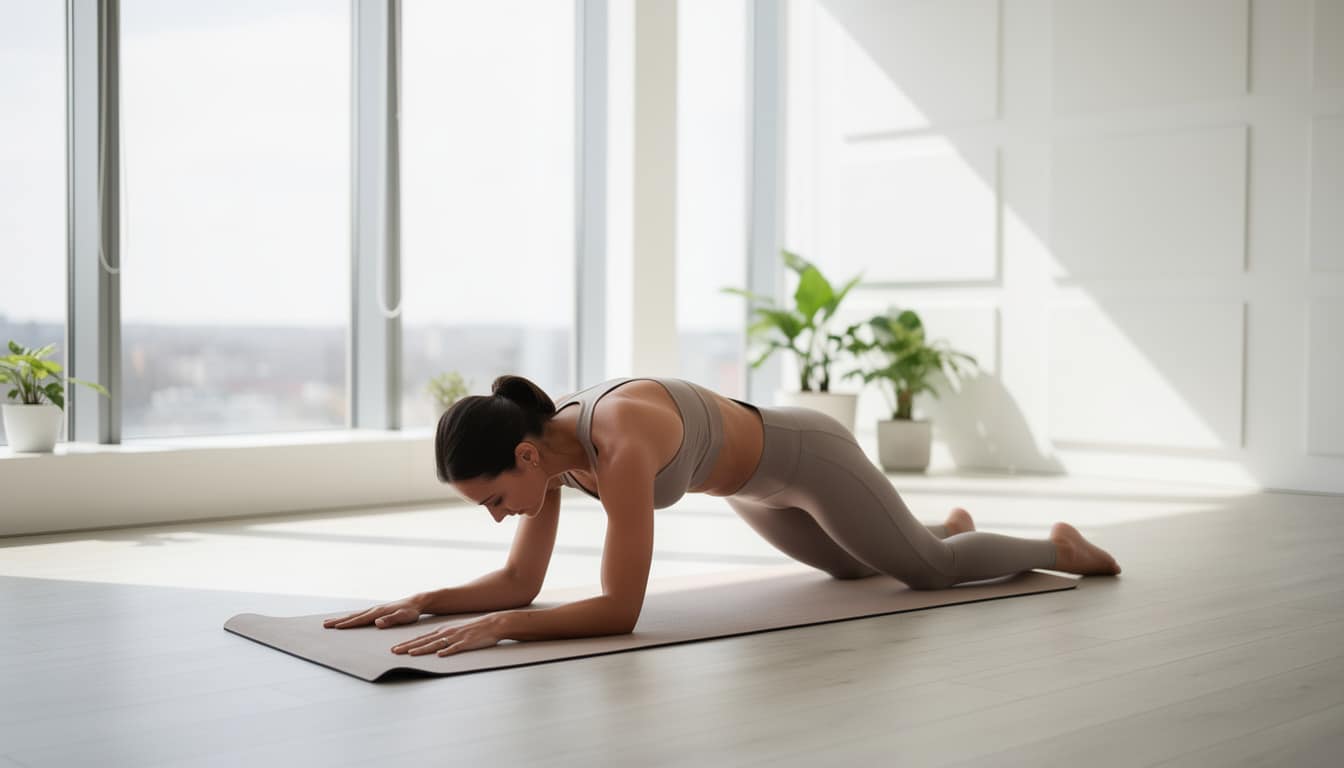
During the first to second week, one does not always notice a spectacular physical revolution. Yet something invisible is happening: awareness. Suddenly you notice how you sit at your desk, how your shoulders creep up toward your ears, how your pelvis collapses under the weight of daily life. It's like acquiring a special pair of glasses that reveal what has been silently damaging for years.
Muscle strengthening begins with this awareness. Instructors insist: every movement must come from the center, that core of the body that stabilizes everything else. An arm bend only exists if the deep abdominals engage. A twist only happens if the pelvis remains stable. This demand, at first frustrating, quickly becomes liberating — you finally understand why your back hurt, and how to stop the cycle.
Week three and four: tangible relief 🌟
It is generally around the third week that back pain begins to decrease. Not to disappear — patience is still required — but to fade. Morning pains ease. Office afternoons no longer leave that feeling of compression in the lower back. Pain, that tyrannical master, gives ground to recovered suppleness.
This change can be explained scientifically: with six to eight weeks of regular practice, the stabilizing muscles strengthen enough to reduce compressive tensions on the spinal discs. But there is also something more subtle — a mental calming that accompanies the physical strengthening, as if well-being were the invisible fruit of daily work.
Key elements of an effective practice against pain 💪
For Pilates to truly transform the relationship with back pain, certain principles are non-negotiable. First, regularity: two to three sessions per week create continuity that the body recognizes and benefits from. Skipping a week erases part of the progress, as if closing the book at the wrong chapter.
Second, correct technique. A poorly executed movement can worsen tensions rather than relieve them. That is why proper supervision — a attentive instructor or a structured online course — makes the difference between improvement and frustrating stagnation. Learning the fundamentals is like learning to bind pages: you never skip the stitching step because it's what holds the work together.
The importance of breathing and mobility 🫁
It is often forgotten, but Pilates is inseparable from conscious breathing. Each movement accompanies an exhalation that engages the deep abdominals, an inhalation that frees space. This breathing dance relaxes the nervous system and creates a muscular relaxation conducive to healing.
Mobility is also what the practitioner gains month after month. The lower back that seemed stiff begins to participate in movements with fluidity. The hips open up. Joints, nourished by this regular and controlled work, regain the freedom they had lost. It is a re-education of the whole gesture, not just an isolated area.
When Pilates changes daily life: well-being and prevention 🛡️
Beyond relieving back pain, the benefits of Pilates slip quietly into everyday life. Movements become less painful: bending to pick something up, sitting without contorting, carrying groceries without the back crying mercy. Well-being is no longer a distant promise but a tangible reality in every moment.
Prevention becomes as important as treatment. Someone who has tried four weeks of regular Pilates finally understands that back pain was not a fate, but the result of neglected postural habits. By strengthening the deep abdominal belt and restoring spinal alignment, one builds a natural armor against future recurrences.
Integrating Pilates as a lasting practice 🔄
What turns a one-month experience into a lasting change is the decision to continue. Those who quit after four weeks often feel the back pain gradually return, the muscles falling asleep again. In contrast, those who make Pilates a routine — two to three times a week — build stability that lasts.
It is not about obsessive perfection, but about kind consistency. Like the bookbinder who returns each day to his bench to patiently continue his work, the regular Pilates practitioner honors their body through repeated, simple, deep gestures. The following months consolidate what the first month initiated.
Pitfalls to avoid to maximize results 🚫
Even with the best intentions, some mistakes hinder progress. The first: pushing the pace. Pilates is not a speed competition, and rushing movements to do more defeats the entire purpose of joint health. Every gesture must remain controlled, conscious, resilient — or it loses its virtue.
The second: neglecting warm-up and stretching. Arriving cold to a session, then leaving without a gentle transition, is to deny your body the transition time it needs. Good Pilates practice includes this care, this attention to detail that transforms a simple exercise into real bodily re-education.
Adapting your practice to your specific body 🧩
Every back is unique. Someone suffering from sciatica will not have the same needs as someone whose back pain stems from joint hypermobility. Good studios offer modifications for each movement, options to make the exercise more accessible or more demanding depending on the profile. It is this flexibility that is the real key to a lasting practice.
It is also wise to consult a healthcare professional — physiotherapist, osteopath — before starting if back pain is severe or chronic. Pilates is a wonderful tool, but it works best when it complements medical guidance, not when it replaces it.
The less visible but decisive effect: the mind 🧠
What few people anticipate is the mental impact. An hour of Pilates is an hour without a phone, without notifications, without the background noise of a hyperconnected world. This digital break works wonders: stress eases, the anxiety that often accompanies back pain diminishes. You leave the session with a serenity that no pill can offer.
This psychological well-being even accelerates physical healing. A body tense from anxiety remains tight; a relaxed body can finally unwind, rebuild, and heal. It's a virtuous circle: less pain brings calm, calm speeds recovery, recovery strengthens self-confidence — an upward spiral.
After the first month: building on the foundations 🏗️
Once the four weeks are completed with regularity, consolidation truly begins. The back stabilizer muscles continue to strengthen. Posture becomes less of a chore and more of second nature. Some practitioners discover they can progress to more advanced movements, variations of the exercise that demand more strength and control.
Mobility refines. Everyday movements become fluid. Back pain, that shadow that weighed on every day, becomes a distant, almost forgotten thought. It is at this stage that Pilates stops being a correction and becomes a way of life — not by obligation, but by a conscious choice to take care of oneself.
To explore further how a regular practice transforms one's relationship to health and pain, consult the detailed testimony of those who continued their commitment well beyond the initial month. These accounts show how patience and consistency become the true secrets of success.
Those who want to start or deepen their approach will also find valuable resources in the concrete experience of Pilates over a full cycle, with honest perspectives on what really works and how to integrate this practice into daily life for lasting muscle strengthening.
Profil de l'auteur
Derniers articles
 Electricity, Gas & Energy14 September 2026Gaz et électricité : ce que la hausse des tarifs va changer sur votre facture
- Agency, Webmarketing & SEO12 September 2026Fusion Omnicom-IPG : ce que la plus grande agence de publicité au monde change pour les marques
- Retirement & Senior Living10 September 2026Carte Avantage Senior SNCF : comment voyager moins cher en train après 60 ans
- Tech & Multimedia8 September 2026Objets connectés : la fin de la 2G et le nouveau Data Act vont rebattre les cartes




Table of Contents