
In short: Artificial intelligence transforms traditional trades without denaturing them. By automating administrative and repetitive tasks, it frees up time for what really matters: the gesture, creativity, the relationship to the material. A saving of ten hours per week that many fear, but which proves to be an opportunity to refocus on the very essence of know-how.
🤖 When technology serves craftsmanship rather than replaces it
There is a persistent misconception: that artificial intelligence threatens traditional trades. Yet, for a few years a very different reality has been emerging in workshops, shops, and entrepreneurs' offices. The automation of menial tasks does not erase the need for the human gesture; it preserves it by giving it room to breathe.
Consider the bookbinder who, in the past, spent three hours a week answering emails, invoicing clients, and managing inventory. Today, AI-powered tools handle those flows without intervention. The result? Ten hours of reclaimed freedom each week, not to do less, but to do better what they know how to do: thread the needle, tighten the stitch, listen to the paper speak beneath the hands.
This alchemy is possible because technology has finally asked the right question: how not to replace the human, but to serve them?
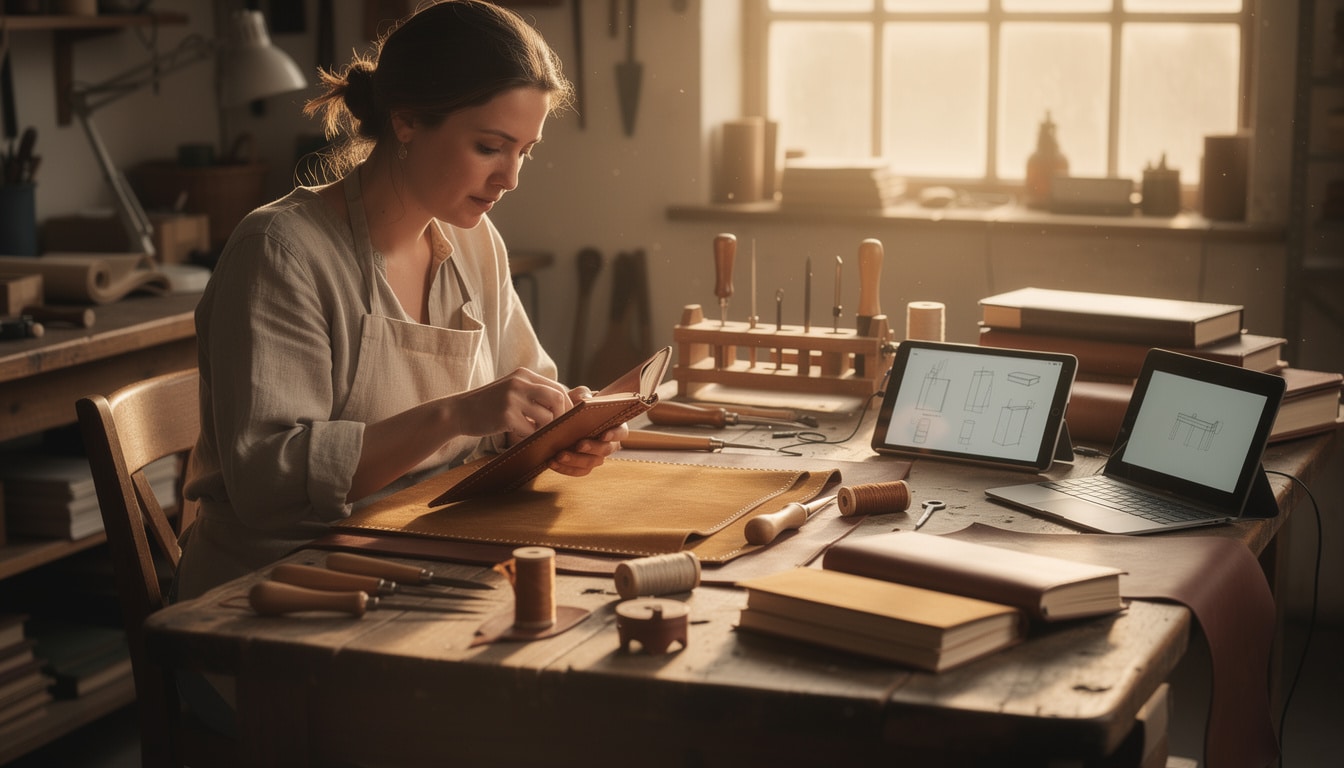
⏱️ Smart process optimization: gaining time without sacrificing quality
The fantasy of productivity gains without sacrificing quality long seemed utopian. Yet that's precisely what well-designed automation enables. Tasks that consume mental energy without requiring particular skill — data entry, sorting, calendar scheduling — become digital automatisms.
Let's take a concrete example. A craftsperson who makes hand-bound notebooks receives orders daily through multiple channels: email, social network, online sales platform. Previously, each order required manual reading, copy-pasting between systems, and checking contact details. With the right artificial intelligence tools, this data automatically converges into a single, verified, enriched system. The time saving is dramatic; the margin of error disappears.
But here's the essential point: this optimization frees the brain for what truly requires judgment. The craftsperson can then focus on creative choices, customer relationships, and continuous product improvement.
💾 Security and trust: protecting your data while automating
It would be naive to think that this liberation comes without questions. When you entrust AI with managing your customer data, invoices, or secret dyeing and finishing formulas, the question of data protection becomes crucial. How can you ensure that automation doesn't turn your workshop into a territory of vulnerability?
The answer lies in the choice of tools. Protecting your data and your AI by securing your information on the web is not a luxury, it's a prerequisite. Serious systems offer end-to-end encryption, decentralized backups, and transparency about the destination of data.
In the workshop, you learn early that good tools are those that serve without hindrance. Artificial intelligence must operate on the same principle: powerful, but invisible, protective rather than chatty.
⚙️ Administrative tasks that steal the artisan's time
Listing the tasks that AI absorbs reveals a hidden truth: how many hours are spent only maintaining structures, never creating. For an independent craftsperson, these tasks were once unavoidable. Today, they are automated.
Invoicing gets taken care of. Payment reminders send themselves. Product pages populate with coherent descriptions. Order schedules adjust according to lead times. Productivity reports write themselves. 🎯 What used to take five hours is handled with thirty minutes of initial setup.
This transformation is particularly visible for micro-entrepreneurs. Starting your microbusiness with confidence thanks to simplified procedures relies precisely on better time management, administrative efficiency without compromise.
✨ Rediscovering the heart of the craft: creativity and know-how
Perhaps the most beautiful paradox of this movement: by removing administrative noise, we rediscover the silence of the craft. Ten hours freed up each week is no small thing. It's time for experimentation, passing on knowledge, and breathing.
A bookbinder can finally spend an entire day testing a new gilding technique, assembling notebooks in a subtler way, training an apprentice without guilt. Quality deepens precisely because we stop sacrificing it on the altar of administrative urgency.
It's a lesson the elders knew well: the best gestures are born from serenity, never from haste. 📚 AI, when well-designed, makes that serenity possible.
🎯 An open question: how to integrate automation without losing its soul
Perhaps the real question isn't “Will AI replace our trades?” but rather “How can we use it to do what we really love, more often?”. The ten hours gained each week are only a visible symptom of a deeper shift: that of a technology beginning to understand that it exists to serve, not to dominate.
In the workshop, the hands have known this for a long time. Good tools are never noticed. They disappear into the gesture. AI is finally beginning to do the same. 🧵
Profil de l'auteur
Derniers articles
 Development, Digital Marketing & SEO11 August 2026Influencer marketing: French brands are increasing their budgets
- Psychology11 August 2026This personality trait may be linked to a longer life
- Agency, Webmarketing & SEO10 August 2026Advertising market in France: CTV and retail media drive growth, despite advertisers' caution
- Farming & Nature8 August 2026Wheat and corn harvests : why the heatwave is causing French production to drop sharply




Table of Contents