📌 In short
Evaluating the ethics of an online shop requires heightened vigilance in the face of often misleading marketing promises. To distinguish a genuine responsible commitment from mere greenwashing, ten key criteria help identify trustworthy retailers: the presence of independently verifiable certifications, transparency of specifications, digital traceability of products, adherence to cumulative environmental and social impact criteria, and finally honest communication without vague claims. Serious labels must display a certificate number, support regular audits and justify their practices. In 2026, consuming responsibly means integrating ecological, social and ethical factors into every purchase, from textiles to furniture to food. A few seconds of analysis are enough to spot scams: check the certifier, scan traceability QR codes, consult audit dates and cross-check sources. This approach turns online commerce into a lever for positive change.
🌱 The three pillars of an authentic ethical certification
An online shop displaying responsible labels must rest on three indispensable fundamentals: independent control by an accredited third-party body, public disclosure of the specifications, and periodic review of practices. Without these three elements, the logo is just an empty marketing argument.
Independent control guarantees that a neutral third party has verified the seller's claims. This body must itself be accredited by recognized instances like COFRAC or ASI, and this accreditation must be clearly displayed. The certificate number, visible under the logo, allows instant verification with the certifier. A participatory supermarket in Lyon thus systematically tested each supplier by requiring the display of the accreditation number: result, 12% fewer supplier returns and an increase in the average basket from €36 to €41 in eight months.
Transparency means consumers can freely access audit reports, the criteria evaluated, and sanctions in case of non-compliance. The best online retailers publish this information on their CSR page or on the label's own site. When a cosmetics chain tried to sell 22 references as “nature-friendly” without justification, consumer associations forced removal within a few weeks.
🔍 Digital traceability: from QR Code to blockchain
Today, tracing a product's origin and journey is no longer limited to a simple paper label. Responsible online shops integrate traceability technologies that allow the customer to trace back to the source. QR codes point to specialized portals, blockchains record each link of the supply chain, and certified algorithms confirm authenticity.
For cocoa or essential oils, for example, the blockchain ensures that each batch is traced from the plantation to the virtual store. A Nantes-based cosmetics brand reduced its dermatological customer returns by 27% by displaying the triple certification GOTS, Oeko-Tex and Fair Wear. It went further: the PUE (Power Usage Effectiveness) data of its data center even appear on its CSR page, proving that sustainability extends to digital infrastructure.
⚖️ Deciphering labels without getting fooled
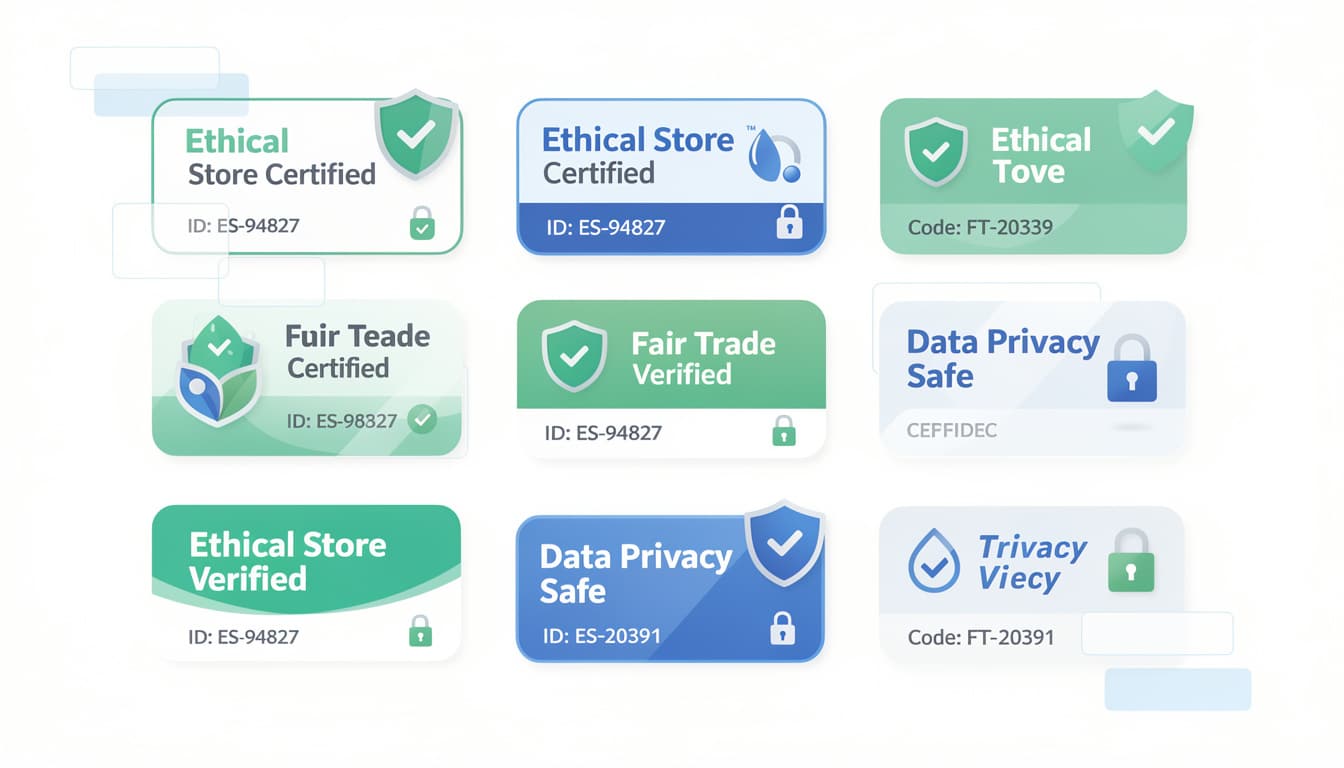
Faced with an unknown logo on an online shop, four simple questions are enough to expose the scam in under a minute: Who controls it? What exact criteria are evaluated? What transparency is offered? What periodic review guarantees it is up to date?
If any of these answers is missing, move on. This pragmatic test has already revealed many greenwashing attempts. Reliable labels openly publish their specifications, accept external audits and communicate the dates of their next revision.
🥕 Food certifications in detail
In the agri-food sector, environmental impact and production ethics complement each other. A coffee simultaneously displaying AB, Bio Cohérence and Rainforest Alliance offers a multidimensional guarantee: no synthetic pesticides, European origin of the beans, and protection of tropical forests.
The AB label now includes a new floristic biodiversity criterion, strengthening ecosystem protection. Bio Cohérence requires that 80% of ingredients come from within 150 km of the processing site, promoting local production. The Label Rouge evaluates taste quality with a minimum sensory score of 14/20, proving that sustainability and gastronomic pleasure are no longer opposed.
A cooperative in the Jura combining AB and Label Rouge recorded an 18% increase in sales after highlighting the double certification on the packaging. Rainforest Alliance, for its part, combines ethical consumption trends and fair trade with blockchain traceability of cocoa.
👕 Textile and cosmetics: sustainability and health combined
The trio GOTS, Oeko-Tex and Fair Wear Foundation forms a comprehensive guarantee for a garment respectful of the planet, the skin and the workers. GOTS requires 95% organic fibers, while Oeko-Tex Standard 100 bans 213 harmful substances.
Fair Wear Foundation monitors the living wage actually paid to seamstresses, eliminating the abuses of fast fashion. In cosmetics, EcoCert Cosmos and Nature & Progrès remove all petrochemicals and animal testing, reinforcing the commitment to ethical beauty. These certifications rely on an EcoCert blockchain algorithm that traces every essential oil and every ingredient.
🏠 Home, furniture and leisure: traceability in everyday life
Beyond the plate and the wardrobe, laundry, furniture and hotel stays fall within the scope of responsible consumption. The EU Ecolabel, Nordic Swan, NF Environnement and Green Key cover these essential everyday areas.
A Green Key certified hotel must reach 20% renewable energy, while a Nordic Swan paint caps its VOCs (volatile organic compounds) at 20 g/L, limiting indoor pollution. For wood, FSC and PEFC ensure replanting and respect for local communities. A Breton carpenter who switched to 100% FSC reports an average lead time shortened by 15% thanks to an optimized supply chain.
Sustainability also extends to travel: opting for eco-responsible travel turns tourism into a lever for conservation. For the home, creating an eco-responsible atmosphere notably involves choosing wood, verifiable via these certifications.
🔗 Local traceability and fair trade
Local production and fair trade are not buzzwords but measurable criteria. A responsible online shop indicates the kilometer zero, the producers' remuneration conditions, and commitments to communities.
A practical guide to responsible consumption encourages favoring short supply chains and fair partnerships. How to buy ethically remains a central question to minimize environmental and societal impacts.
✅ The anti-scam checklist in 30 seconds
Before checking out on an online shop, a few quick checks are enough to avoid traps. Here is the process in five essential points:
🏷️ Spot the certificate number displayed under the logo. Its absence signals a marketing pictogram without substance.
📱 Scan the QR code or consult the LabelCheck portal to access certification information instantly.
📅 Check the date of the next audit. If it's past due, the label has expired and the commitment is no longer valid.
🔄 Compare at least two sources: the label's official website and the retailer's CSR report. Discrepancies betray the bluff.
❌ Check for the absence of vague claims like “green”, “nature” or “eco” without documented evidence. These terms alone constitute greenwashing.
Use tools like Moralscore to discover brands that match your ethics: this app makes sorting easier by providing certified and verified profiles.
📊 Common greenwashing pitfalls
Online scammers favor five recurring strategies: the total absence of an identifiable certifier, nonexistent or locked audit reports, zero transparency on the criteria applied, logos without serial numbers, and finally vague undocumented claims.
Some sites display logos created from scratch, vaguely resembling real certifications but without any official existence. Others pile up labels with no logical connection, creating an illusion of respectability. Greenwashing is all the more insidious because it plays on our good faith: recognizing these tactics is the best defense.
🌍 Responsible consumption and real impact
Responsible consumption means meeting basic needs (eating, housing, heating, traveling) while taking ecological, social and ethical factors into account. This approach includes not only the finished product but the entire production and distribution phase.
Social commitment involves respecting human rights and decent working conditions. This concerns both food, with how to buy eco-responsible meat, and second-hand via platforms like Vinted that extend product life cycles.
💡 The economies of scale effect: prices are finally falling
A major consumer concern is the extra cost of labeled products. Good news: the price gap halved between 2020 and 2025, and the trend remains downward thanks to economies of scale.
As more online shops adopt sustainability, certification costs are spread over larger volumes. Tax incentives and government subsidies accelerate this dynamic. Ethical labels and reliable certifications are gradually becoming the norm rather than the exception.
🎯 Beyond carbon neutrality
Does a label guarantee a carbon-neutral impact? No. It reduces the footprint according to specific criteria, but achieving true neutrality also requires personal sobriety of use and, where appropriate, a certified carbon offset.
Some online shops even offer the possibility to offset purchases via verified programs. This holistic approach shows that responsible commitment goes beyond a simple purchase to encompass a change in behavior.
🤝 Why multiple labels strengthen trust
You may wonder why some products carry multiple labels? Each certification covers a different angle: one protects the environment, another guarantees social fairness, a third validates product quality. The combination offers a multidimensional guarantee and strengthens consumer trust.
An item of clothing displaying GOTS, Oeko-Tex and Fair Wear simultaneously protects the fibers, the user's skin and the workers. This strategic assembly signals a truly committed retailer, capable of orchestrating multiple certifications without contradiction.
Adopting responsible consumption incorporates key concepts and deep issues that go beyond a single criterion. The multi-certified approach illustrates this assumed complexity.
🔐 Verify an unknown logo in three steps
You spot an unfamiliar pictogram? Identify the certifier mentioned, enter the number in the official database, or use the LabelCheck app. A lack of results signals a marketing pictogram without foundation.
This verification takes less than a minute and protects you effectively. The most sophisticated scams collapse quickly when faced with this basic check.
Smart consumption in Belgium and France relies on this collective vigilance: each individual verification strengthens the standards of the entire market.
Profil de l'auteur
Derniers articles
 Electricity, Gas & Energy14 September 2026Gaz et électricité : ce que la hausse des tarifs va changer sur votre facture
- Agency, Webmarketing & SEO12 September 2026Fusion Omnicom-IPG : ce que la plus grande agence de publicité au monde change pour les marques
- Retirement & Senior Living10 September 2026Carte Avantage Senior SNCF : comment voyager moins cher en train après 60 ans
- Tech & Multimedia8 September 2026Objets connectés : la fin de la 2G et le nouveau Data Act vont rebattre les cartes




Table of Contents