
95% of internet users make a major security mistake without even realizing it. This vulnerability, seemingly trivial, throws open the door to hackers and turns every login into a potential risk. Far from being a topic reserved for experts, this flaw affects the digital daily life of millions of people who browse without a safety net.
In short: The use of weak or reused passwords remains the leading cause of hacking. 🔓 Internet users employ predictable combinations (birthdates, family names) without enabling two-factor authentication. Phishing attacks pose as legitimate services to steal credentials and data. Cybersecurity starts with simple actions: strong, unique, and complex passwords. Data breaches increase by 30% each year, exposing data protection to growing risks.
🔑 The weak password: the key that no one locks
Imagine an old notebook, the kind you carefully bind in a workshop. You would never leave it open on a public table. Yet that's exactly what millions of internet users do with their digital credentials. A weak password is like a cardboard lock: it gives the illusion of protection, but it withstands nothing.
The majority of users choose predictable combinations: “123456”, “password”, or worse, a child's first name followed by the birth year. 😰 These patterns are cracked in a few seconds by automated tools. Hackers don't break into safes; they simply test poorly secured doors. This security mistake turns every account into easy prey.
What makes the problem worse: many people reuse the same password across multiple platforms. If one site suffers a data leak, the attacker suddenly has access to email, social networks, banking services. It's like using the same key for your house, your car, and your safe.
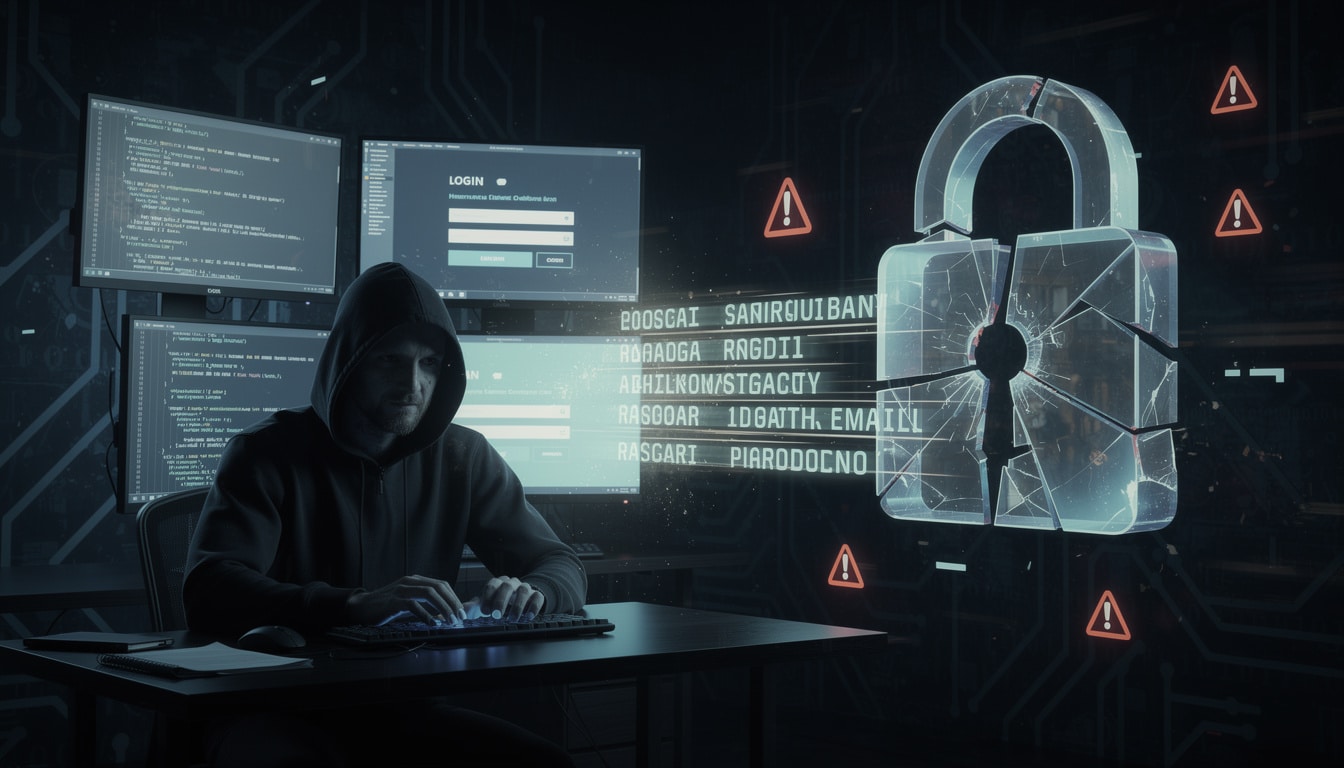
🎣 Phishing: the bait that mimics trust
Phishing is not a violent attack. It's a subtle deception, almost respectful in its cunning. An email lands in your inbox, signed with your bank's logo or a service you use. The message seems urgent: “Verify your identity”, “Confirm your payment”. Everything looks legitimate.
The user clicks, enters their credentials, and the trap closes. 🪤 These phishing messages exploit exactly that moment when vigilance drops, when we act quickly without reading the full email address or inspecting the link. Hackers rely on habit, on that trust we give without thinking about digital services.
What makes phishing particularly insidious: it requires no exceptional technical skill from the attacker. Only psychology matters. Some studies show that even cybersecurity professionals get caught. It's a human, non-technical vulnerability.
🔐 Two-factor authentication: the safeguard we ignore
Despite being widely available for several years, two-factor authentication remains disabled for 80% of users. Yet it's one of the simplest and most effective protections. After entering their password, the user receives a code on their phone or generates a temporary key.
This second step seems tedious. 😒 It takes three extra seconds. But it's precisely that delay that saves entire accounts. Even if a hacker has your password, they cannot access your account without that personal, instant code. Two-factor authentication creates a barrier automated tools cannot cross.
Some services even offer physical security keys or dedicated apps to generate these codes. These solutions combine technical cybersecurity and convenience. Yet few activate them, persisting in the illusion that “it won't happen to me”.
💾 Personal data: what every internet user doesn't realize they're sharing
Over the years, we accept terms of use without reading them. Every click enriches the profiles companies build about us. Browsing history, location, purchase preferences, contacts: everything accumulates in databases often poorly protected. The expansion of the Internet of Things further amplifies this exposure of data, each connected device becoming an exploitable source of information.
Data protection of personal information is not just a private matter. It's a collective issue. When a company suffers a breach, it's not just one or two users who are compromised; sometimes millions are. 📊 Their information is traded on the dark web at low prices. A card number, an email address, a phone number become marketable products.
This accumulation of data is not inevitable. Some mechanisms exist: read privacy policies, limit app permissions, use password managers. But how many actually do this?
🛡️ Simple actions that create a real barrier
Digital security is not an impenetrable fortress. It's more like a set of small precautions that interweave, like the threads of a binding that hold pages together. No single action is enough, but together they create strong protection.
Start with the basics: a weak password should become a 12-character password mixing uppercase, lowercase, numbers, and symbols. 🔤 Each account should have a different combination. A password manager (Bitwarden, 1Password, KeePass) stores all of this effortlessly.
Then, enable two-factor authentication on sensitive accounts: email, banking, important social networks. Check connection logs occasionally. Update your devices as soon as a security patch appears. These actions take a few hours in total, but offer lasting peace of mind.
There are also warning signs to recognize: an email asking you to click a link to confirm something? Go directly to the official site without following the link. Beware of manufactured urgencies. Two-factor authentication for online payments adds an extra layer of security crucial for your transactions.
🌐 Between digital life and human vigilance
What really strikes you, when observing this widespread security mistake, is its almost mundane character. No spectacular catastrophe, just a quiet habit of neglecting what should matter. As if cybersecurity were a chore, an unnecessary complication in our busy lives.
Yet there is something deeply human in the desire to build walls that hold. 🏠 The craftsperson who binds a book cares for every detail because they know that the stitching determines the life of the work. Cybersecurity works on the same principle: each seemingly minor action structures the resilience of our digital lives.
Hackers rely on our collective inattention. They know that 95% of people will take the easy path. Artificial intelligence is changing the cybersecurity landscape, making threats more sophisticated, but also defenses smarter. The question is not if you will be targeted, but when. And that question deserves far more than a few seconds of distraction when creating an account.
Profil de l'auteur
Derniers articles
 Electricity, Gas & Energy14 September 2026Gaz et électricité : ce que la hausse des tarifs va changer sur votre facture
- Agency, Webmarketing & SEO12 September 2026Fusion Omnicom-IPG : ce que la plus grande agence de publicité au monde change pour les marques
- Retirement & Senior Living10 September 2026Carte Avantage Senior SNCF : comment voyager moins cher en train après 60 ans
- Tech & Multimedia8 September 2026Objets connectés : la fin de la 2G et le nouveau Data Act vont rebattre les cartes




Table of Contents