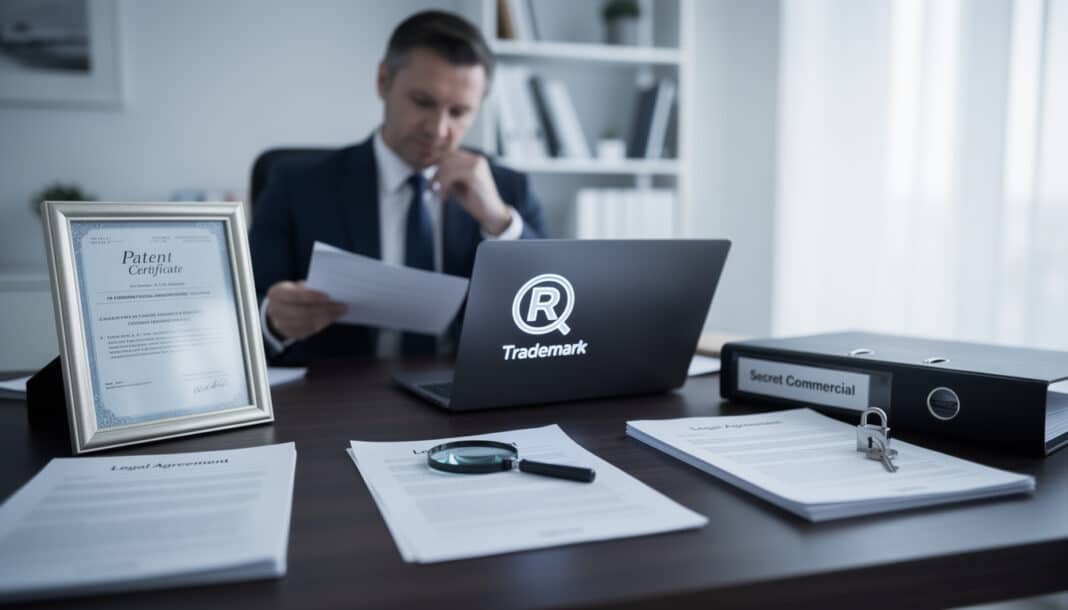
In short. Protecting your business idea requires a multi-layered strategy. The patent secures the technical innovation for 20 years, the INPI trademark preserves the commercial identity, while the trade secret keeps strategic assets out of sight. Choosing the right intellectual property tool depends on the nature of the invention, the industry sector and the development ambitions. Between patent filing, trademark registration and preserving confidentiality, there is a precise mechanism to turn an idea into a lasting competitive asset.
🛡️ Understanding the fundamentals of protecting a business idea
Having a brilliant idea is like sewing the first thread of a binding: without technique or clear intention, the project unravels. Intellectual property protection works the same way. It provides a legal framework to turn an intuition into a real asset, recognized by the law and defensible in court.
Three pillars structure this protection: the patent for technical invention, the trademark for commercial identity, and the trade secret for undisclosed know-how. Each responds to a different logic, a distinct time horizon, and specific implementation conditions. Confusing these tools or neglecting one of them exposes you to risks of usurpation, infringement or loss of value.
The central question remains: what really makes an idea strong? Is it its formula, its appearance, its secret process, or the whole package? Answering this question honestly determines the protection strategy to adopt.
📜 The patent: securing technical innovation
The patent is a contract between the innovator and the State. You give up the secret of your invention to the public, which in return grants you the monopoly of exploitation for 20 years. It's a negotiated transparency, almost austere, which contrasts with the opacity of the trade secret.
A patent filing with the Institut National de la Propriété Industrielle (INPI) follows a demanding protocol. The invention must be new (never disclosed before), non-obvious to a specialist in the field, and susceptible to industrial application. A mere concept does not exist legally; a tangible technical description is required, reproducible by a third party. This rigor is both protection and burden: it forces concrete thinking.
For a biotech startup, proprietary software or an innovative machine, the patent becomes a key valuation element. Investors conducting due diligence demand it. Nevertheless, a patent application costs between €1,500 and €3,000 in France, and more for international protection. It's an investment that presumes confidence in the commercial potential.
🏷️ The INPI trademark: preserving your commercial identity
If the patent protects the how, the trademark protects the who. It secures the name, logo, colors, slogan that embody a promise to customers. Registering a trademark means isolating it from use by competitors in the same business sector.
Trademark registration with the INPI offers protection for 10 years, renewable indefinitely. Unlike the patent, there is no obligation of secrecy or technical documentation: only the distinctive sign matters. A trademark is also defended by use; the more it is known and associated with values, the stronger its protection becomes.
Imagine a small artisanal clothing brand with a minimalist logo. This logo, faithfully reproduced in binding through years of interactions with customers, progressively becomes a sign of emotional recognition. It is this emotional and commercial weight that the trademark protects. Without trademark registration, a competitor could merely copy the same design and progressively erode that capital.
The cost remains moderate: around €250 for national registration in France. But for a European or global ambition, fees increase. The real question is not the cost, but anticipation: registering too late exposes you to capture by a third party.
🔐 The trade secret: keeping what must remain invisible
Some things should never be revealed. That's the philosophy of the trade secret. It is not an official filing, but a confidentiality strategy based on internal practices: access restrictions, non-disclosure agreements, compartmentalization of information.
The Coca-Cola recipe, the manufacturing process of a premium cosmetic, or the algorithmic model of a platform are trade secrets. No patent protects them publicly; that is precisely the source of their power. As long as they are not disclosed, you keep a perpetual competitive advantage, without time limitation.
The downside? If the secret leaks, the protection disappears. A former employee revealing a product's composition, a hacker accessing source code, and everything collapses. Confidentiality is never legally guaranteed; it relies entirely on discretion and organizational vigilance.
That's why many companies combine approaches. You file a patent on certain technical aspects, protect branding with a trademark, and lock the strategic core in silence. This multi-layered architecture makes imitation more costly and complex for predators.

💡 Patent, trademark and secret: building a coherent strategy
Choosing between these three tools is not an isolated decision, but a puzzle. Take the example of a wellness company developing an innovative dietary supplement. The active ingredient deserves a patent filing (patentable as a new composition). The product name and its packaging require a trademark. The precise formula, the secret ratios, the suppliers—all of that falls under trade secret.
This trilogy protects the idea from several angles. If a competitor invents a slightly different molecule, the patent partially blocks it. If they reuse the name or design, the trademark stops them. If they try to copy the finished product through industrial espionage, the trade secret becomes a legal recourse.
Turning to an intellectual property protection adviser becomes necessary beyond a certain commercial ambition. These professionals assess what is worth filing, what should remain secret, and which jurisdictions to target based on the markets in view.
📋 Concrete steps for an INPI patent filing
Applying for a patent requires meticulous preparation. First, you must verify that the invention does not already exist: a prior art search with the INPI, the European Patent Office, or international databases. Discovering late that you are inadvertently copying would be fatal.
Second, draft an impeccable technical description, complemented by drawings or diagrams. Clarity rules here: every component, every step of the process must be understandable to an engineer in the field. The State will not hesitate to reject a vague or imprecise file.
Third, prepare an official application to the INPI with a defined protection strategy: national patent? European? Worldwide? Each extension costs and takes time. The current trend is to prioritize a national filing first, then a European extension if early feedback is promising.
Fourth, accept that the file will be published 18 months after filing. It's the counterpart of the monopoly: the public learns your secret. After this period, competitors can begin preparing legal workarounds. It's therefore a race against time to launch the product and capture the market before others adapt.
🎯 Trademark registration: secure your identity now
Unlike the patent, which requires months of administrative negotiation, trademark registration is often more straightforward. You just need to complete a form, attach an example of the sign (logo, color, etc.), define the classes of activity (the sector) and pay the fees.
Three months are generally enough to obtain provisional registration. Six months for a final decision. After which, the trademark is yours for a decade. Practice dictates that many entrepreneurs register very early, well before launching the product, simply to secure ground.
Be careful, however: if a similar trademark already exists, the INPI will refuse registration, particularly in the same class. The risk of confusion must be excluded. That's why a prior search is strongly advised, even if it's not mandatory.
For a company considering European or global expansion, the Madrid system offers simplification: a single filing covers multiple countries. It's cheaper than registering in each jurisdiction separately.
🚨 When and why the trade secret takes precedence over the patent
Not everything is patentable. Management methods, commercial strategies, customer data, operational processes—no patent protects them. Worse, some inventions are so valuable that disclosing them (a legal requirement of the patent) would destroy the advantage they provide.
Imagine a logistics platform that runs on a revolutionary algorithm, inherently inimitable. Revealing it in a patent would be suicide: competitors would understand the model and replicate it immediately. It's better to keep it secret. As long as it works, the advantage remains. If it leaks, you lose everything at once.
The trade secret excels when confidentiality is maintainable long-term—that is, when the secret cannot be discovered by reverse engineering. For a pharmaceutical molecule, reverse engineering is possible: a competitor can chemically analyze it and understand its composition. A patent then becomes necessary. For a business model or a process invisible to the end customer, secrecy is sufficient.
There is also a psychological dimension: secrecy maintains an aura of mystery around the company. Customers, investors, and the media speculate. This curiosity feeds interest. The patent, on the other hand, reveals everything: it's less spectacular, but more transparent and legally legitimate.
⚖️ Responsibility and legal framework of protection
Once protection tools are in place, who is responsible for defending them? This thorny question touches on legal responsibility within the organization. In an SME, it's often the entrepreneur themselves. In a large organization, it's generally the legal department or R&D.
In case of infringement, legal action falls to the rights holder. If you hold a patent, you have 5 years to act from the date of infringement. Deadlines vary for trademarks. Trade secrets are not subject to any specific legal time limit: as long as they remain secret, theoretical protection persists.
The burden is heavy: identifying the violation, gathering evidence, initiating a lawsuit, bearing the costs (lawyers, experts). Many entrepreneurs file patents or trademarks without ever actively defending them, simply out of fear of the complexity. It's a calculated risk: protection exists, but it is not mobilized.
For this reason, some companies take out specialized legal protection that covers defense costs in case of litigation. This democratizes access to justice for SMEs that would otherwise lack the resources to pursue infringers.
🌍 The international horizon: patents and trademarks beyond borders
A brilliant commercial idea in France is often brilliant elsewhere. But legal protection is never universal. A French patent only exists on French territory. To conquer Europe, you need a European patent. For the United States, a US patent. For Asia, as many filings as the countries targeted.
The Patent Cooperation Treaty (PCT) simplifies this international process. A single initial filing gives access to provisional protection in more than 150 countries. After 30 months, you decide the final jurisdictions where to formalize filings. It's strategically wiser than scattering resources from the start.
Trademarks follow a similar logic. The Madrid system allows registration in multiple countries via a single form. It's not automatic: each jurisdiction can reject registration according to its own criteria. But it's infinitely more efficient than 50 isolated national applications.
The real question becomes: where to bet? What is the priority market? What is the company's financial capacity to defend its rights internationally? These trade-offs shape the filing strategy and the expected return on investment.
🔧 Integrate protection into the business plan from the design phase
Many entrepreneurs think about intellectual property too late: when the product is launched, competitors copy it, and the damage is done. Building a solid business plan means integrating the protection strategy from the earliest stages of development.
This implies not talking too much about your idea before securing at least the fundamentals (a registered trademark, a patent application in progress, confidentiality agreements with partners). Every public presentation, every conversation without a non-disclosure agreement can be perceived as prior disclosure that invalidates certain protections.
Investors, for their part, demand a clear mapping of intellectual property before injecting funds. They want to know: what really protects you? Is it defensible in court? How long before protection expires? Honest answers to these questions largely determine the company's valuation.
Therefore, calling in a specialist from the design phase, not only at commercialization, is investing in the business's longevity. It's as costly as insurance, but it's an existential cost for any serious ambition.
💼 Use cases: how different sectors protect their ideas
In the pharmaceutical sector, protection relies heavily on patents. A new molecule justifies years of research and hundreds of millions of euros. Without the patent monopoly, the business model collapses. Laboratories combine this with trade secrets on manufacturing processes.
In software technology, it's more nuanced. Source code is generally a trade secret. Some patents protect innovative algorithms or patentable interfaces. Product names and logos are trademarks. But a large part of innovation remains underground: nobody really knows exactly how this or that revolutionary AI works.
In gastronomy or high-end cosmetics, recipes are jealously guarded secrets. Branding is paramount: the trademark accounts for most of the value. A perfume sells first because it's called Chanel or Guerlain, not because its composition is patented.
Fashion startups favor trademarks and designs. They rarely file patents (except for technical innovations in textiles or manufacturing). It's style and recognition that create value. The secret lies in supply sources, manufacturing partners, trend forecasts.
This diversity shows there is no universal recipe. Each sector forges its own geography of secrecy and protection according to its economic realities.
🛡️ The risks of neglecting intellectual property
Ignoring intellectual property protection is a progressive fatality. At first, the company moves forward, tests its model, grows. Then the first infringers arrive. They copy the product, relaunch it at low cost, without having borne the initial R&D. Prices fall. Margins collapse.
Without a patent, trademark or defensible secret, there is no legal way to stop them. All that remains is the race to innovate: constantly innovating to stay ahead. It's exhausting and ultimately less profitable than building a solid intellectual property fortress.
There are also intangible losses. An investor or a bank views intellectual property as a pledge of seriousness and durability. A company without legal protection seems fragile, temporary, speculative. This perception affects financing conditions, valuations, and partner confidence.
Finally, remember that some markets or buyers require an explicit guarantee of non-infringement. Selling to a CAC 40 group without being able to assert that you don't violate any third-party patents becomes impossible. It's a minimum access right: the ability to prove you're not stealing from anyone.
Thus, neglecting intellectual property means accepting a growing vulnerability that sooner or later catches up with the company and its growth potential. It's a choice, certainly, but an expensive one.
True wisdom is to recognize that any valuable idea deserves legal armor. This armor costs time, money and strategic thought. But it turns a fragile intuition into a durable, transferable, monetizable asset. It's the difference between inventing and entrepreneuring.
Profil de l'auteur
Derniers articles
 Electricity, Gas & Energy14 September 2026Gaz et électricité : ce que la hausse des tarifs va changer sur votre facture
- Agency, Webmarketing & SEO12 September 2026Fusion Omnicom-IPG : ce que la plus grande agence de publicité au monde change pour les marques
- Retirement & Senior Living10 September 2026Carte Avantage Senior SNCF : comment voyager moins cher en train après 60 ans
- Tech & Multimedia8 September 2026Objets connectés : la fin de la 2G et le nouveau Data Act vont rebattre les cartes




Table of Contents