
🔐 In short : Online payment security has been significantly strengthened in recent years thanks to the implementation of sophisticated protocols. In 2026, two-factor authentication remains the central pillar in the fight against fraud, mandated by the European directive DSP2. Beyond this fundamental requirement, several technologies coexist to protect your banking data: the 3D-Secure V2 standard, the TLS protocol, the PCI-DSS standard and other complementary mechanisms. For online merchants, choosing a certified payment solution is no longer a luxury, but a necessity to build trust with their customers and minimize fraud risks.
🛡️ Fundamentals of online payment security
For several years, cyberthreats related to online purchases have pushed European legislators to strengthen security requirements. Payment security is no longer a simple recommendation, but a legal obligation that applies to all payment service providers. This evolution has transformed the e-commerce landscape, making each transaction more robust and reliable.
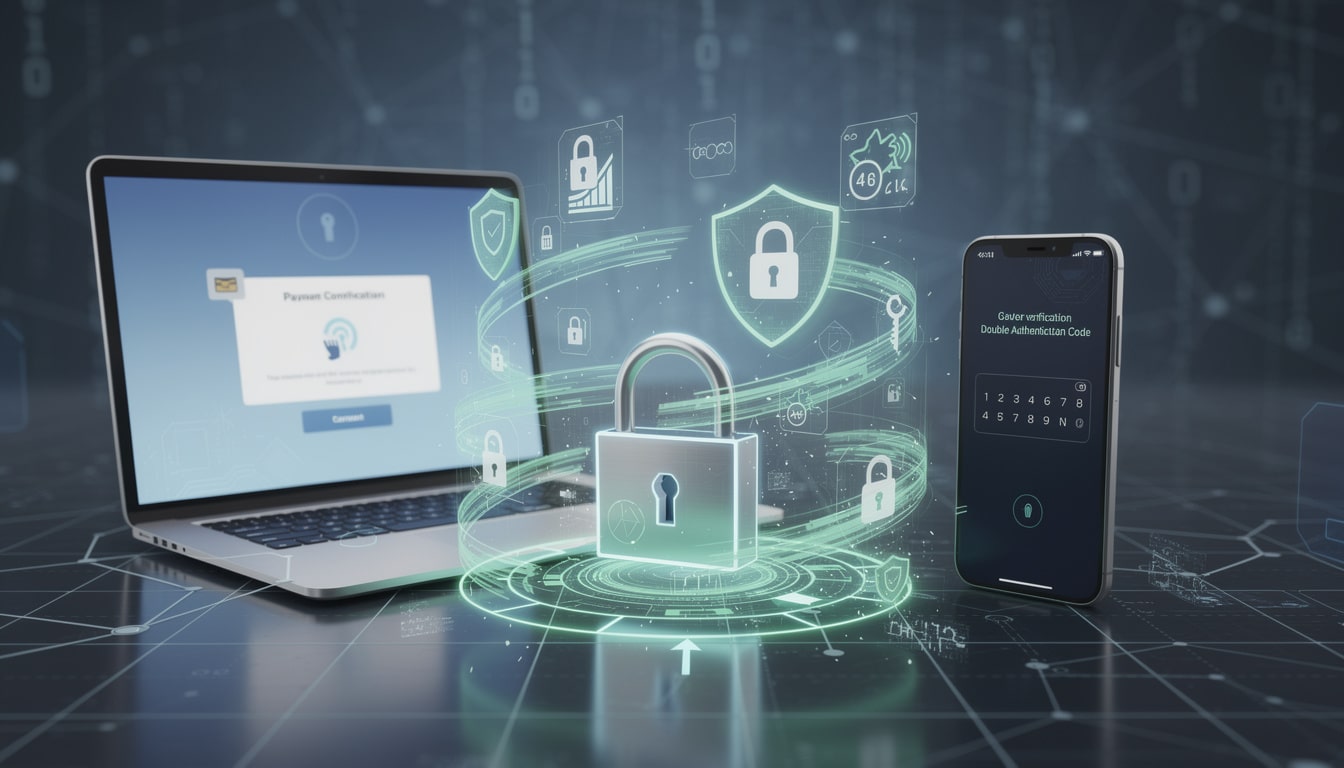
The DSP2 directive, which came into force in 2019, marked a decisive turning point by imposing strong authentication as a mandatory standard for online payments. Concretely, this means that when you make a purchase on the Internet, you must verify your identity through at least two distinct and independent means of identification. This two-factor authentication constitutes an effective barrier against fraud attempts, even in the event of theft of banking data.
The responsibilities fall mainly on payment service providers (PSPs) — banks or specialized companies authorized by the ACPR — who must implement these security protocols. For consumers, this process remains entirely free and transparent.
💳 When strong authentication is truly required
Although strong authentication is mandatory in most cases, the regulatory framework provides for some exemptions. In France, e-merchants can bypass this requirement for certain specific situations. Notably, purchases under 30 € are exempt, as are recurring payments in a subscription context (after the first payment). Some merchants can also obtain an exemption by demonstrating solid technical criteria and effective anti-fraud measures.
These exemptions aim to strike a balance: protect consumers without unduly slowing the purchasing experience for low-risk transactions. However, the amount criterion can seem arbitrary in light of current threats — even a €25 purchase can lead to identity theft.
📊 Essential protocols to secure your transactions
Beyond two-factor authentication, several security protocols work in synergy to protect your information. These technologies, often invisible to the end user, form an armor against cyberattacks and data theft. Understanding their role helps appreciate the seriousness with which merchants and banks take your security.
🔐 The 3D-Secure V2 standard: the first line of defense
The 3D-Secure V2 protocol represents a major evolution in the protection of card numbers. Unlike its previous version, V2 integrates mobile payment methods — Google Pay, Apple Pay and other digital wallets — offering more comprehensive coverage. This standard performs a thorough verification of the entered data and identifies suspicious behaviors even before strong authentication intervenes.
Its operation is based on analyzing the context of the transaction: device used, geographic location, purchase history. If an operation seems abnormal, the system can request additional checks or refuse the transaction. This intelligent approach, called adaptive authentication, makes fraud markedly more difficult.
🔗 TLS: encrypting data exchanges
The Transport Layer Security (TLS) protocol ensures that your data travels encrypted between your browser and the merchant's server. Imagine it as a sealed envelope: only the legitimate recipient can read the content. Without TLS, your credentials and card numbers would be exposed to interception during transmission.
Since 2020, web browsers refuse to load sites without a valid TLS certificate, signaling an “Unsecure Connection.” This drastic measure has forced merchants to comply, making the web considerably safer. Selecting a secure payment solution therefore partly relies on these validated certificates.
💾 PCI-DSS: the continuous audit of sensitive data
The Payment Card Industry Data Security Standard (PCI-DSS) is not just a technical protocol, but a comprehensive and continuous audit framework. It imposes rigorous controls on merchants and payment providers: network segmentation, access management, encryption of stored data, regular vulnerability testing. Non-compliant companies risk substantial fines and a ban on processing card payments.
In practice, this standard means that your payment data is never stored in clear text on servers. It is encrypted or tokenized — replaced by an anonymous code useless without the decryption key. A cyberattack, even if it accesses databases, will only retrieve raw, incomprehensible data.
🌐 Complementary security measures to reinforce your confidence
Beyond the strictly regulated security protocols, additional technologies reinforce data protection and transaction integrity. These additional layers illustrate the defense-in-depth approach adopted by reputable sites.
🔒 HTTPS and trusted certificates
The HTTPS protocol (Hypertext Transfer Protocol Secure) is the visible implementation of TLS at the website level. When you see the small padlock in your browser, it's HTTPS at work. This authentication certificate ensures that you are communicating with the merchant's real server, not an impostor who has hijacked your Internet connection.
HTTPS certificates must be renewed regularly — typically every year. An older site whose certificate has expired displays a threatening warning: your browser blocks access. This technological vigilance, although sometimes inconvenient, has saved millions of consumers from fake payment sites.
🔧 Maintenance and updates: IT hygiene
IT security is never static. Every day, researchers discover flaws in software, operating systems, plugins. Responsible merchants apply patches quickly — automatically for large platforms, scheduled for smaller ones. Neglecting these updates exposes the site to known and easily exploitable attacks.
This constant vigilance explains why modern e-commerce sites are regularly under maintenance: it is not a nuisance, it is protection. The obligations imposed on banks and providers include this permanent maintenance of systems, regulated and documented.
💡 Choosing a secure payment solution: the real challenge for merchants
For an e-merchant, selecting a payment provider is a strategic decision that directly impacts customer trust. A poor solution leaves consumers anxious; a good solution reassures them and increases conversions. How to navigate this complex choice?
📋 Evaluate the essential criteria
Before signing, compare available solutions across several axes. First, verify that the solution integrates all the mandatory protocols: DSP2, 3D-Secure V2, PCI-DSS. Second, examine the accepted payment methods — bank cards, digital wallets, bank transfer, purchase on credit. Third, check the fees: transaction fees, fixed fees, volume-based rates.
A “low-cost” solution that skimpes on payment security will ultimately cost much more in disputes, fraudulent refunds, and reputational loss. The best providers offer transparent pricing and exhaustive documentation on the security measures deployed.
🤝 Support: an overlooked but essential service
Many payment service providers offer personalized support: technical integration, team training, dedicated support. This assistance reduces deployment time and minimizes configuration errors — a common source of vulnerabilities. A provider that invests in your success is a safer partner than a mere transactional supplier.
Small merchants, in particular, benefit from assistance to understand legal obligations, notably regarding strong authentication and its exemptions. This education prevents unintentional non-compliance.
🎯 The evolution of threats and technological responses
The threat of online payment fraud has continuously evolved. In the 2010s, fraud often came from massive data thieves (hacking commercial databases). Today, cyber gangs are more targeted, exploiting specific vulnerabilities or using social engineering to manipulate users. Defense technologies have had to adapt.
🤖 Artificial intelligence and adaptive detection
Modern secure transaction systems now rely on machine learning to identify fraud in real time. Rather than applying rigid rules (“if amount > 1000 €, refuse”), these systems analyze hundreds of variables: geolocation, typing speed, customer history, purchase patterns. Abnormal behavior triggers a discreet additional verification.
This adaptability makes life very difficult for fraudsters, who must continuously circumvent evolving defenses. It also improves the customer experience: a loyal buyer will rarely face additional authentication requests, while a suspicious attempt will be immediately challenged.
🌍 The global battle against cross-border fraud
With global e-commerce, fraudsters operate from anywhere, targeting victims on the other side of the world. Authorities and companies have set up international cooperation: sharing fraud data, harmonizing standards (like DSP2 in Europe). The European GDPR complements this approach by imposing transparency on data usage.
Banks and authorized providers must comply with strict obligations regarding strong authentication, aligned with these international standards. No serious actor can ignore these rules without risking their authorization.
🔄 User experience in the face of security requirements
There is an inherent tension between security and convenience. The more checks there are, the higher the security — but the more cumbersome the purchase becomes. How do modern solutions resolve this dilemma?
📱 Frictionless authentication
The best 2026 technologies aim for authenticity without disruption. Rather than asking for a 6-digit code at every purchase (which increases cart abandonment), systems silently authenticate the user via their registered phone, a biometric scan, or a simple push notification. Two-factor authentication therefore remains in place, but it is imperceptible.
For example, Apple Pay combines payment and biometric authentication in a single gesture: you press the home button with your finger, and the transaction is authorized. You did not feel that two distinct authentication factors (biometrics + phone token) just validated your identity.
🎓 Educating consumers without scaring them
Responsible merchants explain security measures to their customers, but without overloading them with technical information. A simple sentence — “You will receive an SMS to confirm your purchase, that's normal” — is enough to dispel concern. Too much explanation creates doubt where there would otherwise be none.
Displaying the HTTPS padlock, a security certification logo, or a reassuring line about encrypted data helps build trust. These visual markers often replace a long marketing speech.
⚡ Trends to watch in the cryptography and security
The technological landscape continues to evolve rapidly. What changes will shape payment security in the years to come?
🔐 The emergence of post-quantum cryptography
Quantum computers, long theoretical, are gradually becoming a reality. In principle, they could break current cryptography systems based on the multiplication of large prime numbers. To guard against this distant but real threat, standardization bodies (like NIST in the United States) are already developing “post-quantum” encryption algorithms resistant to these new machines.
Payment providers are beginning to assess the impact on their systems — a transition process that will take years, but which will ensure long-term data protection.
💰 Blockchain and decentralized wallets
Cryptocurrencies and decentralized blockchain payment systems offer a radically different approach: no central server to hack, but an immutable distributed ledger. Although volatile and not yet clearly regulated, these technologies influence innovations by traditional providers.
Some digital wallets are already experimenting with hybrid approaches, combining the security of private blockchains with the regulatory requirements of classic online payments. Electronic wallets are attracting more and more users thanks to this adaptability.
🌐 International interoperability and common standards
As global commerce intensifies, fragmentation between different security standards becomes an obstacle. Europe with DSP2, Asia with its variants, America with its own norms — this mosaic complicates life for international merchants. The trend is toward gradual harmonization, with negotiations between regulators to create bridges rather than walls.
Government guides help businesses navigate these regulatory complexities, emphasizing interoperable solutions that comply with emerging standards.
Profil de l'auteur
Derniers articles
 Smartphones & Mobile Phones14 October 2026The loyalty penalty on your mobile bill: why staying put costs you more
- Family, Babies & Children5 October 2026Airline family seating fees: what the planned ban will change for parents
- Everyday Life & Society23 September 2026Consumer confidence index: what the monthly mood check on British households really measures
- Agency, Webmarketing & SEO31 August 2026SEO : a Google bug skews visibility statistics in AI results




Table of Contents