
Summary : Moving from a chronic overdraft to regularly saving 20% of your income is not an unattainable dream. It's a gradual transformation that requires budgetary clarity, negotiation with your bank, and above all, a deep overhaul of your financial habits. This story of resilience shows how analyzing your expenses, identifying invisible money leaks, and putting in place lasting automatic habits can lead to genuine financial peace of mind.
In short — What you need to remember :
💰 A chronic overdraft actually costs €200 to €600 per year in invisible bank fees. 📊 Moving to 20% monthly savings first requires diagnosing precisely where every euro goes. 🎯 Negotiating with your bank and shifting direct debits can be enough to break the cycle. 🔄 Small additional incomes (selling items, one-off gigs) provide a decisive boost. 🧠 The lasting key: automate savings and create an emergency fund, even if symbolic. ✨ A change of mindset matters more than the numbers: move from “I endure” to “I steer” your account.
💳 When overdraft becomes a spiral: understanding the true cost
There is something perverse about bank overdrafts. At first glance, it's only a few euros, a few dozen at most. But these amounts accumulate silently, month after month, like the imperceptible fold of an old parchment that eventually forms deep wrinkles.
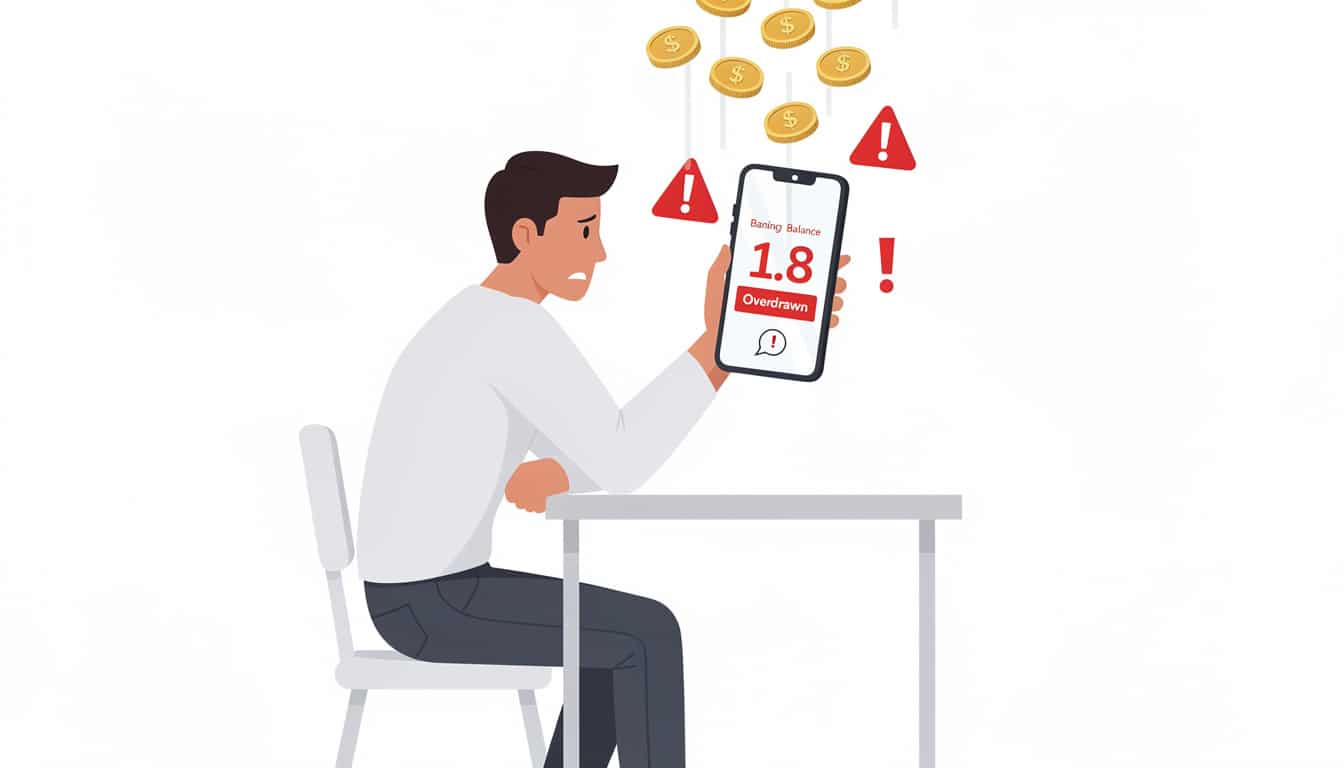
Many people only discover at the end of the year that they've paid the equivalent of a restaurant meal in intervention fees, overdraft interest (agios) and commissions. These automatic debits act like discreet moths: individually insignificant, collectively devastating. Understanding the real fees of a bank overdraft is the first step to breaking the vicious circle.
A chronically overdrawn account generates several types of fees. Overdraft interest first, those debit interests calculated on the negative amount and its duration. An €800 overdraft for 15 days, even at an apparently moderate rate of 8%, costs about €2.60. But add two bounced transactions (€16 each), and the month costs you €18.60. Multiply by 12, and that's more than €220 of money evaporated as pure loss.
The real scandal is that these fees increase in proportion to your financial distress. The more you are overdrawn, the higher the risk of bounced transactions, the higher the fees. It's a system that penalizes the most vulnerable, entrapping them further instead of helping them.
🔍 How fees accumulate without you noticing
Imagine a bookbinder who used to assemble pages, before they became e-books. Each stitch seems insignificant. But a thousand stitches create a durable structure. In finance, it's the opposite: a thousand small fees destroy that structure.
Intervention fees, legally capped at €8 per operation (or €4 for vulnerable customers), don't seem like much. But in a month where three direct debits are bounced, you've already lost €24. Solutions for managing an overdraft exist, but few really know them.
What distinguishes a temporary overdraft from a chronic one is precisely this accumulation. Anyone can have a month in the red after an unexpected expense. But when red becomes your default color, when you dive before your paycheck is even paid, there is a structural imbalance. That's when fees stop being an anomaly and become a permanent tax on poverty.
📋 The diagnosis: making an honest inventory of your money
Getting out of a chronic overdraft begins with a disturbing act: radical honesty. Not accounting honesty (that of bank statements), but behavioral honesty. Where does your money really go? Not where it should go according to the ideal budget, but where it actually flows.
This inventory is like the work of the bookbinder who examines an old book before restoring it. You must first see all the damage: the worn pages, the flaking covers, the strings barely holding. Apply the same method to your finances: list every income, every expense, every leak.
Start with income, all income. Salary of course, but also benefits, aid, odd jobs. List fixed charges: rent, insurance, loans, essential services. Then, and this is where it gets interesting, spend 15 days noting every variable expense. Not to judge yourself, but to see.
🎯 Identify the items that silently sabotage you
Almost everyone who moves from overdraft to savings discovers the same thing: they have micro-zombie subscriptions. A streaming service you forgot, a paid meditation app you never opened, a digital magazine you never read. These “little things” at €5 or €10 per month are invisible individually but often total €50 to €100.
There are also emotional behaviors. Meal deliveries ordered when you come home stressed from work. Small consolatory purchases. Supermarket trips without a list that inflate the cart by 30%. These expenses are not vices: they are symptoms. They indicate that something isn't working in your daily life.
The complete diagnosis also requires looking at fixed expenses with a new perspective. Is your phone plan really suitable? Was your car insurance renegotiated last year? Are your energy costs optimized? Many people drag around obsolete contracts simply because they've never checked whether a cheaper alternative existed.
💼 Getting out of overdraft: the three pillars of transformation
Turning a chronically negative account into a savings-producing account relies on three simultaneous actions. None is sufficient on its own. It's like bookbinding: you need the thread, the glue and the paper. Without one of them, the work falls apart.
🏦 Pillar 1: Negotiating with your bank is possible
The first thing to understand: your banker doesn't hate you. He or she simply manages client risk. If you come with a complete diagnosis and an action plan, you stop being a risk and become a project.
Prepare this meeting seriously. Bring your last three months of statements, your exact quantified balance, and above all, a realistic repayment plan. “I'll manage better” is not enough. “I will save €150 per month by reducing X, Y and Z, and I'll clear my €1,000 overdraft in 6–7 months” works.
What you can negotiate: a temporary suspension of overdraft interest (1 to 3 months), reduced intervention fees, setting up an official authorized overdraft (which costs less than an unauthorized overdraft), a repayment schedule. Benefiting from an overdraft adapted to your income requires a real conversation, not a plea for a favor.
💡 Pillar 2: Shift direct debits to create breathing room
Here comes a little-known secret: many people are overdrawn not because their total spending exceeds their income, but because everything concentrates a week or two after payday. Bills arrive, loans collect, insurances are debited, and boom: the account goes red before you've had time to manage it.
Contact each of your creditors (telecom operator, energy provider, insurance company) and ask for a change of debit date. You'd be surprised by how many refusals are only relative. Most accept willingly. The aim: create a spread: half your charges debited on days 5–10 of the month, the other half after the 20th. This creates a liquidity buffer. It's simple, but incredibly effective.
Even a simple request — “Can I be debited on the 23rd instead of the 10th?” — can transform your account reality. You suddenly find days when there is cash, instead of being constantly suffocated.
🚀 Pillar 3: Create supplementary income, even modest
This is where you stop only cutting and start increasing. Selling items cluttering your home (clothes on Vinted, books on Bouquinerie, electronics on Backmarket) is easy and generates €200 to €500 quickly. Babysitting, tutoring, offering small services: that's €200 to €300 per month if you dedicate 5 to 10 hours.
What matters here is less the absolute amount than the psychological signal. Shifting from a purely restrictive strategy (“I must spend less”) to a generative approach (“I can earn more”) changes your relationship with money. You regain power.
🎯 From zero to 20% savings: the path in four steps
Reaching 20% monthly savings isn't reserved for high earners. It's an arithmetically achievable goal when you move from overdraft to balance. But how do you really travel the road that looks long from zero to 20%?
📅 Step 1: Months 1–2, regain zero balance
The first two months are devoted to erasing the overdraft. Quick actions: sell unused items, request an advance, negotiate fees with the bank. You generate €500 to €1,000 quickly. The money goes directly to filling the red hole.
At the same time, start permanent reductions: cancel subscriptions, renegotiate contracts, adopt new shopping habits. This should generate €50 to €150 in monthly savings. It's not spectacular, but it's sustainable.
The goal: reach an account that never drops below zero. That's the critical threshold. You're not rich, you're just… stable.
🌱 Step 2: Months 3–4, build a safety cushion
Once the overdraft is eradicated, any new money saved should not be spent. During these two months, cover your normal expenses and set aside €50 to €100. The goal: reach €300 to €500 of savings. This is your first real financial breathing room.
This savings has a major psychological function. It means that if an unexpected event occurs (repair, medical expenses), you won't dive straight back into overdraft. You have an airbag.
💪 Step 3: Months 5–8, switch to regular savings
Now that expenses are stable and optimized, every extra euro saved can go to savings. Set yourself a target of €100 to €150 per month. That's roughly 5 to 7% of typical incomes. This is when you really feel the difference: your savings visibly accumulate.
Put an automatic in place: as soon as you receive your paycheck, transfer this amount to a separate account (Livret A, regular savings account, whatever). Out of sight, out of temptation.
🏆 Step 4: Month 9+, reach and exceed 20%
At this stage, your budget runs smoothly. Expenses are known, controlled, optimized. All that's left is to gradually increase your savings rate. Increase by €50 every 2–3 months. Move from €100 to €150, then to €200, until you reach 20% of your income.
What makes this possible: every small increase in income or additional saving goes to savings, not consumption. It's the discipline of “I earned more, so I save more,” not “I earned more, so I spend more.”
🔐 Habits: your best ally for lasting change
The difference between someone who gets out of overdraft only to fall back three months later and someone who succeeds long-term is habit. Not willpower. Not motivation. Habit.
The most effective systems work without you. An automatic transfer on payday. An SMS alert if the balance drops below €100. A block that prevents operations below zero. These are benevolent handcuffs that protect you from yourself.
There are also free apps (Linxo, Bankin', Budget Insight) that track your spending in real time and alert you if you exceed your categorized budgets. They turn financial management from a monthly chore into a transparent, continuous process.
🧠 Change your psychological relationship with money
Here may lie the deepest secret. Moving from overdraft to savings is less a matter of mathematics than of narrative. You stop seeing yourself as someone who “can't get out” and start seeing yourself as someone who “takes back control”.
Every small success reinforces this narrative. Have you eliminated the two useless subscriptions? Celebrate it. Have you reached €300 in savings? Note it. These small victories gradually build confidence: if I managed to get out of overdraft, I can succeed at other things.
Chronic overdraft creates a form of financial fatalism. “That's how it is, nothing can be done.” Getting out of that rut requires rejecting that story and giving yourself the right to succeed. That right is the true starting point.
🌍 Traps to absolutely avoid
There are tempting shortcuts that completely sabotage your plan. Here is what will definitively kill your progress.
Taking out a loan to cover the overdraft may be the worst idea. You exchange a short-term cash problem for a long-term charge. You solve nothing, you just complicate matters. Understanding the risks of chronic overdraft helps precisely to avoid these traps.
Ignoring bank notices is a second major mistake. Every reminder about the overdraft, every fee notification is an opportunity to negotiate. Ignoring it is losing time and money. Respond, propose, discuss.
Multiplying bank accounts to “disperse” your debts only complicates your situation. You lose global visibility. Keep it simple: one main account, one savings account, that's enough.
Spending without checking your balance is a return to chaos. Even after overcoming overdraft, this quick-check habit must become reflexive. A few seconds to avoid a month of agios.
✨ Regaining ground: the role of small victories
Something happens when you move from a life of overdraft to a life of savings. It's not just a question of numbers. It's a change in the texture of daily life.
Before, every month-end was a worry. Every direct debit was an unpleasant surprise. Every bank statement was a source of anxiety. After, it's tranquility. You know exactly where you stand. You know where every euro comes from. And above all, you know you have a margin.
Reaching 20% savings is not just a financial goal. It's living proof that you control your economic life. That you are not a victim of your income, but a pilot of your expenses. That's the feeling to aim for.
And when that day comes — when you see your savings account exceed for the first time the amount of your former overdraft — something changes irrevocably in you. You now know it's possible. And that certainty is the foundation of all future financial progress.
Profil de l'auteur
Derniers articles
 Smartphones & Mobile Phones14 October 2026The loyalty penalty on your mobile bill: why staying put costs you more
- Family, Babies & Children5 October 2026Airline family seating fees: what the planned ban will change for parents
- Everyday Life & Society23 September 2026Consumer confidence index: what the monthly mood check on British households really measures
- Agency, Webmarketing & SEO31 August 2026SEO : a Google bug skews visibility statistics in AI results




Table of Contents