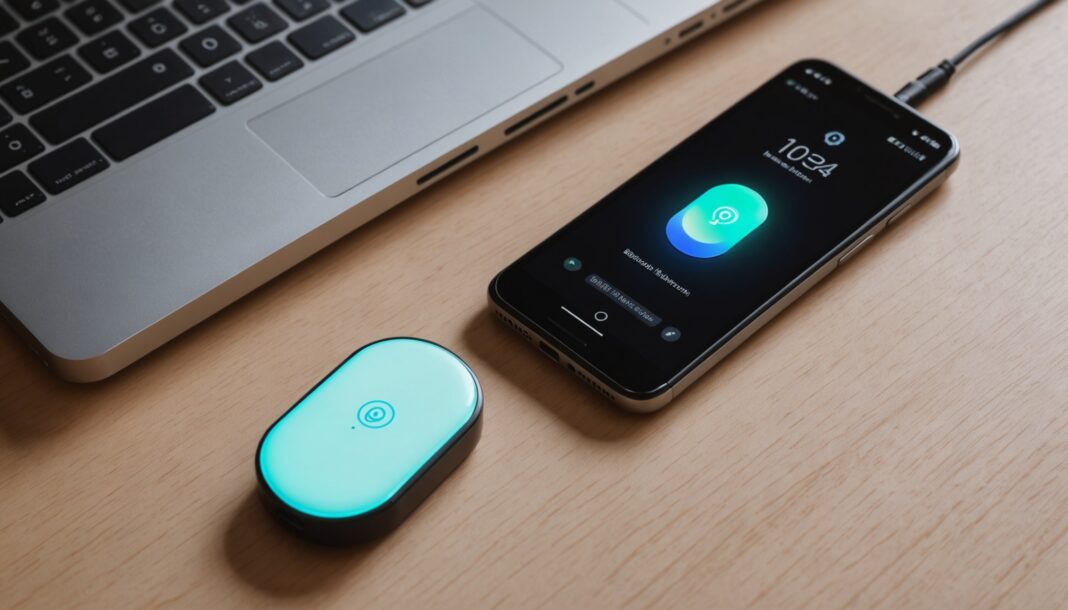
On November 11, 2026, Google launched its own Bluetooth tracker, the Pixel Tag, positioned directly against Apple's AirTag. Sold through the Google Store for $29.99 apiece or $99.99 for a four-pack, the device includes the usual ingredients of the category — but its real selling point isn't the price: it's a cross-brand anti-tracking detection feature that has gotten little attention in early reports.
What the Pixel Tag actually offers
The small oval case pairs Bluetooth with Ultra Wideband (UWB) and “channel sounding” technology, which refines the location of a lost item when it's nearby but out of sight. It's certified IP67, making it water- and dust-resistant, and it packs a user-replaceable battery rated to last up to a year. A dedicated button also lets you ring the paired smartphone — the reverse of the usual setup, where the phone makes the tracker ring. On the compatibility side, a smartphone running Android 9 or newer is enough.
The Find Hub network, the piece that changes the scale
The Pixel Tag relies on Google's Find Hub network (formerly “Find My Device”), which draws on more than a billion Android devices worldwide to help pinpoint a lost item's location, with end-to-end encryption. The denser this mesh network, the faster and more accurate the location — a principle Apple has already proven with its own iPhone network.
The real novelty: anti-tracking detection that crosses platforms
This is the point that has drawn the least attention so far: unknown tracker detection alerts are becoming interoperable between the two ecosystems. An iPhone can now flag the presence of an unknown Pixel Tag that's moving along with its owner without their consent, and an Android smartphone can issue the same alert for an AirTag. Until now, each brand only monitored its own tags, leaving a loophole for anyone using one brand's tracker to follow someone carrying a phone from the rival camp. This security bridge benefits all users, whether or not they buy a Pixel Tag.
What to check before buying one
- The phone must run Android 9 or later to take advantage of the Find Hub network.
- UWB precision is only useful if the paired smartphone itself supports that technology.
- The pricing closely matches the AirTag 2: this isn't a “budget” option, but a direct competitor in the same segment.
- The replaceable battery means the device doesn't have to be thrown away after a year, unlike some trackers with sealed batteries.
For readers with earbuds or smartphones whose battery will soon have to be replaceable under regulatory requirements, Google's choice on this point is far from trivial: it's already the standard that upcoming legislation is set to impose on all connected devices. More broadly, this launch comes amid news in which connected devices already have to contend with the end of 2G and the European Union's new Data Act, two developments that are reshaping the sector's technical constraints. The Pixel Tag also arrives just weeks after Google made its voice translation available offline, a sign of a broader strategy of mobile features that work without relying on a network connection.
Frequently Asked Questions
Does the Pixel Tag work with an iPhone?
No, it's designed for the Android ecosystem and the Find Hub network. An iPhone can only detect its presence through the interoperable anti-tracking alert, not use it as a personal tracker.
Do you need a recent smartphone to get the full benefit?
Android 9 is enough for basic use, but location accuracy via UWB and channel sounding depends on the smartphone itself having that chip.
Does the Pixel Tag protect privacy better than an AirTag?
It uses the same end-to-end encryption principle as its rival, with one genuine improvement shared by both brands: anti-tracking detection now also works across different systems, not just within a single ecosystem.
Sources
Profil de l'auteur
Derniers articles
 DIY & Troubleshooting18 November 2026Dexter Sander Recall 2026: What Leroy Merlin and Weldom Customers Need to Know Before Using It
- Restaurants, Drinks & Food18 November 2026Flexitarianism in France: Less Meat on the Plate, but Not for the Reasons You'd Think
- Home Appliances & Equipment18 November 2026Washing Machine, Oven, Dishwasher: Which Brand to Choose for Appliances That Last?
- Nutrition, Diet & Weight Loss18 November 2026Pancreatic Fat: The Diet That May Help Reduce It




Trending now on legal streaming
FilmObsession
SeriesLupin
This article was written with the help of artificial intelligence. Editorial policy
Table of Contents