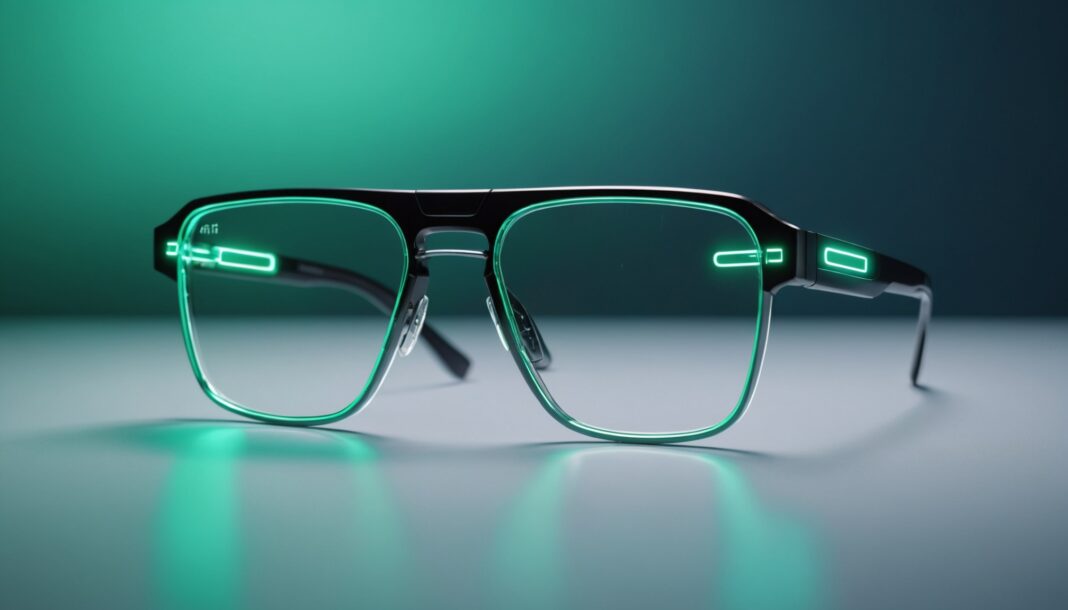
What if the smartphone screen was no longer the center of attention? That's the bet from Chinese manufacturer RayNeo, which has just unveiled two new ranges of AI-powered connected glasses: the discreet RayNeo iO, designed for professional use, and the spectacular RayNeo GT and GT Max, built for entertainment. The stated goal: to make on-device AI a credible alternative to the pocket screen.
Glasses without a visible camera, for discreet use
Unlike some competing models equipped with front-facing cameras, the RayNeo iO favor discretion. The frame weighs barely 33 grams, with a weight distribution designed for prolonged wear. Information is displayed on a waveguide display, in 1300-nit green monochrome: invisible from the outside, but perfectly readable for the user.
The device houses four microphones and a vocal vibration sensor, as well as a dial placed on the temple to navigate between functions without taking out one's phone. A strength highlighted by the brand: real-time translation covering 55 languages and 109 accents, with a reported latency of about one second. Battery life would reach two days of typical use.
Choice of AI assistant left to the user
The real selling point remains artificial intelligence. By default, the RayNeo iO rely on Gemini 3.1 Flash Lite. But an optional subscription allows switching to other models: ChatGPT 5.1, Gemini 2.5 Pro, Claude or DeepSeek. A multi-model approach rather rare for this type of device, where manufacturers usually favor a single in-house assistant.
- Weight: 33 grams, without a visible front-facing camera
- Simultaneous translation: 55 languages, 109 accents, about 1 second of latency
- Choice of AI: Gemini by default, ChatGPT, Claude or DeepSeek as paid options
- Announced battery life: two days of typical use
The GT Max range bets on a giant virtual screen
Opposite the professional positioning of the iO, the RayNeo GT and GT Max models target entertainment and video gaming. They project a virtual screen that can reach 231 inches for the GT and up to 307 inches for the GT Max, with a field of view widened to 59° versus 46° on the standard model. Enough to turn a pair of glasses into a movie theater or a giant portable monitor, without hardware setup.
This diversification illustrates an underlying trend in the sector of AI-connected devices: rather than a single model, manufacturers are now segmenting their offerings between discreet professional use and immersive entertainment, as display technology advances.
Price and availability
The RayNeo iO will be offered starting at 479 dollars, with availability announced for September 4, 2026. Access to premium AI models (ChatGPT, Claude, Gemini 2.5 Pro) requires an optional subscription billed at 9.99 dollars per month. This price remains comparable to that of competing connected glasses already on the smartphone and connected accessories market, where the race to integrate AI intensifies month after month.
Whether the general public will follow remains to be seen: beyond the technical feat, adoption of this type of device will depend mainly on everyday ergonomics and on manufacturers' ability to convince beyond early testers, a classic challenge for any new category of consumer technology product.
Frequently asked questions
Do the RayNeo iO include a camera?
No, unlike several competing smart glasses, the RayNeo iO do not have a visible front-facing camera. The manufacturer highlights this absence as an argument for discretion and respect for the privacy of people filmed without their knowledge.
Which AI assistants can be used on the RayNeo iO?
The Gemini 3.1 Flash Lite model is offered by default. An optional subscription at 9.99 dollars per month gives access to other models: ChatGPT 5.1, Gemini 2.5 Pro, Claude or DeepSeek.
When will the RayNeo GT Max be released and at what price?
Availability is announced as starting on September 4, 2026, with a starting price of 479 dollars for the lineup, before subscription options for premium AI models.
Sources
Clubic –
Journal du Geek –
Phonandroid
Profil de l'auteur
Derniers articles
 Smartphones & Mobile Phones14 October 2026The loyalty penalty on your mobile bill: why staying put costs you more
- Family, Babies & Children5 October 2026Airline family seating fees: what the planned ban will change for parents
- Everyday Life & Society23 September 2026Consumer confidence index: what the monthly mood check on British households really measures
- Agency, Webmarketing & SEO31 August 2026SEO : a Google bug skews visibility statistics in AI results




This article was written with the help of artificial intelligence. Editorial policy
Table of Contents