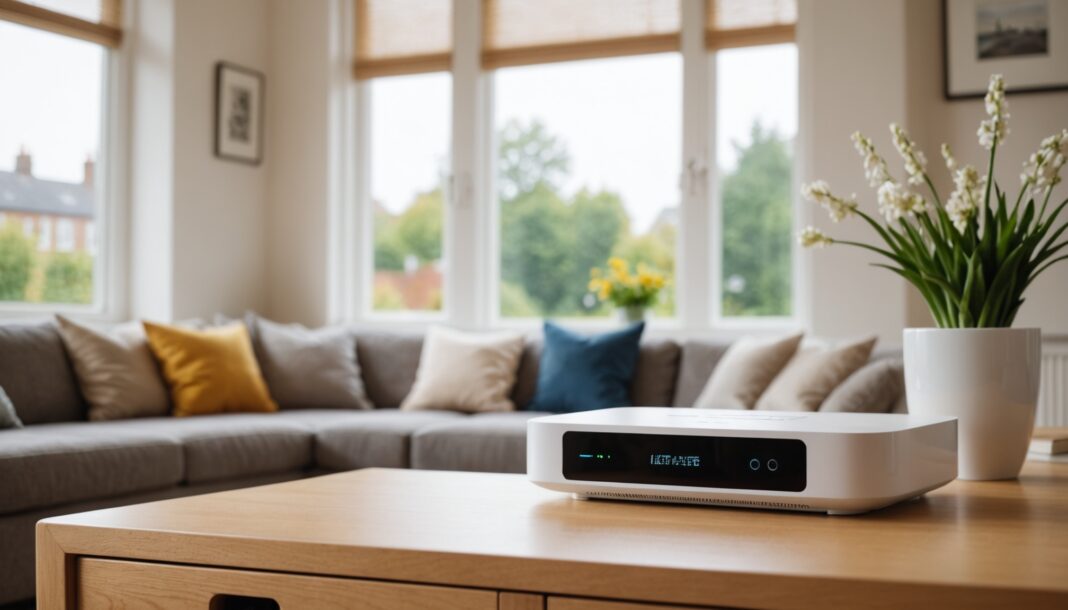
Home networks in the UK have just been handed more room to breathe. Since 10 November, the rules governing 6 GHz Wi-Fi have changed: Ofcom has opened an extra slice of radio spectrum to ordinary household kit, licence-exempt, with no permission and no paperwork required. It is one of those decisions that sounds abstract until you realise it touches every flat, terraced house and student halls where a dozen devices fight over the same airwaves.
What actually changed in the 6 GHz band
Low-power indoor Wi-Fi was already allowed between 5925 and 6425 MHz. The new rules stretch that to 5925 to 6585 MHz, adding 160 MHz — roughly a third more space — on the same licence-exempt basis. Indoor equipment can transmit at up to 250 milliwatts, and very low power devices, the sort used by mobile hotspots, headsets and augmented-reality glasses, are capped at 25 milliwatts and can be used outdoors as well.
Ofcom reached this position after a long consultation on sharing the so-called upper 6 GHz band between Wi-Fi and mobile networks. The regulator split the band in two: the lower part becomes Wi-Fi territory, while the stretch from 6585 to 7125 MHz is earmarked for future mobile use. That sharing arrangement was the subject of a formal decision earlier in the year, and the technical conditions for Wi-Fi took effect this month.
Why extra spectrum matters more than extra speed
The point of the change is not raw speed, it is width and elbow room. Wi-Fi performance in a block of flats collapses not because routers are slow but because neighbouring networks overlap on the same channels. The 6 GHz band is largely free of that legacy congestion, and the extra 160 MHz allows a fourth 160 MHz channel plus a second wide 320 MHz channel of the kind Wi-Fi 7 is built around.
In practice that means fewer collisions when a smart TV, a games console, a laptop on a video call and a handful of smart home gadgets are all talking at once. It is a congestion fix, not a broadband upgrade.
Will your router change? Almost certainly not
Nothing happened automatically on the day the rules changed. Three conditions have to line up before a household sees any benefit:
- the router has to support 6 GHz at all — that means Wi-Fi 6E or a Wi-Fi 7 model that includes the 6 GHz radio, and not every Wi-Fi 7 hub does;
- the router needs a firmware update that unlocks the newly available frequencies;
- the device at the other end — phone, laptop, tablet — needs to support 6 GHz too, and may also need an update.
Some of the newest hubs supplied by the larger providers include a 6 GHz radio, but plenty of recent kit does not, and older hubs never will. Crucially, none of this changes the speed arriving at your property: that is set by your line and your package, which is why it pays to read the small print before signing anything, as anyone who has looked at the cost of staying on an old contract will recognise.
Higher-power and outdoor Wi-Fi is still waiting
There is a second tier in the rules. Fixed equipment can transmit at up to 36 dBm — about 4 watts — across 5925 to 7125 MHz, which is what large venues such as stadiums, factories and hospitals need. But that use is only legal under the control of an Automated Frequency Coordination system, a database that tells each access point which frequencies it may use so it does not interfere with existing licence holders. Ofcom has to register such a service before anyone can switch it on, and at the start of November none had been registered. High-power 6 GHz Wi-Fi will therefore arrive later, not now.
The mobile half of the band
The upper slice reserved for mobile will not be handed out nationally. Ofcom decided that any licences will be subnational, concentrated in defined high-density areas where data traffic piles up — city centres, transport hubs, event venues. It is a pragmatic answer to a band that carries a lot of data over short distances, and a reminder that the mobile and fixed worlds keep converging, much as they did when the copper telephone network began to be retired.
What to do if you want to use it
- check your hub's specification for “6 GHz” or “Wi-Fi 6E” rather than relying on the Wi-Fi 7 badge alone;
- install pending firmware updates on the router and on your main devices;
- place 6 GHz kit in the same room where possible — the higher the frequency, the worse it travels through walls;
- do not replace working equipment on the strength of this change; the gain is in crowded homes and flats, and nowhere near a line upgrade.
Frequently asked questions
Do I need a new router to benefit from the new 6 GHz rules?
Only if your current one has no 6 GHz radio. Wi-Fi 6E and 6 GHz-capable Wi-Fi 7 routers can use the extra frequencies once their firmware supports them; anything older cannot, whatever the rules say.
Will the change make my broadband faster?
No. The extra spectrum reduces congestion inside the home. The speed reaching your router is determined by your connection and your tariff, not by the number of Wi-Fi channels available.
Is 6 GHz Wi-Fi allowed outdoors now?
Very low power devices capped at 25 milliwatts may be used outdoors. Higher-power outdoor and fixed installations are permitted in principle, but only under an Ofcom-registered coordination system, which was not yet in place at the beginning of November.
Sources
- Ofcom — Expanding access to the 6 GHz band for commercial mobile and Wi-Fi services (statement)
- ISPreview UK — Ofcom adopt shared upper 6GHz band for UK mobile and Wi-Fi networks
- Broadband Switch — New Wi-Fi rules from 10 November: will my router change?
Profil de l'auteur
Derniers articles
 Tech & Multimedia16 November 2026New 6 GHz Wi-Fi Rules: What They Mean for Your Router
- Electricity, Gas & Energy6 November 2026Heating oil is set to be regulated: what it will mean for off-grid homes
- Real Estate, Sales, Purchases & Rentals26 October 2026EPC C for rented homes: what the new energy rules will mean
- Ecology & Environment16 October 2026Plastic wet wipes are being banned: what it means for your shopping basket




Trending now on legal streaming
FilmHeart of the Beast
SeriesVisionQuest
This article was written with the help of artificial intelligence. Editorial policy
Table of Contents