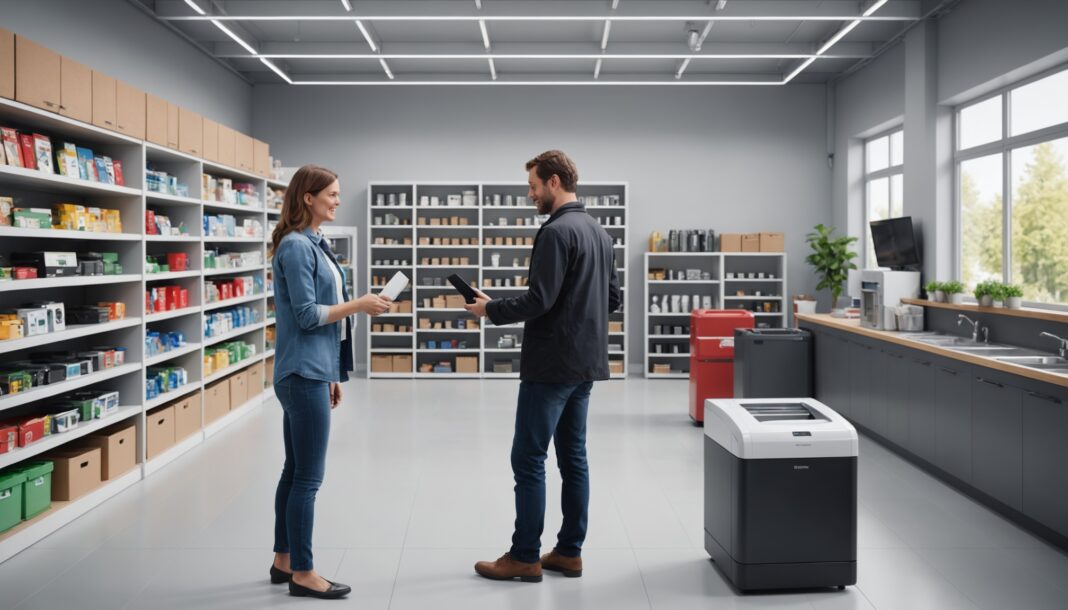
The appliance sector in France is about to undergo a regulatory shift. Starting October 1, stores with at least 400 square meters dedicated to selling electrical and electronic equipment will have to take back customers' used small appliances for free, with no purchase required. This new rule, known as the “1 for 0” rule, complements an existing system and is meant to speed up the collection of waste electrical and electronic equipment (WEEE).
What the “1 for 0” Rule Changes
In practice, the requirement applies to appliances whose outer dimensions are all under 25 cm: electric razors, hair dryers, keyboards, small kitchen appliances, or electric hand tools. Customers can now drop these off at a store for free, whether or not they buy a new product. Stores subject to the rule will have to clearly post the terms of this takeback before the purchase is made, a requirement designed to make sure the information doesn't get lost between the aisle and the checkout.
An Obligation That Adds to the “1 for 1” Rule
This measure doesn't replace existing systems—it adds to them. Retailers are still required, under the “1 for 1” principle, to take back an old appliance for free when a customer buys an equivalent new one, whether in-store or online. Nor does it replace at-home collection, which is also becoming more widespread for bulky appliances. The stated goal is to multiply the number of drop-off points for small items, which are too often left forgotten in a drawer for lack of a practical solution.
Why This Measure Now
The pool of small electrical equipment remains largely underused despite progress made by the industry. The eco-organization ecosystem (the French nonprofit that manages electronics recycling) already reports collecting 876,000 tons of WEEE, or roughly 65% of the estimated total, with an average recycling rate of 79.2% for a household appliance turned into new raw materials. Small appliances—easy to toss out with household trash or leave sitting in a cabinet—represent the biggest room for improvement for the industry, which is why there's a push to multiply local collection points rather than rely solely on recycling centers.
What Noncompliant Stores Risk
Failing to comply with this requirement exposes retailers to a fine of up to €1,500 for an individual and €7,500 for a company, with these amounts doubled for repeat offenses within the year. Enforcement falls to the DGCCRF (the French consumer protection and fair trading authority), which is already in charge of checking the posting of the repairability index and its successor, the durability index, currently being expanded to cover new types of appliances.
How to Take Advantage of This in Practice
- Check that the store you're visiting has an appliance or electronics section of at least 400 square meters.
- Look for the mandatory signage listing the takeback terms, usually near the entrance or the relevant section.
- Bring in the broken appliance with no proof of purchase and no obligation to buy a new one.
- For bulkier appliances (washing machines, refrigerators), continue to rely on trade-in at purchase or at-home collection.
Beyond the regulatory requirement, this measure is part of a broader movement around the right to repair, driven by both public authorities and some manufacturers. It remains to be seen whether multiplying collection points will be enough to durably change household habits, since people still too often hang onto their broken small appliances instead of bringing them back.
This development directly affects the world of home equipment and fits into the broader environmental issues tied to managing electronic waste.
Frequently Asked Questions
Which appliances are covered by this free takeback?
Only small electrical and electronic equipment whose outer dimensions are all under 25 cm: razors, hair dryers, keyboards, small kitchen appliances, and so on. Large appliances are not covered by this specific rule.
Do I need to buy a new appliance to take advantage of this takeback?
No, that's exactly the point of the “1 for 0” rule: the takeback is free and requires no purchase, unlike the standard “1 for 1” rule, which assumes the purchase of an equivalent appliance.
What happens to stores that refuse to comply with this requirement?
They face a fine of €1,500 for an individual and €7,500 for a company, with the amounts doubled for repeat offenses within the year. The DGCCRF is in charge of enforcement.
Sources
Profil de l'auteur
Derniers articles
 Retirement & Senior Living24 November 2026Mothers' Retirement: What the New 2026 Pension Calculation Changes
- Home Appliances & Equipment24 November 2026Appliance Repair Bonus: The Little-Known Boost to Fix Rather Than Toss
- Nutrition, Diet & Weight Loss24 November 2026Intermittent Fasting: What the Science Really Shows About Weight Loss
- Restaurants, Drinks & Food24 November 2026Restaurant Trends Set to Reshape How We Eat Out



Trending now on legal streaming
FilmSpider-Man: Brand New Day
SeriesCampus Drivers
This article was written with the help of artificial intelligence. Editorial policy
Table of Contents