



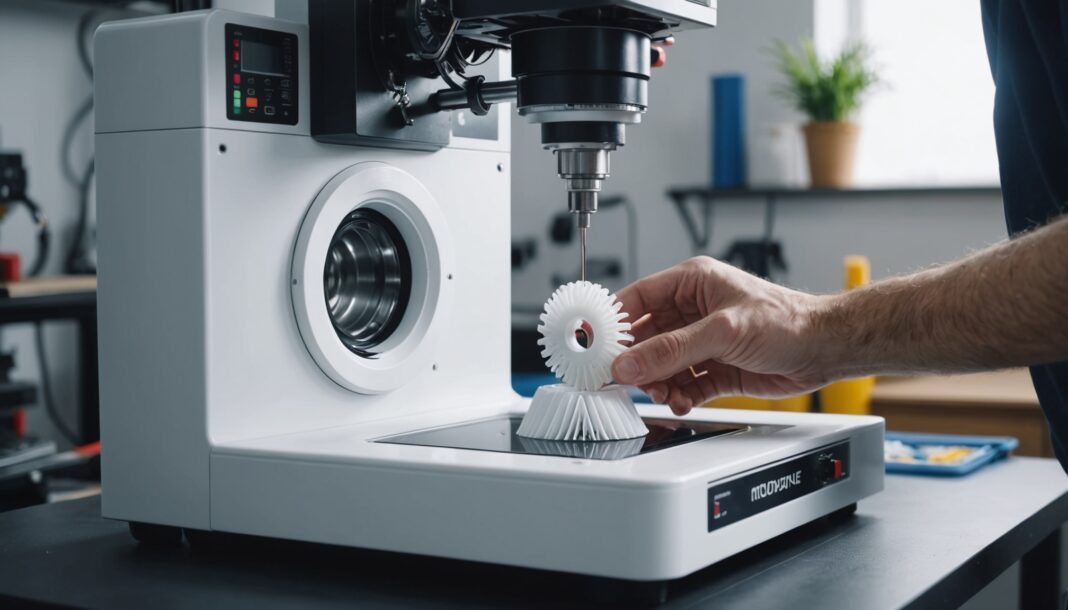
The European right to repair, which took effect on July 31, 2026, doesn't just require manufacturers to repair their appliances at a reasonable price. A more discreet but potentially more disruptive clause states that manufacturers will have to hand over the 3D printing blueprints for certain spare parts when those parts are no longer available on the market. This advance has been welcomed by independent repair shops, but manufacturers are already trying to strip it of its substance.
An unprecedented obligation, but with a major reservation
The text is clear on the principle: when a spare part essential to the use of a washing machine, dishwasher, or small appliance is no longer available on the market and can be manufactured using three-dimensional printing, the manufacturer or importer must provide the manufacturing blueprint — or, failing that, the technical information needed to produce it. This request can come from professional sellers, refurbishers, or repair technicians, whether certified or not.
But the law immediately adds a reservation that changes a great deal: this transmission must take place “in compliance with intellectual property rights,” and is therefore subject to the consent of the rights holder. A part protected by a patent or a registered design can therefore, in practice, remain out of reach for repair technicians, even after the text takes effect.
Manufacturers are already dragging their feet
According to trade press reports, several appliance manufacturers have indicated that they intend to rely on this intellectual property reservation to limit the distribution of their blueprints, citing the risk of counterfeiting or parts that don't meet safety standards. Independent repair associations dispute this argument, pointing out that the availability of spare parts is precisely the number one reason consumers cite for giving up on repairing an appliance and buying a new one instead.
This obligation to provide 3D blueprints is part of a broader framework: manufacturers must now guarantee the availability of spare parts for 7 to 10 years depending on the type of product (compared with 5 years under the former AGEC anti-waste law of 2020 in France), with delivery within a maximum of 15 days. Clauses or commercial practices that previously stood in the way of repairs — such as banning independent repair technicians from using secondhand or 3D-printed parts — are now prohibited.
What this means in practice for households
- A broken appliance whose part is no longer manufactured is no longer automatically doomed: a 3D printing blueprint can, in theory, step in.
- Access remains conditional on the consent of the holder of the intellectual property rights to the part in question.
- The availability period for standard spare parts is increasing significantly, a benefit households gain directly without having to do anything.
- The repairability index, already displayed on certain appliances (washing machines, dishwashers, vacuum cleaners), continues to evolve toward a broader durability index, as detailed in our article on its extension to four new appliance categories.
This new framework builds on the measures that already took effect this summer, which we covered in our article on what the right to repair actually changes for consumers. It also fits into a broader trend: more and more households are looking to extend the lifespan of their appliances rather than throw them away, as shown by the gradual rollout of at-home pickup for appliance recycling.
Frequently Asked Questions
Does the 3D blueprint obligation apply to all home appliances?
No. The obligation applies to spare parts essential to the use of the appliance, and only when they are no longer available on the market and can technically be manufactured using 3D printing.
Can an individual consumer request these blueprints directly from the manufacturer?
The law primarily targets professional sellers, refurbishers, and repair technicians, whether certified or not. An individual consumer therefore generally has to go through a repair technician to benefit from it.
Can the intellectual property reservation completely block this obligation?
It can significantly limit it for parts protected by a patent or a registered design, since the rights holder's consent remains necessary. This is exactly the point disputed by repair associations.
Sources
- Next.ink — Manufacturers oppose providing 3D blueprints for unavailable spare parts
- Que Choisir — The European Union puts the right to repair products on track
- economie.gouv.fr — Everything you need to know about the repairability index
Profil de l'auteur
Derniers articles
 Retirement & Senior Living24 November 2026Mothers' Retirement: What the New 2026 Pension Calculation Changes
- Home Appliances & Equipment24 November 2026Appliance Repair Bonus: The Little-Known Boost to Fix Rather Than Toss
- Nutrition, Diet & Weight Loss24 November 2026Intermittent Fasting: What the Science Really Shows About Weight Loss
- Restaurants, Drinks & Food24 November 2026Restaurant Trends Set to Reshape How We Eat Out



Trending now on legal streaming
FilmThe Hunger Games: The Ballad of Songbirds & Snakes
SeriesLupin
This article was written with the help of artificial intelligence. Editorial policy
Table of Contents

