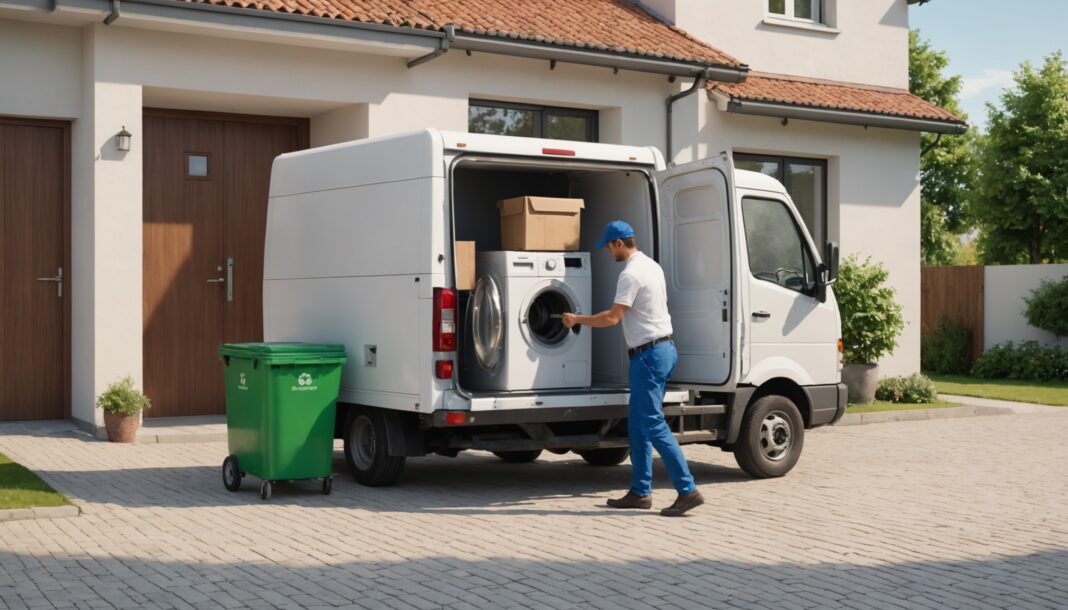
A broken washing machine, an oven to replace, a fridge that gives up the ghost: until now, disposing of these properly often meant hauling them yourself to the waste disposal site. This constraint is gradually receding thanks to a home collection service for large household appliances, rolled out by the eco-organization ecosystem in several major French urban areas. But behind this practical advance, a quieter debate is stirring in the appliance recycling sector: that of the figures actually achieved.
A home collection service that is expanding
Via the dedicated platform, households can now schedule the free removal of their large household appliances directly from their homes, without having to disassemble or transport the equipment. This service is currently available in four urban areas: Île-de-France, Greater Lyon, Alpes-Maritimes and Var. At the same time, the traditional network remains extensive: about 42,000 collection points and nearly 3,000 waste disposal sites are mobilized across the territory, in addition to in-store take-back when purchasing a new appliance, at retailers such as Fnac-Darty, Leroy Merlin, Carrefour or Auchan.
The official collection figures
Over the past year alone, ecosystem reports having collected 876,000 tonnes of electrical and electronic equipment, both household and professional. The eco-organization claims a capture rate of 65% of its estimated available stock, which would correspond to about two out of three appliances recovered within its scope. Collected equipment is not systematically destroyed: it is first directed toward reuse when possible, and otherwise sent to one of the 48 treatment centers for depollution and recycling. Part of this logistics and treatment chain relies on actors from the social and solidarity economy, notably the Envie and Emmaüs networks, which refurbish certain appliances to resell them at reduced prices.
A debate about the calculation method
This assessment, widely praised internally, nevertheless calls for a cautious interpretation. The specialized press in the recycling sector highlights a methodological difference that greatly changes the perception of the results: the rate claimed by ecosystem is calculated on the quantities of appliances put on the market by the producers it represents only, while the national rate, which aggregates all eco-organizations and all flows combined, would remain well below the European target of 65% set by the WEEE directive. The two indicators therefore measure different scopes and are not directly comparable term for term, which explains the apparent gap between very positive communication and a more contrasted national reality. Small electronic devices, such as smartphones or tablets, are also identified as the least well collected, due to the lack of an easily identifiable stock in households.
What this concretely changes for households
For households, the issue remains primarily practical. Here are the key points to remember:
- Home collection of large household appliances is free in the covered areas, with a simple online reservation.
- An appliance that is still functional has a good chance of being reused rather than destroyed, via local solidarity structures.
- In-store take-back remains possible throughout France when purchasing a new appliance, including outside the four pilot areas.
- Small electronic devices must be returned to a collection point or dropped off in-store, due to the lack of a dedicated home pickup stream.
This movement is part of a broader evolution of the appliances sector in France, between the progressive extension of the sustainability index to new product categories and European regulatory pressure to lengthen equipment lifespans. To explore obligations and good practices related to purchasing or maintaining an appliance, the Appliances & Equipment section of DirectMag brings together several analyses on the subject. Broader environmental issues are covered in the Ecology & Environment section, while practical everyday advice can be found in Tips & Tricks, DIY.
Frequently asked questions
Is home collection of appliances really free?
Yes, in the four areas currently covered (Île-de-France, Greater Lyon, Alpes-Maritimes, Var), the removal of large household appliances at home incurs no charge for the individual; you only need to book a time slot via the dedicated platform.
What happens to appliances once collected?
They are first assessed for potential reuse, notably via partners from the social and solidarity economy such as Envie or Emmaüs. If they cannot be refurbished, they are sent to specialized centers for depollution and then recycling of materials.
Why do collection figures vary by source?
Because calculation methods differ: an eco-organization measures its rate on its own scope of producers placing products on the market, whereas the national rate sums all flows and actors, which mechanically gives different results for the same situation on the ground.
Sources
- ecosystem — WEEE collection report 2026
- Recy.net — Analysis of ecosystem's collection figures
- Je donne mon électroménager — Home collection platform
Profil de l'auteur
Derniers articles
 Development, Digital Marketing & SEO24 August 2026TPE-PME websites : why they have become the preferred entry point for ransomware
- Home Appliances & Equipment22 August 2026Household appliance recycling: home collection is becoming widespread, but the figures are disputed
- Nutrition, Diet & Weight Loss21 August 2026Nutri-Score : the reform changes the scores, but its display remains optional
- Nutrition, Diet & Weight Loss21 August 2026Nutrition education at school: a national experiment to teach children to eat better


This article was written with the help of artificial intelligence. Editorial policy
Table of Contents