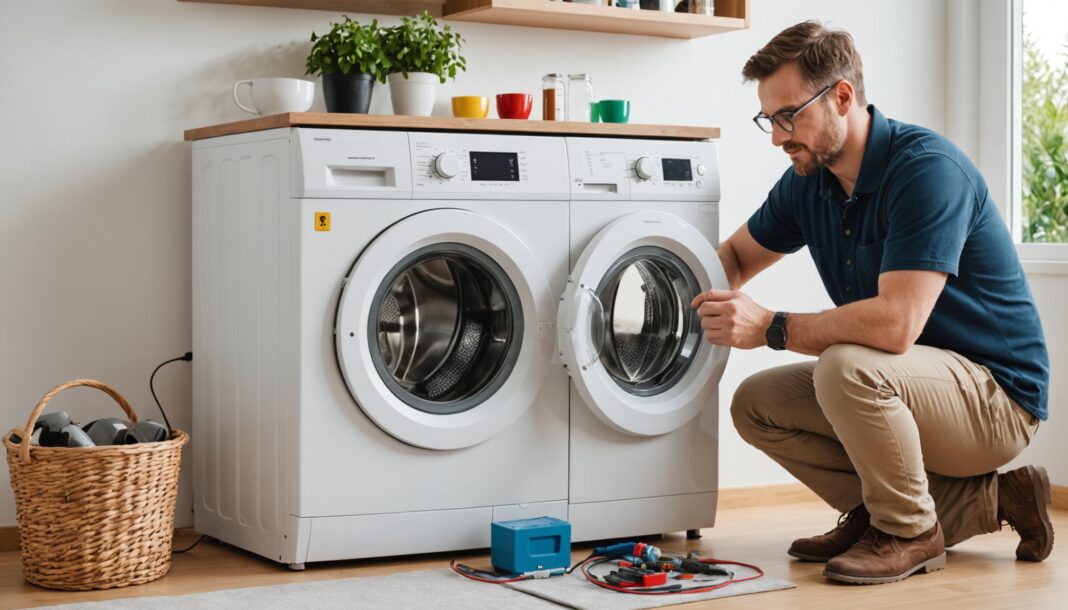
From 31 July 2026, having your washing machine, refrigerator or vacuum repaired rather than throwing it away becomes a real right. This is the deadline set for Member States to transpose the European directive on the right to repair (Directive (EU) 2024/1799 of 13 June 2024). For purchasers of household appliances, the change is concrete: repairing will cost less, will be better regulated and will often become more attractive than buying new.
A harmonized right to repair across Europe
Published in the Official Journal of the European Union on 10 July 2024 and entering into force on 30 July 2024, the directive imposes on manufacturers an obligation to repair for goods subject to the European repairability requirements, listed in its annex. These include everyday appliances: washing machines, dishwashers, refrigerators, vacuum cleaners, but also smartphones and tablets.
This obligation applies even outside the warranty, at a reasonable price and within a reasonable timeframe. If repair proves technically impossible, the manufacturer may offer the consumer a refurbished device. The objective stated by Brussels: to extend product lifespans and reduce waste.
What changes concretely for your household appliances
Several new measures will weigh in the balance when choosing between repairing and replacing:
- Extended 12-month warranty: if you opt for repair rather than replacement of a defective product under the statutory warranty, that warranty is extended by one year. A strong incentive not to repurchase automatically.
- A European repair information form, provided free of charge, which details the price, the methods, the timelines and the repairer's contact details. Enough to compare quotes on identical bases.
- An online European platform to easily find a repairer near you and consult the services offered.
Concretely, a refrigerator that breaks down a few months after the end of the warranty will no longer be a foregone conclusion leading to the recycling centre: the manufacturer will have to propose a repair solution.
The durability index, the other tool for buying wisely
France has taken the lead on one complementary point: the durability index, stemming from the anti-waste law for a circular economy (AGEC). It has been displayed since 8 January 2025 on televisions and since 8 April 2025 on washing machines. It is gradually replacing the repairability index.
Its logic: a score from 1 to 10, calculated from seven sub-criteria that measure not only the ease of repair but also the reliability of the appliance. Before purchase, it allows you to spot at a glance models designed to last. Coupled with the right to repair, it gives consumers two levers to make more sustainable choices.
Repairing, an increasingly cost-effective choice
The context is favorable. The French repair market is estimated at around €10.4 billion in 2026, up by about 23% compared with 2021. Household appliances are one of the main categories, behind only automotive repair.
For the buyer, the equation is changing: between the obligation to repair, the extended warranty, the durability index and existing support measures, extending the life of one's appliances becomes both an economic and ecological reflex. A few good maintenance habits are often enough to avoid breakdowns.
Frequently asked questions
Does the right to repair apply to appliances purchased before 31 July 2026?
The directive sets the transposition deadline into national law. The precise arrangements, notably for appliances already in circulation, will be set by the implementing texts of each Member State. The spirit of the text, however, remains to extend repair beyond the warranty alone.
Which appliances are prioritized?
Goods subject to the European repairability requirements: notably washing machines, dishwashers, refrigerators and vacuum cleaners, as well as smartphones and tablets.
What is the purpose of the durability index compared with the right to repair?
The durability index helps to make a good choice before purchase, by flagging reliable and repairable appliances. The right to repair comes into play after, by facilitating the restoration of a product that has broken down.
Sources
- Directive (EU) 2024/1799 — EUR-Lex
- UFC-Que Choisir — Right to repair
- info.gouv.fr — The durability index
Profil de l'auteur
Derniers articles
 Weddings & Special Occasions18 September 2026Mariage : pourquoi les maires durcissent les règles contre les nuisances sonores
- Agency, Webmarketing & SEO16 September 2026Référencement : pourquoi Google rebat les cartes du SEO avec l'intelligence artificielle
- Nutrition, Diet & Weight Loss16 September 2026Aliments ultra-transformés : pourquoi 43 associations interpellent le gouvernement
- Tech & Multimedia15 September 2026Smartphones : la fin de l'indice de réparabilité français et le nouveau droit à la réparation




Table of Contents