



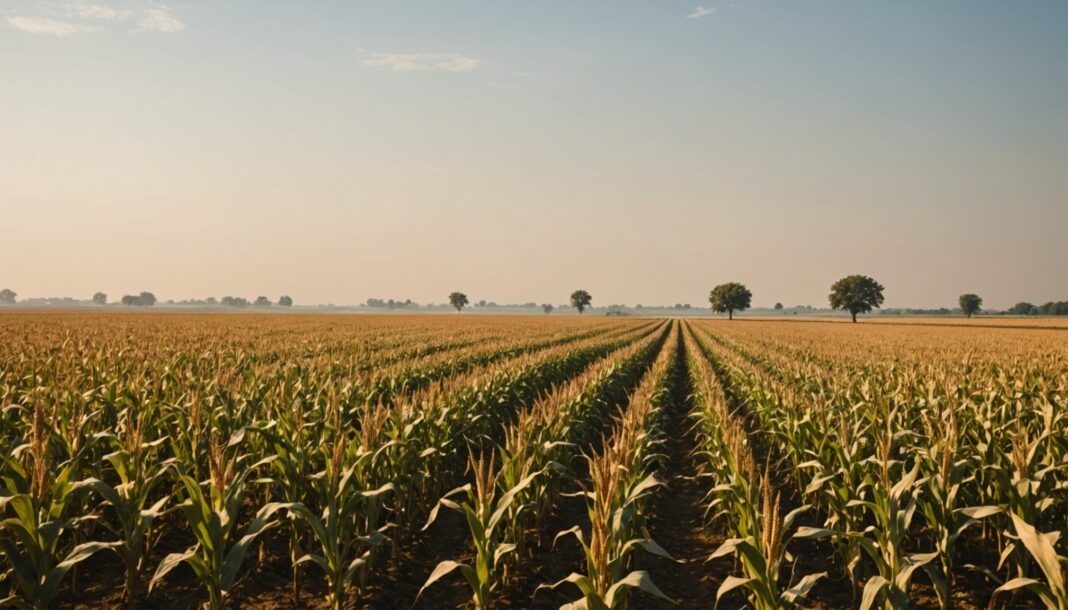
After a summer marked by a historic drought and several heat waves, France's Minister of Agriculture Annie Genevard announced, on September 4, 2026, an emergency farm plan worth more than €1 billion. The stated goal: ease farms' cash-flow problems and revive production before winter.
A drought hitting harvests hard
According to estimates from Agreste (the French agricultural statistics office) as of August 1, 2026, corn production has collapsed by 35.3% year-over-year, falling to 9.0 million tons compared with 13.9 million in 2025. Livestock farmers already under heavy pressure this summer are now facing, on top of the drought, a heavier agricultural fuel bill, which is putting even more strain on farm finances.
The dairy sector has not been spared either: prices paid to producers fell by 7.3% in the first quarter of 2026, reigniting tensions with processors over pay. This comes on top of a year already marked by a health alert in dairy farms in eastern France and by a feed shortage that had already forced organic farmers to buy non-organic feed.
What the €1 billion plan actually includes
Unveiled in early September, the government's plan is primarily meant to prevent a wave of farm failures before the end of the year. It includes, among other things:
- A deferral or reduction of social security and tax contributions for the hardest-hit farms
- Targeted cash-flow aid for the grain and livestock sectors most affected by the drought
- Support for financing agricultural fuel and animal feed
These measures come on top of aid already paid out through the Common Agricultural Policy, whose effectiveness is itself being questioned: the French Court of Audit (Cour des comptes) recently deemed its implementation “poorly suited” to the scale of the climate shocks the sector is facing.
Farm unions say it's not enough
Despite the announced amount, the response from industry groups has been cool. The FNSEA (France's leading farmers' union) says “it's not enough,” while several regional unions say the support is too limited given the scale of the losses. For farmers, the stakes go beyond immediate cash-flow needs: it's also about farms' ability to secure new financing from banks at a time when incomes have deteriorated.
Beyond the farming world, these tensions have concrete effects on households' daily lives in France, between the risk of rising food prices and the weakening of local supply chains.
Frequently Asked Questions
How much is the emergency farm plan announced in September 2026 worth?
The French government announced a support plan of more than €1 billion, meant to ease the cash-flow problems of farms hit by the drought and to revive production.
Why did corn production drop so sharply in 2026?
According to Agreste, the drought and heat waves of summer 2026 caused corn production to fall by 35.3% year-over-year, to 9.0 million tons compared with 13.9 million in 2025.
Are farm unions satisfied with the aid plan?
No: the FNSEA and several industry groups consider the amount insufficient given the scale of the losses suffered by farms.
Sources
Profil de l'auteur
Derniers articles
 Retirement & Senior Living24 November 2026Mothers' Retirement: What the New 2026 Pension Calculation Changes
- Home Appliances & Equipment24 November 2026Appliance Repair Bonus: The Little-Known Boost to Fix Rather Than Toss
- Nutrition, Diet & Weight Loss24 November 2026Intermittent Fasting: What the Science Really Shows About Weight Loss
- Restaurants, Drinks & Food24 November 2026Restaurant Trends Set to Reshape How We Eat Out




Trending now on legal streaming
FilmHope
SeriesVisionQuest
This article was written with the help of artificial intelligence. Editorial policy
Table of Contents

