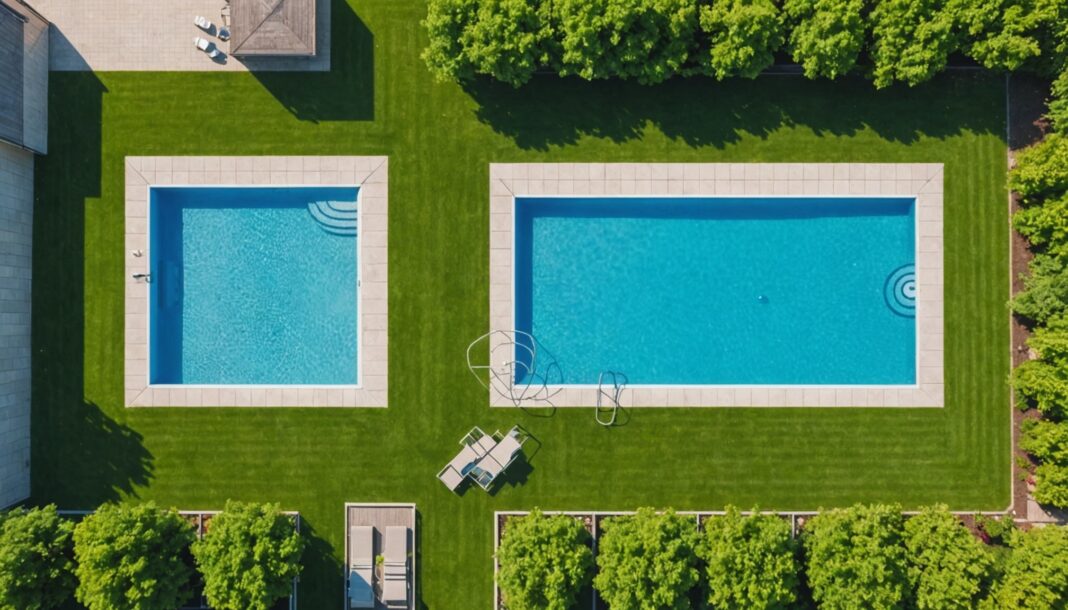
Every summer, thousands of blue pools appear in backyards across France without ever being reported to the authorities. Bad news for their owners: an undeclared swimming pool is increasingly easy for the tax authority to spot, as it now relies on artificial intelligence to cross-reference aerial photographs with land registry records. The phenomenon, which isn't new, is intensifying, and the bill can climb quickly for anyone who delays getting their situation in order.
An Algorithm That Scans Backyards From the Sky
The system, named “Foncier Innovant” (Innovative Property Tax), combines aerial photographs from the IGN (France's national mapping institute), satellite images, and land registry databases. An artificial intelligence system spots blue rectangles that have appeared since the last round of photography, then checks whether they already appear in existing tax filings. In 2023, this method identified more than 140,000 pools that had previously gone unnoticed by the authorities, compared with roughly 20,000 a year earlier — a dramatic acceleration that, according to several industry observers, is expected to continue in upcoming rounds of inspections.
In practice, a flagged homeowner receives a letter from the tax authority inviting them to correct their situation, sometimes accompanied by an aerial photo of their own property as supporting evidence. For many homeowners surprised to receive such a letter, it's a striking wake-up call.
How Much a Late Correction Can Cost
French law requires any construction, including a pool, to be declared within 90 days of completion, using Form H1. Without a declaration, the tax authority applies a flat-rate value per square meter of pool to calculate the property tax owed:
- A flat-rate value set at 251 euros per square meter of pool for the current year;
- Possible back taxes covering four years of property tax, not just the current year;
- In the most serious cases, treated as undeclared construction, a fine that can reach several thousand euros per square meter.
For an average-sized pool, the total bill can therefore far exceed the price of an entry-level pool, including four years of back taxes. Many homeowners learn this the hard way: the development tax (taxe d'aménagement) and property tax are calculated separately, and the recent cut to the development tax on pools in no way exempts owners from declaring their pool to the local tax office.
Who Is Actually Affected, and How to Get Compliant
Not all pools are treated the same way. Removable pools set up for less than three months a year are generally exempt from the declaration requirement, as are certain inflatable pools with a small footprint. On the other hand, an in-ground or semi-buried pool installed year-round, whether covered or not, falls within the scope of taxation as soon as it exceeds a modest surface area.
On paper, the process for getting compliant is simple: file a Form H1 with the local public finance center, ideally before receiving any follow-up notice, which often makes it possible to limit penalties to a straightforward back-tax adjustment. Homeowners who used the summer to have a pool built therefore have every reason to check their situation before the next tax filing season, rather than waiting for a reminder letter. It's reasonable to expect this automated inspection process to keep expanding to other outdoor structures that can be photographed from the sky, such as garden sheds or hard-surface patios — though this remains a forecast, not an official announcement.
Beyond the tax issue alone, outdoor renovations are also a good opportunity to rethink the whole yard: many homeowners take advantage of these corrections to relaunch their planting projects, ahead of the next blooming season in their garden. Those unsure of the exact scope of their obligations can also turn to a legal professional or a financial advisor to work out the precise impact on their budget before signing the Form H1.
Frequently Asked Questions
Does an Inflatable Pool Need to Be Declared?
No, in most cases: inflatable or self-supporting pools that are taken down for more than three months a year are exempt from the declaration requirement and from the flat-rate per-square-meter taxation.
How Many Years Back Can the Tax Authority Claim Property Tax?
The tax authority can go back up to four years to claim the property tax owed for an undeclared pool, in addition to the current year.
What to Do If You Receive a Letter From the Tax Authority After an AI Review?
It's advisable to file a Form H1 with the local public finance center without delay: a voluntary correction, even a late one, generally limits penalties to a simple back-tax adjustment.
Sources
Profil de l'auteur
Derniers articles
 DIY & Troubleshooting18 November 2026Dexter Sander Recall 2026: What Leroy Merlin and Weldom Customers Need to Know Before Using It
- Restaurants, Drinks & Food18 November 2026Flexitarianism in France: Less Meat on the Plate, but Not for the Reasons You'd Think
- Home Appliances & Equipment18 November 2026Washing Machine, Oven, Dishwasher: Which Brand to Choose for Appliances That Last?
- Nutrition, Diet & Weight Loss18 November 2026Pancreatic Fat: The Diet That May Help Reduce It




Trending now on legal streaming
FilmThe Hunger Games: The Ballad of Songbirds & Snakes
SeriesCat's Eyes
This article was written with the help of artificial intelligence. Editorial policy
Table of Contents