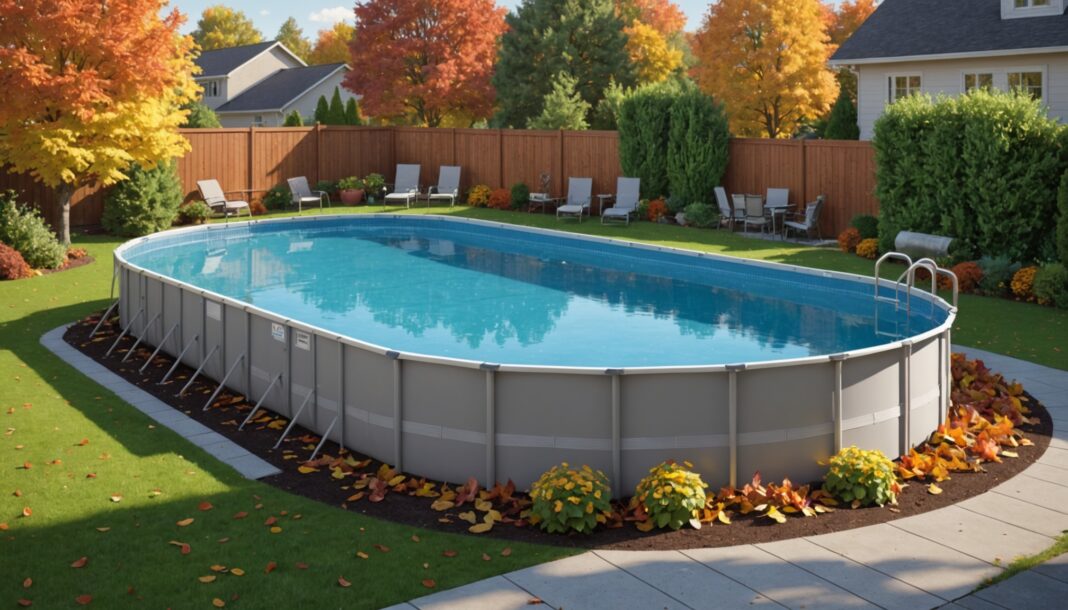
Between rumors of a “banned pool” and actual legal requirements, it can be hard to know what to believe. Yet owning a private pool comes with precise rules—covering both safety and taxation—that every current or future owner should know about before winter sets in.
Safety: An Obligation With No Exceptions
Since French law no. 2003-9 of January 3, 2003 took effect, every unenclosed in-ground or partially in-ground pool must be fitted with at least one certified safety device. Four solutions are recognized: a safety fence (standard NF P90-306), an immersion or perimeter alarm (NF P90-307), a rigid safety cover (NF P90-308), and a pool enclosure (NF P90-309).
The requirement applies year-round, whether the owner is present or not. For non-compliance, Article L183-13 of the French Construction and Housing Code sets a criminal fine of €45,000, even if no accident has occurred. If a drowning occurs due to the absence of a compliant device, the owner can be charged with involuntary manslaughter, carrying a sentence of up to three years in prison.
Before winter arrives is actually the right time to check the condition of your cover or alarm: a few simple habits can help secure your home without breaking the bank.
Taxation: What a Pool Really Costs
Any pool larger than 10 square meters must be the subject of a preliminary declaration of work filed with the town hall (mairie), within 90 days of the end of construction. Beyond 100 square meters, a building permit becomes necessary. On the tax side, the flat-rate value used to calculate the development tax (taxe d'aménagement) is set at €251 per square meter of pool surface in 2026, down from €262 the previous year—a slight decrease resulting from the annual revision of flat-rate values. A 32-square-meter pool (8 x 4 m) therefore generates a national median tax of about €522, including both municipal and departmental rates.
Pools of 10 square meters or less are exempt from this tax, which explains the popularity of small above-ground or compact semi-buried pools. To understand why this amount changes every year, the details of how the development tax is calculated are explained in this report. Another point worth watching: tax authorities now cross-reference their data with aerial imagery to spot undeclared pools, as shown by this investigation into the hunt for forgotten pools.
The False Rumors to Ignore
Every fall, the same misinformation resurfaces on social media: bans on certain pools, mandatory energy audits, chlorine bans, or a compliance kit imposed by decree. None of these measures exist in current law. Only the 2003 safety rules and the taxation described above are legally binding on owners. For pools rented out seasonally between private individuals, additional insurance and tax rules apply and are worth anticipating before the next season.
Frequently Asked Questions
Does the safety requirement apply to above-ground pools?
No. Only unenclosed in-ground or partially in-ground pools are subject to the requirement for a certified safety device. Removable above-ground pools are not covered by the 2003 law.
Does a 9-square-meter pool need to be declared?
No. Below 10 square meters, neither a preliminary declaration nor the development tax applies, regardless of the pool's depth.
Does the €45,000 fine apply even without an accident?
Yes. The absence of a compliant safety device is enough to trigger the owner's criminal liability, regardless of whether an accident actually occurs.
Sources
- Construires.fr — In-Ground Pool Safety: NF P90 Standards and the €45,000 Fine
- Permis-piscines.fr — 2026 Pool Development Tax
- PagesJaunes Piscine — What's True and What's False About 2026 Regulations
Profil de l'auteur
Derniers articles
 Agency, Webmarketing & SEO19 November 2026Search Console API: Three New Features for SEO Agencies
- DIY & Troubleshooting18 November 2026Dexter Sander Recall 2026: What Leroy Merlin and Weldom Customers Need to Know Before Using It
- Restaurants, Drinks & Food18 November 2026Flexitarianism in France: Less Meat on the Plate, but Not for the Reasons You'd Think
- Home Appliances & Equipment18 November 2026Washing Machine, Oven, Dishwasher: Which Brand to Choose for Appliances That Last?




Trending now on legal streaming
FilmThe Hunger Games: The Ballad of Songbirds & Snakes
SeriesCarrie
This article was written with the help of artificial intelligence. Editorial policy
Table of Contents