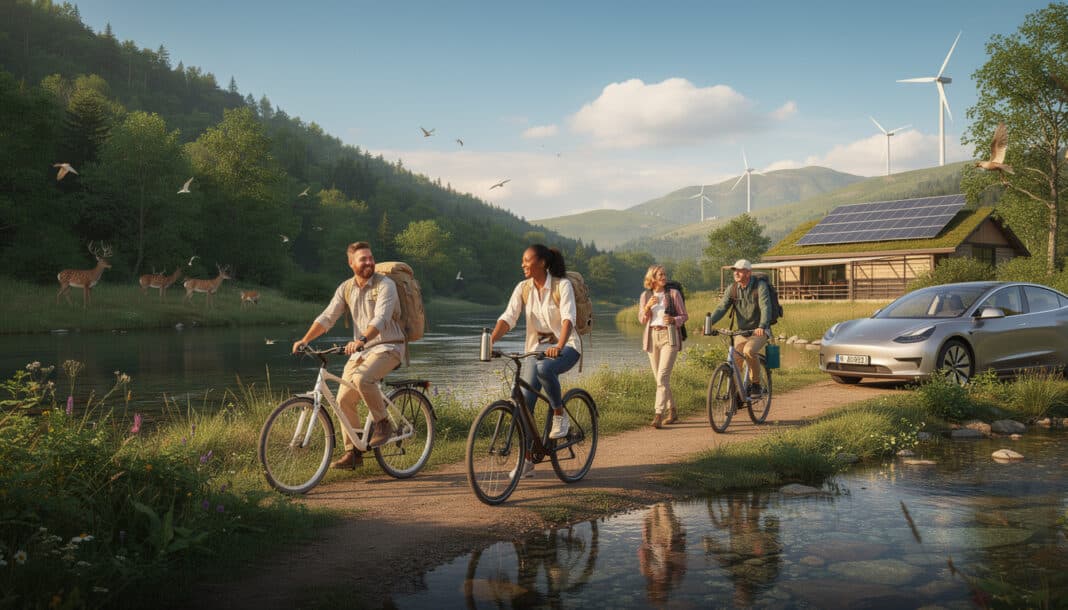
Holidays are a well-deserved time of relaxation, but they weigh heavily on our environment. In France, the tourism sector generates 97 million tonnes of CO₂ equivalent each year, of which 69% come from transport. Yet, becoming a responsible traveler does not mean giving up the pleasure of discovering the world—it rather means turning every stage of your journey into a positive act. From choosing your destination, selecting modes of transport, preferring green accommodations and respecting local cultures, every decision counts.
In short: Transport accounts for the majority of the carbon impact of holidays, with air travel being the most polluting. Favoring trains, limiting your luggage and choosing less crowded destinations are first steps toward sustainable tourism. Accommodation, food and activities also play a significant role. 🌍 Responsible travel requires prior thought but offers a much richer and more authentic experience while preserving the world's treasures for future generations. WWOOFing, slow travel and supporting local communities turn holidays into meaningful adventures.
🌍 Turning your choice of destination into a political act
Before even packing your suitcase, the responsible traveler asks the fundamental question: where should I really go? This initial decision deeply influences the ecological and social impact of the entire stay. Too often, destinations are chosen based on Instagram clichés or tourism rankings without real discernment.
Major world capitals and UNESCO-listed sites attract millions of visitors annually, creating a phenomenon called overtourism. Venice, the Gorges du Verdon, the bay of Mont-Saint-Michel—these jewels are under increasing ecological pressure. In the Mediterranean, more than half of the waste found at sea comes from tourist activities. Marseille had to limit access to the Calanques to 400 daily visitors versus 2,500 previously.
Opting for less crowded destinations eases that pressure while redirecting economic benefits to regions that truly need them. Slow travel promotes authentic immersion over a few days rather than the hunt for photos across several places in one week. A small town in Bulgaria, a rural region in Slovenia or even an overlooked area in France can offer experiences far more rewarding than classic circuits.

🔍 Investigate community tourism initiatives
Before booking, look into local sustainability efforts. Are there tourism cooperatives run by residents? Local guides committed to environmental preservation? Tours supporting community projects?
Platforms like Voyageoscope list ethical and responsible tourism initiatives. Offways also offers concrete ways to travel while reducing your footprint. Local tourist offices and environmental NGOs are also excellent sources of information about ongoing sustainable projects.
✈️ Transport: where does your carbon footprint really lie
Here is an often uncomfortable reality: 69% of tourism-related emissions come from transport. That's far more than accommodation or on-site activities. A round trip Paris–New York represents 1.8 tonnes of CO₂e—about 20% of the average French person's annual carbon footprint, while the national climate target aims for 2 tonnes per year by 2050.
For a comparable journey of 1,000 kilometers, emissions vary considerably: the train remains one of the most efficient options, while long-haul flights are the most polluting. The car, although often used, also emits significantly, especially when carrying only one or two people.
🚆 Rediscover the train as a real alternative
The train offers much more than just reduced emissions. It allows you to cross varied landscapes, meet other travelers and relax without being stuck behind the wheel. In Europe, the rail network spans thousands of kilometers, connecting 33 countries via Interrail passes.
A particularly interesting trend is emerging: the return of night trains. Ten French destinations—Nice, Toulouse, Lourdes, Briançon—are now accessible overnight from Paris. You sleep during the journey and arrive rested, without having flown or driven for long. By 2030, new lines are expected to enrich this network, making low-carbon holidays even more accessible.
✈️ If flying becomes unavoidable
Some destinations—Asia, Oceania, the Americas—are only reachable by plane. In that case, rather than feeling guilty, optimize your impact. A direct flight emits less CO₂ than one with multiple connections, because takeoff and landing require the most energy.
Traveling light has a concrete importance: less weight means less fuel consumed. Offsetting your emissions through certified projects (Gold Standard, Myclimate) can also support tangible environmental initiatives. Some airlines are gradually investing in alternative fuels, although this transition remains slow.
🚗 Carpooling and shared mobility
For domestic trips, carpooling offers the ideal balance between emission reduction and human interaction. Platforms like BlaBlaCar connect travelers who share the same route, turning the trip into an opportunity for enriching encounters. A car carrying four people divides the carbon footprint per passenger by four.
Once on site, public transport—buses, metro, trams—provides authentic everyday local access while limiting your impact. They are often economical and reveal a city's true rhythms far better than tourist taxis.
🏠 Accommodation: choose lodging that doesn't exploit
Your place of nightly rest is not neutral environmentally. Accommodation accounts for 13% of tourism's carbon footprint in France, but this percentage varies drastically depending on the type of lodging. A night in a campsite emits up to 5 times less CO₂e than a night in a little-used secondary residence.
This disparity is explained by several factors: some accommodations require enormous energy to build, heat and equip. Moreover, a secondary residence monopolizes a building empty most of the year instead of housing permanent residents.
🌿 Labels and certifications: finding your way through the forest of promises
Many hotels today commit to greener hospitality, but not all offer the same guarantees. Independent certifications bring clarity. The Green Key rates establishments that meet strict ecological criteria. The EU Ecolabel audits resource management. EarthCheck verifies overall sustainable performance.
Fairbnb.coop represents a cooperative alternative to Airbnb: it returns 50% of service fees to local social projects. Greencross offers a complete guide to assess your carbon footprint while traveling, including the selection of responsible accommodations.
🌱 Beyond labels: immersive alternatives
Rural cottages run by local families, ecolodges in the middle of nature, autonomous tiny houses—these atypical options create a direct link with residents and their territory. WWOOFing—working on organic farms in exchange for room and board—offers total immersion while supporting sustainable agriculture.
These stays transform holidays into learning. You discover how to grow your food, manage water sparingly or produce your own energy. Far from being dull, it is often the most memorable dimension of the trip.
💼 Packing: a minimalism that frees
Traveling light proves to be much more than a simple philosophy. Less weight means less fuel consumed, therefore fewer carbon emissions. It's also less logistical stress, more freedom of movement and more space to bring back genuine local finds rather than useless souvenirs.
Think about what you will actually wear. Versatile clothing suited to the climates you'll pass through—natural materials, ethical brands, compressible pieces—are more than enough. A reusable filtered water bottle, fabric bags, a bamboo cutlery set and collapsible containers drastically reduce your waste on site.
🧴 The small gestures that change everything
Hygiene products must respect the natural environments you will visit. Biodegradable solid soap, reef-safe sunscreen, toothpaste tablets, solid shampoos—so many zero-plastic solutions that weigh little.
One last practical tip: check baggage policies before booking your flight. Some restrictive airlines will naturally push you to travel lighter. It's a constraint that becomes a climate ally.
🎯 Once arrived: the art of traveling without imposing
The true test of the responsible traveler takes place on the ground. It is there that your values manifest through concrete gestures, respectful interactions and daily choices. Every decision—where to eat, what to buy, how to get around—directly impacts the inhabitants and the environment that welcome you.
🙏 Respect what welcomes you
Humility is the first rule. Every culture has its codes, beliefs and taboos. What seems trivial at home can be deeply offensive elsewhere. Before leaving, inform yourself about dress codes, tipping customs, religious or social rites that structure daily life.
Learning a few words in the local language goes beyond mere politeness—it's an act of respect toward those who welcome you. It also opens unexpected doors to authentic encounters.
💰 Consuming locally redistributes wealth
Every euro spent is a vote for the world you want. Buying from a large international chain or consuming imported products leaves little benefit for the local community. Conversely, eating in small family restaurants, buying from local artisans and participating in activities led by cooperatives redistribute tourism revenues fairly.
Look for farmers' markets, small grocery stores, artisans' workshops. Tour du Mondiste offers advice to limit your ecological footprint while truly supporting the local economy.
🗑️ Manage your waste without fighting
Some regions severely lack waste treatment infrastructure. Adopting an eco-conscious attitude then becomes an act of responsibility toward the destination itself. Keep your filtered water bottle handy to avoid plastic bottles. Refuse straws, unnecessary bags and pointless packaging.
If no sorting bins exist, keep your recyclable waste until airports or stations where sorting is generally better organized. Some hotels appreciate if you refuse daily cleaning—this saves water and energy.
🌊 Water and energy: resources to honor
Some destinations suffer from severe water stress. Short showers, turning off water while soaping, reusing towels for several days—these gestures seem minor but become critical collectively. Don't leave lights or air conditioning on when leaving your room. These everyday reflexes at home become essential there.
🦁 Respect wildlife without exploiting
Observing animals in their natural habitat is a rare privilege. This privilege demands strict responsibility: never disturb these fragile ecosystems. Keep your distance from animals, never approach close enough to touch them. Use binoculars or a zoom lens instead of getting closer.
Refuse categorically attractions that involve handling wild animals—elephant rides, captive dolphin shows, selfie farms with tigers. As popular as they may be, these activities rarely rely on real animal welfare. Turn to excursions led by guides certified in ecotourism who prioritize respectful observation.
Stay on marked trails, don't pick flowers or plants as “souvenirs”, take all your waste with you even if biodegradable. Leave as little trace as possible—literally and philosophically.
🌱 The journey continues after your return
The departing airport does not mark the end of your responsible journey. It is often upon returning that the real transformation begins. The experiences lived, the realities observed, the people met profoundly change your view of the world and your daily habits.
📝 Share to inspire
Your personal testimony has a power that official figures do not hold. Write a blog post, share your photos and reflections on social networks, create an interactive Google Maps with your sustainable recommendations. This is a valuable resource for those around you and encourages others to travel differently.
Talk about the realities on the ground, the actions you changed, the exemplary local structures you discovered. Your genuine enthusiasm will inspire far more than a generalized critique of conventional tourism.
🏡 Integrate sustainable practices into daily life
The traveling minimalist approach can perfectly continue at home. Less but better—this logic also transforms your domestic life. Reducing your waste, favoring local producers, valuing sustainable agriculture, limiting compulsive purchases become natural extensions of your commitment.
Resources exist to deepen this transition toward eco-friendly travel and a lifestyle aligned with this philosophy.
💡 Become a conscious tourism consumer
Every booking, every purchase represents a vote for the tourism you want to see emerge. Learn to read between the lines of marketing promises. Who really wins? The local economy or an opaque foreign platform? Does the activity truly respect employees, animals and the environment?
Leave positive reviews for structures that make real efforts. Follow and share inspiring initiatives. Nos Gestes Climat offers resources to calculate and reduce your carbon footprint on holiday and beyond.
🗺️ Exemplary destinations: where to travel consciously
Some regions stand out for their advanced environmental policies and authentic commitment to sustainable tourism. These destinations make ethical tourism easier rather than imposing it as a constraint.
🌴 Costa Rica: the essential pioneer
Costa Rica embodies the global model of ecotourism. More than half of its territory benefits from official protection—national parks, reserves, biological corridors. The country produces 93 to 98% of its electricity from renewable sources and aims for carbon neutrality.
There you can discover immersive treks in parks like Corcovado, spot jaguars and sloths, and take canoe tours through rich ecosystems. Ecolodges are designed to minimize environmental impact while offering authentic comfort and direct contact with passionate local guides.
🏔️ Rwanda: when tourism protects wildlife
Volcanoes National Park in Rwanda illustrates how tourism can financially support conservation. Revenues generated by gorilla trekking are reinvested directly in the protection of endangered species and the development of local communities.
Lodges like Sabyinyo Silverback exemplify this model. Rwanda also stands out for strong national initiatives—bans on single-use plastic bags, car-free days in Kigali. The unforgettable experience of observing mountain gorillas therefore carries a clear political dimension: your presence funds their survival.
🌍 Other exemplary destinations
Slovenia produces 75% of its electricity from hydropower and its capital Ljubljana was named a “European Green Capital.” The Austrian region of Styria promotes organic vineyards and circular tourism. Iceland runs on geothermal energy. New Zealand protects its unique endemic biodiversity. Botswana adopts a “high value, low volume” tourism model in the Okavango Delta.
More unusual but fascinating: Guyana offers indigenous ecotourism in the Amazon via community lodges like Rewa and Surama. Belize combines diving on the second largest barrier reef with agritourism at the Copal Tree Lodge.
The common thread of all these places: tourism actively supports conservation rather than exploiting it. Your spending there truly finances environmental projects and the well-being of host communities.
Responsible travel turns your holidays into a conscious political act, where every gesture—from choosing a destination to managing waste—helps preserve the world we share. It is not a constraint but a liberation: deeper discovery, more authentic encounters and measurable positive impact replace superficial tourist accumulation. Your next adventure awaits you, not as a mere spectator, but as a respectful guardian of what welcomes you.
Profil de l'auteur
Derniers articles
 Smartphones & Mobile Phones14 October 2026The loyalty penalty on your mobile bill: why staying put costs you more
- Family, Babies & Children5 October 2026Airline family seating fees: what the planned ban will change for parents
- Everyday Life & Society23 September 2026Consumer confidence index: what the monthly mood check on British households really measures
- Agency, Webmarketing & SEO31 August 2026SEO : a Google bug skews visibility statistics in AI results




Table of Contents