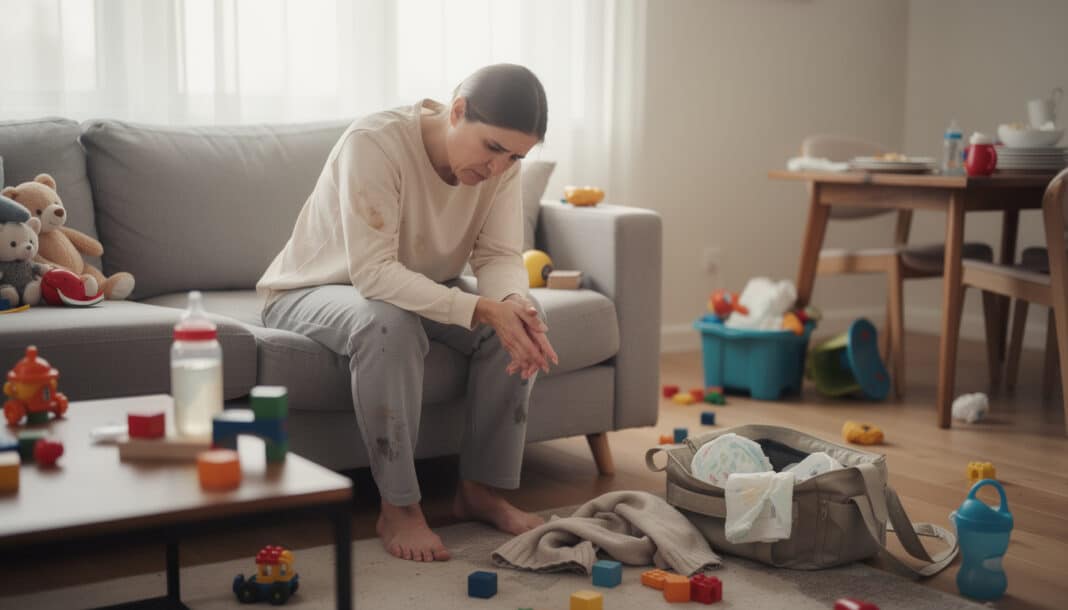
In short — Parental burnout is not a simple passing tiredness, but a state of physical and emotional exhaustion rooted in a dysfunctional social organization. Far from being a personal failure, this syndrome reveals how our societies simultaneously impose boundless professional availability and intensive parenting. The warning signs — constant mental load, chronic guilt, disproportionate irritability, emotional detachment — are all signals that the system is asking the impossible. Recognizing these symptoms means understanding that the problem is structural, not individual, and that breaking the taboo begins by naming what is lived in silence.
The invisible paradox: how modern parenting devours time and energy
Monday morning, 7:30. Sarah prepares three different breakfasts, checks the homework, signs the school permission slip she had forgotten. Mentally, she calculates whether she can leave the office at 5:45 p.m. Her phone buzzes: urgent meeting at 5:30 p.m. Her heart races. This scenario, which seems like an isolated bad day, has become the daily reality for 65% of working parents according to recent studies.
The figure astonishes because it appears illogical: today's parents spend more time in paid work AND more time on parenting tasks than forty years ago. How could this accumulation take hold without causing a general revolt? The answer lies in what sociologists call the naturalization of inequalities. What was once recognized as work — feeding, educating, caring — has gradually been transformed into a series of invisible injunctions, presented not as requirements but as expressions of parental love.
This transformation has a name: intensive parenting. It requires the contemporary parent not only to care for their children, but to “fulfill” them, to develop their “potential,” to guarantee their “future success.” It is no longer enough to feed them healthily; meals must be balanced, varied, homemade. It is no longer enough to supervise them; they must be stimulated, enriched, enrolled in the “appropriate” activities. Every moment becomes a missed or exploited educational opportunity.

The seven signals that parental exhaustion has crossed a critical threshold
The mental load that never stops
Parental mental load is not comparable to a stressful day at work. It is a constant background: pediatrician appointments, checking shoe sizes, replying to the teacher, organizing the birthday, buying milk. The brain operates continuously on two levels, even during an important meeting. This is not ordinary worry; it is a systemic cognitive overload that drains mental resources before the day even begins.
The impossibility of experiencing moments of real presence
You are sitting in the park with your children, but part of your attention slips away. The paradox: the more we value “quality time,” the less we manage to truly be present. This fragmentation of attention creates additional guilt. You are there physically, absent emotionally, and you judge yourself as failing for that absence.
Irritability that explodes over trifles
A toy left lying around triggers a disproportionate emotional outburst. The toy is not the problem. It represents the umpteenth invisible micro-task of a day in which every gesture becomes an unrecognized unit of labor. Irritability is often the first warning sign that something has broken in the psychic balance.
Guilt that comes from everywhere
No matter what you do, it's never enough. Too strict? Not available enough? Too permissive? This constant guilt is not a personal weakness; it is the result of contradictory social injunctions. Studies show that 73% of mothers report feeling daily guilt related to their parenting, compared with 42% of fathers. This asymmetry reveals how certain social norms are embodied differently according to gender.
Fatigue that persists despite rest
You sleep eight hours and wake up already exhausted. This type of fatigue is not physiological; it is existential. It comes from a permanent tension, a vigilance that never switches off, even unconsciously. That is the difference between normal tiredness and chronic exhaustion: rest alone is not enough to repair it.
The feeling of parental incompetence
The more exhausted you are, the more you judge yourself as failing. You forgot your son's sports session, you shouted at your daughter over a trifle, you gave in to a frozen meal when you had planned homemade cooking. Each deviation from the idealized image of the parent feeds a feeling of personal failure. A vicious circle sets in: fatigue → guilt → compensatory effort → increased fatigue.
The isolation produced by collective silence
No one really talks about it. To other parents, we show a polished version of our lives. This social staging greatly aggravates isolation, because everyone believes they are the only one cracking. Silence becomes a prison: you do not seek help because you think you are abnormal, while you are simply living what millions of others experience in silence.
Why it's not your responsibility: the structural mechanisms at work
Here is what changes everything: it is not your fault. Parental burnout is not a personal failure; it is the symptom of a social organization that asks the impossible. Contemporary structures demand intensive parental presence while imposing flexible and limitless professional availability. These two demands are incompatible, yet they weigh simultaneously on parents' shoulders.
Since the 19th century, economic analyses have ignored domestic and parental work. It has no market value, so it exists socially only as natural, as an expression of love and self-sacrifice. But without this invisible work, the economy would collapse. It enables the reproduction of the workforce, it maintains the social fabric, it raises the children who will become tomorrow's workers. Yet no salary recognizes it.
Parental work — particularly among women — still accounts for 71% of domestic and parental tasks according to INSEE, even when they work full-time. This inequality is not accidental; it is structural. It reproduces from generation to generation because it has crystallized into social norms so deeply naturalized that they seem self-evident.
Recognizing exhaustion as a signal of a society in crisis
Parental stress should not be pathologized at the individual level. It is a collective signal that something is not working in the social organization itself. A person in burnout does not need to be taught to “manage their stress better”; they need the structures that pressure them to stop asking the impossible.
Labeling one's exhaustion “parental burnout” is not an admission of weakness; it is an act of clarity. It is recognizing that the chronic fatigue experienced is not due to personal incapacity, but to the mismatch between social demands and real resources. It is understanding that the guilt we carry is not justified, but produced by norms that judge us by criteria impossible to meet.
Talking about the problem, even in a small circle, begins to loosen the isolation. Discovering that a friend, a colleague, a neighbor is experiencing exactly the same thing creates a crack in the wall of silence. And in that crack grows the possibility of feeling less alone, less abnormal, less responsible.
Paths toward balance: from personal to collective
Claiming the right not to be perfect
There is no perfect parent. There never has been. The idealization of the always-available, patient, creative, pedagogical parent is a contemporary construction that kills. Accepting one's limits also protects one's children: a parent at peace with their imperfections is a present parent, not an exhausted parent feigning serenity.
Letting go of certain norms — homemade meals every night, attendance at every practice, constant enrichment — is about redistributing energy toward what truly matters: a calm presence, an authentic relationship, real moments rather than scheduled ones.
Creating new forms of family support
The isolated nuclear family was never intended to raise children alone. Historically, children were raised in environments where multiple generations and families cohabited or helped one another. Intensive parenting as experienced today — the parent, alone, entirely responsible for the child's development — is a historical anomaly.
Restoring forms of collective support begins small: informal exchanges between parents, creating discussion groups, using family help services without guilt. More broadly, it is an argument for public policies that recognize parenting as work: equitable parental leave, accessible public childcare services, economic and social recognition of care time.
Preventing burnout starts with structural change
At the individual level, stress management has its limits if the structures that create stress do not evolve. Meditation apps help, but they will never solve the problem for a parent who works 40 hours a week and assumes 70% of the domestic work. They can mask the problem, not solve it.
Burnout prevention requires a collective mobilization to transform social norms and public policies. It requires recognizing that parental work is real work, that it has value, that it deserves time, resources and respect. It also requires a redefinition of masculinity: when fathers truly — and structurally — share the burden of parental tasks, some of the inequalities that perpetuate maternal exhaustion will disappear.
As long as our societies exclusively value economic productivity at the expense of care and social reproduction, parental burnout will remain endemic. But recognizing this systemic problem is already the first step toward transformation.
Profil de l'auteur
Derniers articles
 Electricity, Gas & Energy14 September 2026Gaz et électricité : ce que la hausse des tarifs va changer sur votre facture
- Agency, Webmarketing & SEO12 September 2026Fusion Omnicom-IPG : ce que la plus grande agence de publicité au monde change pour les marques
- Retirement & Senior Living10 September 2026Carte Avantage Senior SNCF : comment voyager moins cher en train après 60 ans
- Tech & Multimedia8 September 2026Objets connectés : la fin de la 2G et le nouveau Data Act vont rebattre les cartes




Table of Contents