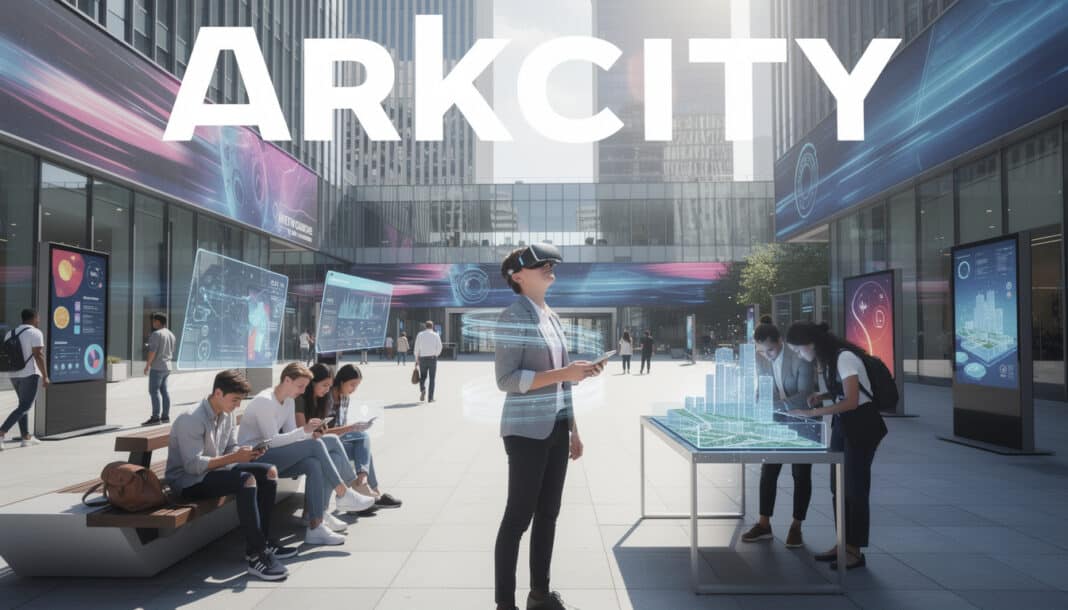
There are weeks when the news feels like a stack of loose sheets: it piles up, it slips, it crumples, and nothing really holds. In this landscape of media saturation, arkcity is intriguing because it does not try to accelerate the world, but to give it something to hold on to ✨. The site presents itself as a hybrid magazine, between digital culture and society, with a simple stance: to offer a different angle that favors understanding rather than reaction.
What strikes is the circulation of content: no endless feed where controversy “wins” mechanically, but an architecture close to a newspaper, with sections, recognizable formats and a readable hierarchy. When a topic is difficult, the space left for nuance seems almost subversive in 2026, so much has the digital conditioned readers to shortcuts. Result: fewer “quick hits”, more substance to form an opinion 🧩.
Arkcity, a magazine between digital culture and society that restores depth to the news
Arkcity functions like a carefully run collaborative newspaper, where contribution is not reduced to posting an opinion. The texts fit within an editorial framework: you can feel an effort toward clarity, contextualization, and a preference for what illuminates rather than what excites. This orientation does not prevent disagreements; it simply makes them more livable.
In practice, a dossier on urban planning can bring together technical insight, an on-the-ground account and a citizen’s point of view, without the whole turning into an ego contest. This yields news that is less abstract, because it connects to streets, timeframes, constraints, and professions. And this link to the real ends up producing a form of local memory — something sorely missing from many communication platforms that only know how to do the permanent present.

An editorial design that quiets the noise and restores reading
Reading comfort is not a luxury: it’s a policy. An interface that breathes, a stable layout, visual elements that explain instead of distract… all of this reduces cognitive fatigue, especially on mobile. When the reader does not struggle against the design, they become available again for the substance — and that’s where the rarest innovation sometimes nests 📌.
A simple test, done on public transport with a long article: the absence of assaults (pop-ups, interruptions, overlays) changes the relationship to the text. Arkcity relies on a continuous reading, almost artisanal in intent, as if each paragraph had to be able to “stand” without artifices. This discreet choice puts technology back in its place: to serve understanding.
Experts and citizens on arkcity: a debate mechanism more useful than spectacular
Many participatory spaces promise dialogue and deliver parallel monologues. Arkcity tries something else: encouraging sources, asking for facts, valuing concrete feedback. The expert is not expected to close the discussion there, but to add a layer of method; the citizen is not a bystander, but the on-the-ground observer.
A typical scene illustrates the mechanism well: an artisan describes an administrative difficulty on a downtown construction site; a legal expert specifies the texts; an elected official clarifies the schedule; a local resident proposes a traffic option. Nothing “viral”, yet something adjusts in the city. At that moment, current affairs stop being a spectacle: they become a common matter again 🧵.
Freedom of expression, editorial framework and trust: the balance that is built
Freedom of expression only makes sense if it accepts its counterparts: responsibility, verification, contradiction. Arkcity does not claim neutrality — no one does — but seeks a practical reliability, by limiting classic excesses: ad hominem attacks, insinuations, misleading content. Trust often arises from tiny signals: a clear chronology, a visible correction, an acknowledged source.
This requirement has an unexpected effect: it makes content more durable. Publishing an op-ed or a guide takes more time than an immediate reaction, but that time becomes indexed in collective memory, and sometimes in that of search engines. At a time when digital communication is often reduced to the instant, rereading the mechanisms of networks helps to understand this gap: digital communication across social networks.
Arkcity and digital innovation: when immersive formats make the city open to debate
Arkcity also moves on a rarer terrain: formats that go beyond text, with explanatory visuals, sometimes maps, and the idea of moving toward high-definition 3D content, even immersive layers. There, the stake is not the “wow” effect, but the reduction of abstraction. Visualizing a pedestrian development often defuses misunderstandings before they escalate 🏙️.
A through line helps to understand: a fictitious collective, “Atelier Urbain”, documents the renovation of a neighborhood by mixing photo reports, plans and testimonies. Residents no longer only discuss intentions, but scales, traffic flows, cast shadows, timeframes. When the technology makes things visible, it also redistributes the power to debate — and it is precisely there that the digital culture touches the society most closely.
Digital architectures have hidden powers: who sees what, and why?
No curation is innocent: a platform chooses what it highlights, what it slows down, what it demands as proof. Arkcity, in seeking to reward clarity rather than noise, sketches an implicit norm: that of the readable, reasoned text tied to facts. It’s a form of “moderation by form”, less brutal than a ban, but just as structuring.
In a world where the news is often consumed as a succession of shocks, this type of architecture acts like a workshop: it imposes gestures, steps, a gentle discipline. And this discipline, if well kept, changes the quality of debate — not by making it tepid, but by making it workable 🔍. To broaden the perspective on these new practices and trends, a detour through web culture, lifestyle and innovations helps to situate Arkcity in a broader movement.
Local SEO and editorial presence on arkcity: a visibility that must be earned
For a company, a shop or an association, Arkcity can become a support for local visibility — provided one renounces the advertising reflex. The lever is not to “place a link”: it’s to write useful, grounded, regular content. Search engines better understand a local actor when their content answers local questions, with examples and evidence.
The healthiest method looks like a workshop notebook: a monthly guide on a recurring question, a short statement when a rule changes, a few targeted interventions when expertise really sheds light. This tempo avoids burnout and builds a patient reputation. For those who want to structure a more solid strategy (without turning writing into a factory), an external reference can serve as a compass: a ranking of the best SEO agencies.
What really changes: moving from promotion to proof
A credible presence accepts constraints, mentions limits, responds to objections with verifiable elements. On Arkcity, this type of stance is quickly visible — and, paradoxically, it “sells” better because it does not try to sell. In local life, trust is not a campaign: it is an accumulation of small instances of getting it right 🤝.
Ultimately, Arkcity’s appeal may lie in this: reminding that the digital is not condemned to the instant and to excess. It can also become a place where threads are tied together, where meaning is sewn, where enough margin is left for everyone to breathe — and ask themselves, without rushing: which part of the news deserves to be preserved, and which can finally be left to noise?
Profil de l'auteur
Derniers articles
 Smartphones & Mobile Phones14 October 2026The loyalty penalty on your mobile bill: why staying put costs you more
- Family, Babies & Children5 October 2026Airline family seating fees: what the planned ban will change for parents
- Everyday Life & Society23 September 2026Consumer confidence index: what the monthly mood check on British households really measures
- Agency, Webmarketing & SEO31 August 2026SEO : a Google bug skews visibility statistics in AI results




Table of Contents