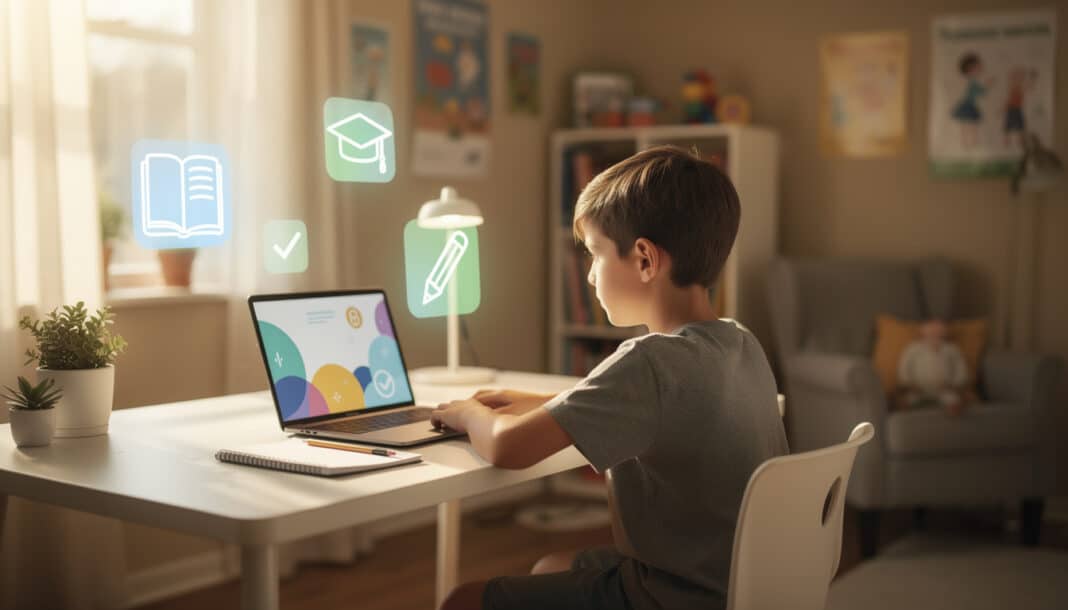
In brief: In the digital age, online homework help has become widespread, offering families accessible and often free solutions. Studies show that 78% of high school students regularly use digital tools for their revision. Between free platforms like Lumni and personalized services like Acadomia, the choice depends on each child's specific needs. The best solutions combine quality educational resources, access flexibility and human support—far from replacing the teacher, but intelligently complementing them.
The landscape of online academic support: how to choose the right platform
In recent years, academic support has shifted from the private tutor's office to the family screen. This transition is reminiscent of the move from the hand-bound notebook to the digital file—a change of form that raises questions about substance. Today, parents wonder how to support their children without getting lost in the jungle of offerings.
The market for free courses and paid subscriptions has been enriched by a multitude of solutions. Each claims to offer maximum effectiveness, but in radically different forms. You therefore need to learn to distinguish what is marketing from what truly meets the needs of helping children who are struggling or seeking improvement.

Why digital platforms are transforming educational support
The primary strength of distance learning lies in its accessibility. A child in a rural area can access the same resources as a child in the city center. No need to wait for the private tutor: explanations are there, available at midnight or six in the morning, according to each person's rhythm.
But there is a subtle difference between “available” and “effective.” A well-constructed lesson video is worth many pages of a textbook, certainly. Yet it will never replace the teacher's gaze that detects the exact moment the student loses the thread. That is why the best platforms blend rich content with interaction possibilities—quizzes, self-correcting exercises, progress dashboards.
The five pillars of effective online homework help
Before diving into the details of each platform, let's establish the criteria that make an educational resource truly worth it. These pillars will guide your choice, beyond surface reviews or commercial promises.
The quality of pedagogical content and its alignment with curricula
A course is only reliable if it is based on verified expertise. The best platforms, like Kartable, employ teachers from the French National Education system, which guarantees strict alignment with official curricula. That means your child is not learning notions that will not appear on exams.
Verifying the source of content is therefore as important as checking the provenance of an old paper before rebinding it—authenticity guarantees durability.
Accessibility and flexibility of use
A good homework help platform adapts to the real constraints of families. Can it be used on a smartphone? Does it require a permanent connection? Are lessons short and fragmented, or do they demand long blocks of concentration?
Modern children have a fragmented relationship with time. Ten- to fifteen-minute sessions, much more than monolithic hours, correspond to their real rhythms. That's why the short videos and quick quizzes from Schoolmouv or the concise sheets from Reviz Quiz work so well.
Ongoing monitoring and tailored feedback
Academic support that never tells the child whether they are progressing or stagnating is like a ship without a compass. The best solutions include a clear dashboard, with regular assessments and self-correcting exercises. Acadomia, for example, offers detailed progress tracking, essential when working remotely.
This monitoring allows parents to adjust their support and the child to celebrate their victories—even small ones. That's psychologically crucial.
The human dimension and access to teachers
No algorithm fully replaces dialogue with a human. Hybrid platforms, which combine digital content and the possibility of asking a real teacher questions, offer the best of both worlds. That's what Superprof and Acadomia's tutoring extensions provide.
Certainly, this has a cost. But it is an investment in mental clarity, and sometimes a half-hour with someone who truly explains is worth ten hours alone in front of a screen.
Cost-benefit ratio and pricing transparency
Finally, a reliable platform displays its prices plainly. Hidden subscriptions, “optional” fees that become mandatory, “free” content that is only half free: these practices wear down trust. Lumni, a free public platform, and Kartable, with its clear subscriptions, embody this transparency.
To evaluate the real cost, ask yourself: how much time will my child actually spend on this platform each week? What is the cost per hour of use? That is the calculation that matters, not the listed price alone.
Overview of the best tutoring platforms in 2026
From Lumni, the French public audiovisual platform, to more specialized solutions, the spectrum has widened. Here is an overview of the must-haves.
Lumni: the comprehensive free resource
Lumni remains an exception in the commercial landscape: it is a platform funded by French public audiovisual actors, entirely free. It offers videos, interactive games, articles and podcasts for students from kindergarten to high school.
The massive advantage? Zero cost. The drawback? The absence of personalized tracking. Lumni is an excellent complement, a source of enrichment, but not a fully structured distance learning system from end to end. Ideal for discovery, less so for targeted deepening.
Kartable: teacher reliability and competitive pricing
Kartable was built on a simple promise: courses written by teachers of the Éducation nationale, from CP to Terminale. The content is therefore rigorously aligned with the curricula. The prices are among the most affordable on the market, without sacrificing quality.
Users appreciate the dense revision sheets, corrected exercises, and the ability to revise at their own pace. It's particularly effective for independent children who know how to motivate themselves.
Schoolmouv: dynamic videos and interactivity
Schoolmouv has understood that the screen requires a different pedagogy. Its videos are short, dynamic, and enhanced with graphics and animations. The interactive exercises that follow each video allow immediate consolidation. It's particularly effective for middle and high school students who learn more visually.
The content remains aligned with official curricula, and the interface fits young people's mobile habits. A strong point for this “scrollers” generation.
Maxicours: comprehensiveness and pedagogical structure
Maxicours impresses by volume: more than 20,000 educational resources, from interactive lessons to self-correcting exercises. The structure is designed for progressive learning, from kindergarten to Terminale. Regular quizzes allow the child and parents to measure progress.
It's a complete, almost exhaustive tool. Its only risk? Overwhelming by its abundance. For children who need a clear roadmap, it's ideal. For those who get lost easily, you need to guide the path.
Acadomia: personalization and human tutoring
Acadomia has been operating for more than 20 years and offers a hybrid offering: digital content, but also private lessons online or in person, intensive courses during holidays. It's for families who want truly tailored support.
The prices are higher than purely digital platforms, but the quality of interaction with a human tutor justifies the investment. Particularly recommended for children in serious difficulty or those preparing for major stakes (baccalauréat, entry to preparatory classes).
Note that visual fatigue related to screens is an issue that deserves attention for children who spend long hours on a platform. Give them regular breaks.
DigiSchool: variety and tracking tools
DigiSchool offers more than 10,000 course sheets covering all levels. Regular tests allow progress tracking. The interface integrates interactive tools and mobile apps that make learning more fluid. It's a good balance of variety, accessibility and monitoring.
Superprof: connecting with private tutors
Superprof operates on a different model: it is not a content platform, but a network that connects students and private tutors in various subjects. Lessons take place online or in person, according to preference. It's ideal for very targeted help in a subject or a specific concept.
Building a balance between digital and traditional learning
Here lies a truth often forgotten: the most effective academic support is never purely digital nor purely traditional. It is a thoughtful mix of both.
Integrating digital tools without abandoning classical knowledge
A child who only reads digital sheets will struggle to concentrate on a long text. A child who only types will lose fluidity in handwritten composition. The best educational resources maintain this dialogue between screen and paper.
We recommend a balanced split: about 60% of revision time on classical methods (handwritten notes, readings, written exercises), 40% on digital tools. This keeps the child anchored in the realities of the written exam while benefiting from the dynamics and accessibility of digital technology.
The limits of all-digital: what no platform can offer
No video will teach a child self-discipline. No algorithm will replace the conversation that arises when a child finally dares to ask, “Why don't I understand?” A teacher who watches their student's face and detects the moment of emotional blockage offers something that digital cannot simulate.
This is especially true for children suffering at school, who need to feel seen, not just assessed by a score on a platform.
Creating a conducive environment: far beyond the platform
A good platform is a tool, not a magic wand. The environment matters enormously. A child who studies in chaos, with notifications pulling them back at every moment, will not get much out of Schoolmouv or Kartable.
Create a dedicated, quiet space where the working screen is not polluted by social networks. Set a realistic schedule with the child: two twenty-minute sessions rather than one stressful hour. Finally, check their progress dashboard regularly, not to judge, but to encourage.
Choose according to specific needs: a concrete example
Imagine Zoé, a 14-year-old teenager who excels in history-geography but struggles in mathematics. Her time-pressed parents are looking for the best homework help for her.
What to recommend? Not a “generalist” platform that will offer history and math at the same level of depth. Rather a combined approach: Lumni or Kartable for regular history revision (where Zoé only needs consolidation), and human tutoring in mathematics via Superprof or Acadomia, where a trusting relationship and patient explanation will change everything.
This preliminary diagnosis—identifying where the difficulty really lies—is the step many families omit. Yet it is the basis of a good choice.
The question of security and privacy
Before entrusting your child's school and personal data to a platform, ask about its guarantees. Some, like French public services, offer maximum protection levels. Others, notably start-ups, may be less scrupulous.
Check how data are stored, who has access, and how the platform monetizes their use. This issue deserves attention at least equal to the pedagogical quality. Also find advice on how to check the terms and conditions of any service to which you entrust your information.
Parental support: the real key to success
An excellent platform without parental engagement remains an empty shell. This is not to induce guilt, but to clarify: helping children does not fall entirely to technology. It depends on a presence, even a minimal one.
Check the platform's dashboard once a week. Ask: “What did you learn today that surprised you?” Really listen to the answer. Help the child identify their mental blockages, not just academic ones. Encourage perseverance during difficult moments.
These gestures—small, accessible to all—turn a platform into real academic support. No technological innovation will ever replace them.
When organizing your child's school year, don't forget to consult the school calendar and holiday periods to plan intensive learning sessions or well-deserved rest.
Profil de l'auteur
Derniers articles
 Development, Digital Marketing & SEO11 August 2026Influencer marketing: French brands are increasing their budgets
- Psychology11 August 2026This personality trait may be linked to a longer life
- Agency, Webmarketing & SEO10 August 2026Advertising market in France: CTV and retail media drive growth, despite advertisers' caution
- Farming & Nature8 August 2026Wheat and corn harvests : why the heatwave is causing French production to drop sharply




Table of Contents