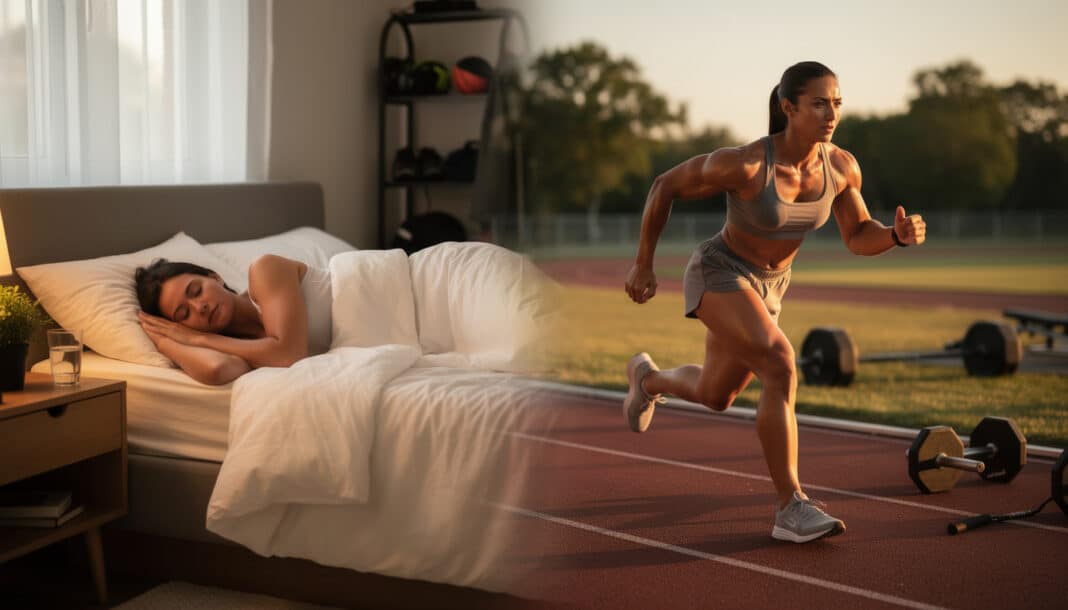
Sleep is not time wasted. It's an active regeneration process where the body repairs microtears in muscles, consolidates the motor memory of technical skills, and secretes hormones essential for recovery. For an athlete, neglecting their nights is sabotaging their training efforts.
In short: A 9 to 10-hour night improves accuracy, speed and reaction time far more than a dietary supplement. Basketball players who extended their sleep gained 16% in speed. Tennis players saw their serving accuracy increase by 14% in one week. Sleep hygiene matters, but duration remains the number one lever. A cold shower, a dark and cool bedroom, regular schedules: the fundamentals are simple, free, and devastatingly effective.
🌙 Why sleep shapes your athletic performance
For a long time, athletes believed that the magic happened in training, in sweat and effort. But science tells another story: it's at night that the body becomes stronger. Far from the weight rooms and tracks, sleep orchestrates a biological symphony on which every measurable improvement depends.
When the eyes close, growth hormone rises. Damaged muscle fibers repair. The consolidation of motor memory takes place in silence. All this takes time—lots of time. Sleep and physical activity work in tandem: one feeds the other in an invisible but decisive dialogue.
There are several stages of sleep, each playing a distinct role. Light sleep lays the groundwork. Deep sleep repairs the damage. And REM sleep—the dreaming stage—consolidates learning and regulates emotions. Skipping a full night is interrupting this precious cycle. Systematically shortening your rest is leaving progress on the bench.
📊 The biological mechanisms behind performance
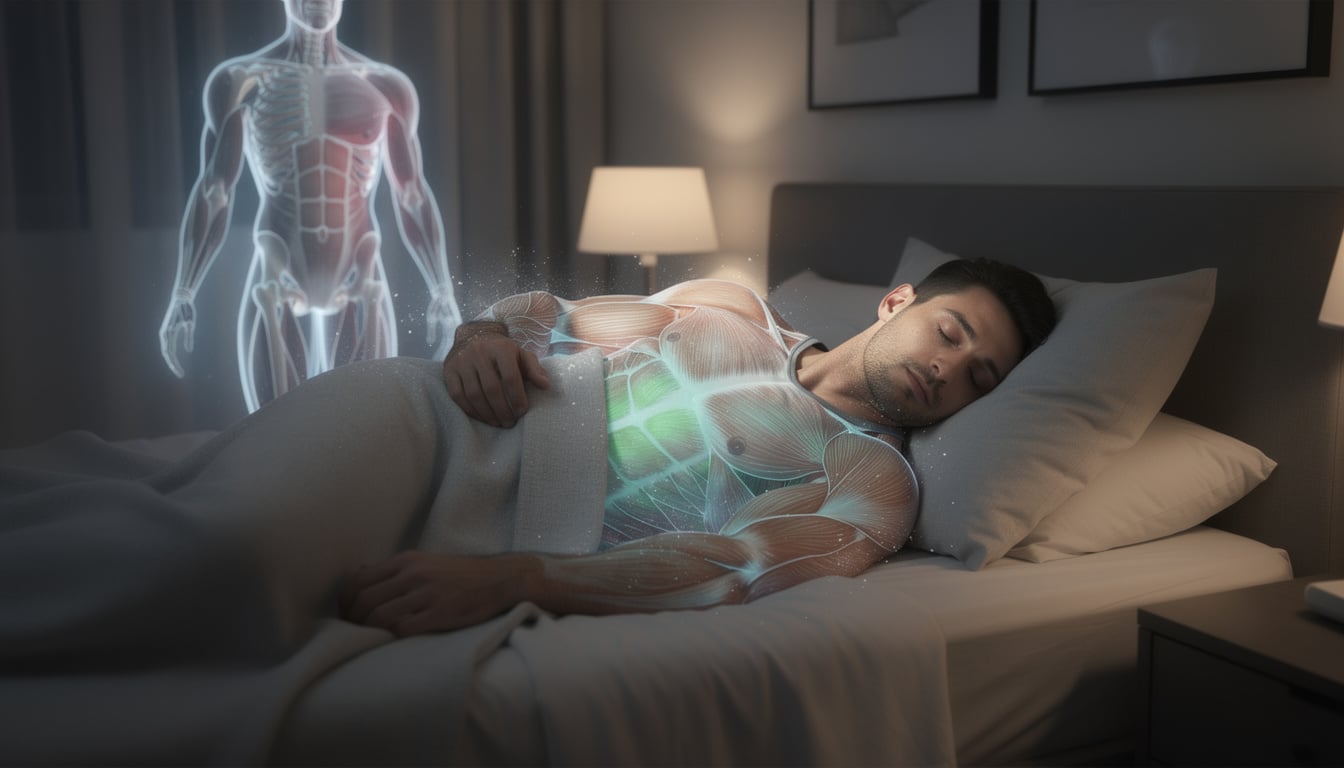
Three key transformations occur during your sleep. First, the endocrine system activates: testosterone, growth hormone, cortisol—these chemical messengers all work to rebuild and strengthen. Next, immunity regenerates. NK cells, those warriors of the immune system, proliferate when you sleep well, protecting you from infections and chronic inflammation.
Finally, energy metabolism reorganizes. Muscle glycogen stores are restored, preparing your body for the next effort. Without this energy recovery, you'll show up exhausted to your next session, and the adaptations to training—what truly drives progress—will be meager.
It's an alchemy that no cutting-edge equipment can replace. Cryotherapy is trendy. Light therapy gets talked about. But none of these strategies equals simply… sleeping more.
💪 Measurable results: when adding hours of sleep changes everything
The numbers speak better than theories. A team of collegiate basketball players agreed to stay in bed at least ten hours per night for five to seven weeks. Their actual sleep climbed from 6.6 to 8.4 hours—nearly two extra cycles each night.
What were the results? Their sprint time dropped from 16.2 to 15.5 seconds. An improvement of 16% in pure percentage terms. Their free-throw accuracy jumped by 9%. Their reaction time decreased. And their perceived fatigue plunged by more than 80%.
Elsewhere, female tennis players received the same instruction: sleep at least nine hours for a week. Actual sleep increased from 7.14 to 8.85 hours. Result? Serving accuracy increased by 14.3% in seven days. No new hitting techniques. No extra coaching. Just sleep.
The effects of sleep on athletic performance become evident when measured properly. These are not marginal or static improvements. They are clear, visible, reproducible leaps.
🎯 Precision and coordination: the role of the nervous system
Why does sleep affect accuracy so much? Because every precise movement depends on the central nervous system, that delicate conductor that synchronizes your muscles, tendons, and reflexes. Deprived of rest, this system becomes sloppy. Neurotransmitters are depleted. Communication between the brain and the body degrades.
A tired basketball shooter doesn't have the same timing. An exhausted tennis player loses their feel. These are not impressions: objective data confirm it. Sleeping more sharpens the neural instrument on which every movement relies.
🛌 Sleep duration: how many hours to truly progress?
The question that nags every athlete: how much time in bed? General recommendations speak of seven to eight hours for a standard adult. But a standard athlete doesn't exist—certainly not in competition.
Research converges: high-level athletes need nine to ten hours. Some, depending on their sport and training load, require even more. That's less than recommendations for adolescents (who sleep 8 to 10 hours), but well beyond what a sedentary office worker demands.
Why this difference? Because intensive training exhausts not only the muscles, but also the nervous system, the immune system, and hormonal reserves. To repair everything, you need time—more than someone who gets up at six and does light activity in the evening imagines.
⏰ Sleep cycles: how to get the most out of each night
Sleep is not made of interchangeable minutes. It organizes into cycles of about 90 minutes, each composed of specific stages. Light sleep prepares the descent. Deep sleep repairs. REM sleep consolidates memory and regulates emotions.
Sleeping six hours is about four cycles. Sleeping nine hours is six. This difference of two complete cycles represents 180 additional minutes of recovery: two full deep sleep phases, two full REM phases. For an athlete who is strengthening muscles or refining technique, that's colossal.
It's a detail many ignore while getting up at the same time for years. They think they sleep well because they don't wake up. They ignore that they stop their regeneration process too early—far too early.
🌡️ Sleep hygiene: the simple habits that change everything
Adding hours in bed is not enough if you enter a poorly designed bedroom or if your mind is restless until midnight. Sleep hygiene is the grammar of the night: respect it and everything improves. Violate it and you'll pay for every wasted hour.
The basics? A dark room—really dark. Screens removed thirty minutes before bedtime. Regular schedules, like a binding that expects its pages every day in the same place. A cool temperature: between 16 and 19 degrees is ideal. Silence, or at least the absence of sudden noises.
The importance of sleep for athletic performance also depends on these invisible details. A quality mattress, for example, regulates body temperature and supports the spine for seven or eight hours. You might change it once every ten years, but that investment will accompany every night of recovery.
🚿 Cold shower and winding down after exertion
Here's a practice that high-level athletes have applied for decades: the post-training cold shower. Why? Because exertion raises core body temperature, disturbing the falling-asleep phase. Cool water accelerates cooling and physiologically prepares the body for sleep.
It's not an aggression. It's a signal: your body receives the message that performance is over, that the time for regeneration is approaching. Combined with light stretching and regular hydration, this simple shower reduces nighttime awakenings and shortens time to fall asleep.
☕ What to avoid: the enemies of rest
Caffeine after 4 p.m.? Poison for anyone who wants to sleep. Alcohol in the evening? Its initial sedative effects mask fragmented, non-restorative sleep. Screens before bed? Blue light suppresses melatonin, the sleep hormone, delaying falling asleep by 30 to 60 minutes.
Exercise too late in the evening can also be problematic, although studies show that regularity compensates for this effect. What remains true: an evening competition generates cerebral arousal that eight hours are not enough to switch off. The positive stress of a win or the negative stress of a loss remains memorized, sabotaging sleep.
🥗 Nutrition and sleep: the invisible balance
What you eat in the evening influences how you sleep. It's not a metaphor: macronutrients directly influence the production of neurotransmitters and sleep hormones.
A light, low-sugar meal with sufficient protein shortens time to fall asleep by 10 to 20 minutes. Conversely, a heavy, fatty meal or one too rich in fast sugars prolongs digestion and fragments sleep. Hydration also plays a decisive role: well-hydrated, the body recovers more effectively and muscle pain decreases. Dehydrated, it wakes you sweaty and irritated.
Stimulating beverages—coffee, black tea, energy sodas—should be avoided after the afternoon. Their metabolic half-life can reach five to six hours, leaving you still stimulated when it's time to sleep.
💤 The nap: a double-edged weapon
Many imagine that a nap compensates for short nights. It's an attractive but deceptive illusion. Studies show that a nap never completely replaces nocturnal sleep, although it can improve it in certain specific contexts.
A 90-minute nap, taken two hours after training, can generate extra deep sleep and improve readiness for a second session. But a short 20-minute nap after lunch? It doesn't improve performance and can, for those not used to it, delay falling asleep at night.
Timing matters enormously. Ideally, the nap occurs around 1:30 p.m., six to seven hours before bedtime. Later, it interferes with nighttime sleep. Shorter than 15 minutes, it offers no real benefit. Longer than 90 minutes, it plunges into very deep sleep, from which emerging becomes difficult (sleep inertia).
😴 When the nap helps, when it harms
For an athlete who trains twice a day—common among swimmers, dancers, footballers in intensive preparation—a well-placed nap becomes an ally. For anyone already sleeping seven or eight hours at night, it risks nibbling away nighttime sleep without providing any real surplus.
The real question? Can you increase your nights from nine to ten hours? If so, that's the option to prioritize. The nap becomes relevant only if the architecture of your day imposes a double training session without scheduling flexibility.
⚠️ Warning signs: when sleep reveals a problem
Poor sleep is not always a simple bad habit. Sometimes it shouts a message: you're doing too much.
If you feel exhausted but are unable to sleep, if you go to bed and wake up after three hours, if your sleep becomes fragmented despite your hygiene efforts, you may be suffering from overtraining. The organism, overloaded, requests rest, but nervous excitement prevents it from taking it.
In that case, the paradoxical solution works: reduce training. Increase caloric intake. Wait one or two weeks. If sleep improves, that's the confirmation. You had exceeded the limit. Rest, ultimately, is non-negotiable with the body.
🫁 Sleep apnea and other silent pathologies
Some sleep disorders require medical intervention. Obstructive sleep apnea, for example, fragments rest without you perceiving it consciously. Repeated breathing stops deprive the brain of oxygen and generate micro-awakenings that are invisible but exhausting.
Restless legs syndrome—those irresistible tinglings at the end of the day—also disrupt falling asleep. Sleep and sport remain closely linked to overall health, including pathologies that simple sleep hygiene does not solve.
If you've applied all the advice and nothing improves your sleep after three weeks, a medical consultation becomes justified. Your doctor can prescribe a sleep study that will reveal what is really hidden.
🎯 The real secret of performance: accept the slowness of recovery
When we talk about performance, we often think of action: lifting heavier, running faster, hitting harder. But what champions know and others forget is that true performance is built during rest.
This requires a different mentality. You must accept that getting 9 or 10 hours of sleep is not laziness but work. Invisible, silent work, but absolutely critical. It means going to bed early when you'd prefer to stay up. It means protecting your sleep as you protect your training.
It's a paradoxical renunciation: you'll progress more by reducing your apparent presence at the gym, the pool, or the field, provided you transform that absence into deep, regular sleep. Your rival who sleeps seven hours and wonders why they progress more slowly will look for the answer everywhere except the right place: their mattress.
In a world that values action and the visible, sleep remains an essential determinant of health, often forgotten—even by those who dream of excellence. The numbers speak nonetheless. Basketball players who slept more improved their results by 16%. Tennis players by 14%. No supplement, no miracle program offers these gains. Nothing but sleep.
The question is therefore not whether you have time to sleep nine hours. It's whether you can afford not to—and accept that your progress will stagnate until you change your mind.
Profil de l'auteur
Derniers articles
 Smartphones & Mobile Phones14 October 2026The loyalty penalty on your mobile bill: why staying put costs you more
- Family, Babies & Children5 October 2026Airline family seating fees: what the planned ban will change for parents
- Everyday Life & Society23 September 2026Consumer confidence index: what the monthly mood check on British households really measures
- Agency, Webmarketing & SEO31 August 2026SEO : a Google bug skews visibility statistics in AI results




Table of Contents